

Blog
Complete Guide to Dual Type-C Buck Charging Modules
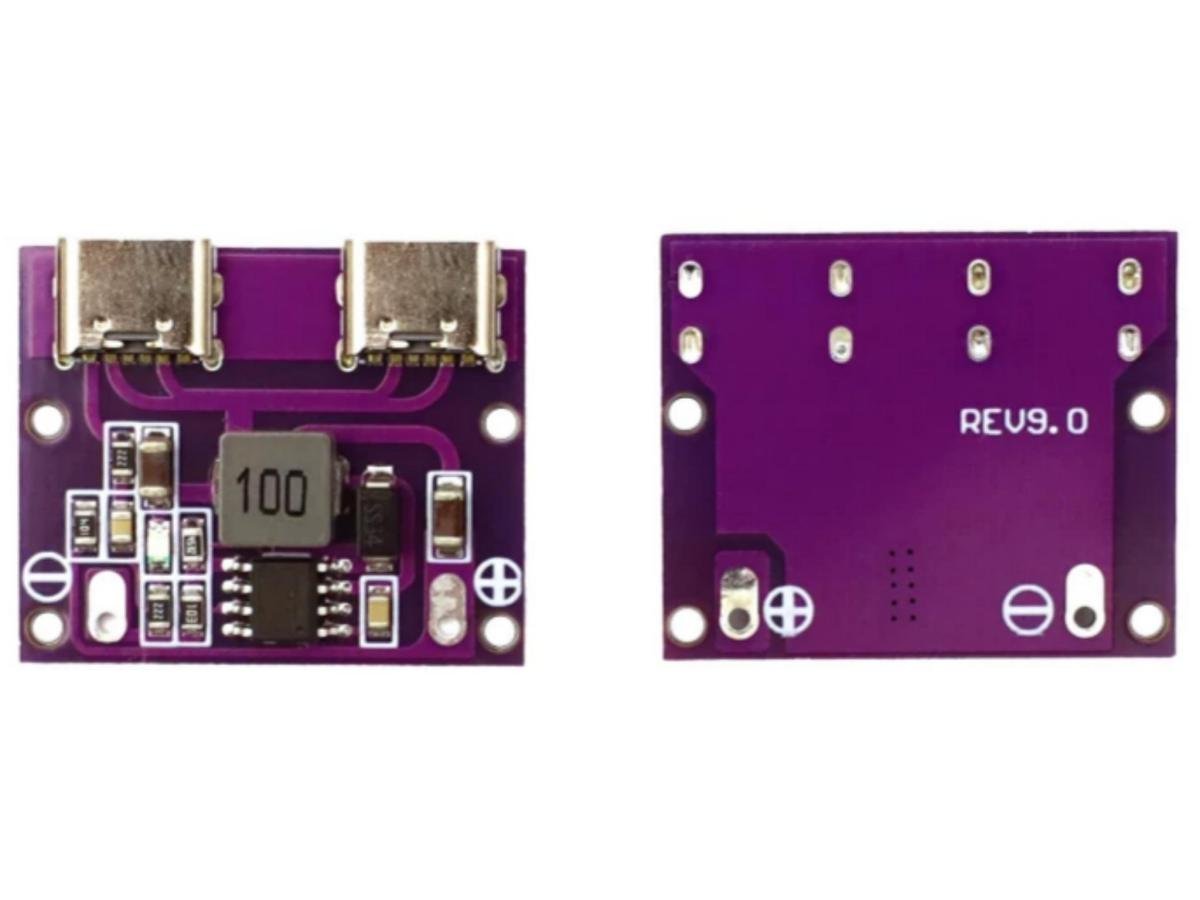
Introduction
In power supply scenarios for portable devices, DIY electronics projects, and compact industrial equipment, power modules featuring “wide voltage input + stable low-voltage output” serve as core components.The Dual Type-C Buck Charging Module, with its DC 6-36V to 5V wide-range voltage conversion capability, dual Type-C output interface convenience, and 3A high-output current performance, has become the preferred power solution for makers, electronics enthusiasts, and small device developers.This article provides a comprehensive analysis of the module’s practical value, covering product definition, core parameters, operating principles, and practical application guidelines.
What is a Dual Type-C Buck Charging Module?
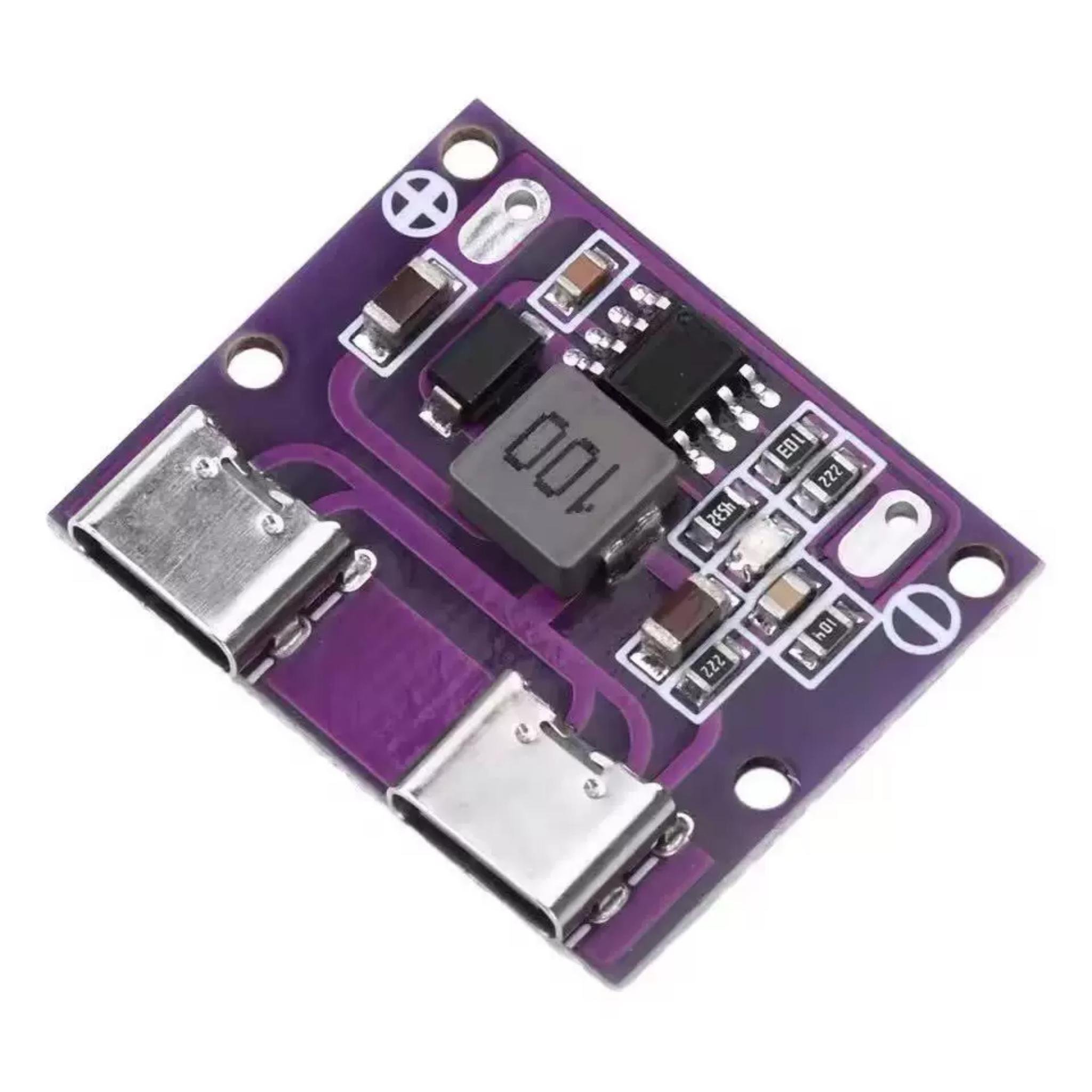
he Dual Type-C Buck Charging Module is a power conversion device specifically engineered for modern electronic devices. It reliably converts input DC voltages (ranging from DC 6-36V) into a stable 5V output, whilst providing two Type-C ports for simultaneous charging or power delivery. These Type-C ports are compatible with the vast majority of commercially available products.This design not only fulfils the need for simultaneous charging of multiple devices but also ensures charging speed and efficiency through its high output current capability (3A). It is particularly suitable for portable devices, DIY electronics projects, and small industrial equipment requiring high power supply stability.
Core Competitive Advantages
- Wide voltage input accommodates multiple power sources (e.g., automotive 12V, industrial 24V, battery packs);
- Dual Type-C ports enable simultaneous charging of two devices;
- Maximum 3A output current meets power demands for smartphones, microcontrollers, small sensors, and similar devices;
- Features an operational indicator light and compact dimensions (5.30 × 24.8 × 5mm), suitable for various space-constrained installations.
Dual Type-C Buck Module vs Traditional Buck Charging Module
Within the power module domain, the Dual Type-C buck module exhibits significant distinctions from conventional single-port, narrow-input-voltage buck modules. Key comparisons are outlined below:
| Functional Dimensions | Dual Type-C Buck Module | Traditional Buck Charging Module |
|---|---|---|
| Input Voltage Range | Wide voltage (6-36V) | Narrow voltage (typically 9-12V) |
| Output Interface Type | Dual Type-C ports (compatible with mainstream devices) | Single USB-A/Micro USB (single interface) |
| Output Capacity | Maximum 3A (combined output from both ports) | Typically 1-2A (single-port output) |
| Suitable Scenarios | Simultaneous powering of multiple devices, wide-voltage power supply scenarios | Single-device power supply, fixed-voltage input scenarios |
| Installation Convenience | Compact size + mounting holes (suitable for confined spaces) | Larger dimensions / No mounting holes (limited flexibility) |
| Practicality | Supports mixed power supply for multiple devices including mobile phones and microcontrollers | Compatible only with specific interface devices |
What is the working principle of the module?
This module employs a switching DC-DC buck converter circuit for voltage conversion, with the core process broadly divided into four stages:
- Input rectification and filtering
Following external wide-range voltage input, surface-mount capacitors first filter out noise and interference from the input signal, ensuring stable input voltage and providing clean power for subsequent step-down processing.
- PWM switching regulation
The core buck converter chip incorporates an integrated pulse width modulation (PWM) controller. By rapidly switching the internal switching transistor on and off at high frequency, it converts high-voltage DC power into high-frequency pulsed energy, achieving initial voltage reduction and energy transfer.
- Inductive Energy Storage and Voltage Stabilisation of High-Frequency Pulses
Upon entering the inductor, the energy is stored and filtered by leveraging the principle that current cannot change instantaneously, thereby converting the pulsed signal into a smooth, low-voltage DC output. Capacitors further smooth the voltage waveform, ensuring stable output voltage.
- Output Distribution and Power Supply
The regulated 5V voltage undergoes further filtering via the output capacitor before being distributed through dual Type-C interfaces. This enables simultaneous stable 5V power supply to two devices, with the interfaces’ universal compatibility accommodating most mainstream electronic equipment.
Core Parameters and Hardware Specifications
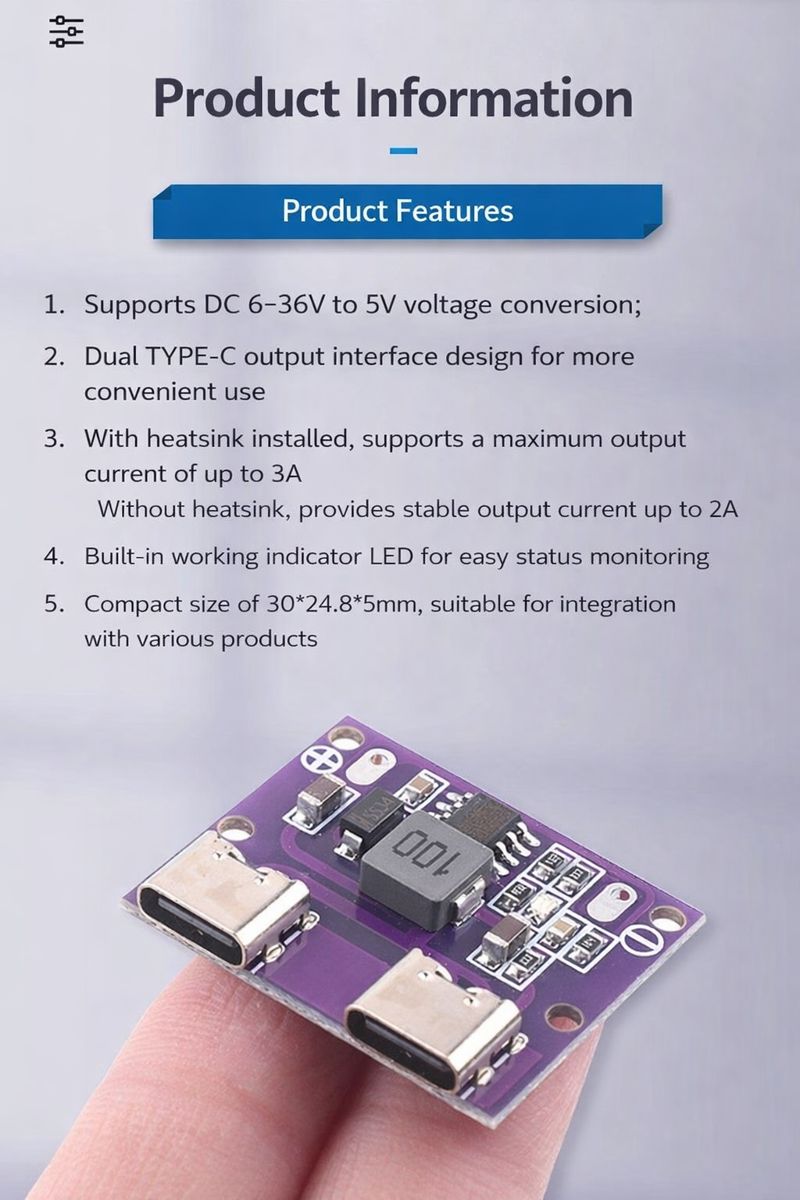
1.Core Technical Parameters
| Parameter Item | Specification |
|---|---|
| Input Voltage Range | DC 6V to 36V |
| Output Voltage | 5V to 5.2V (regulated output) |
| Output Current | 3A (with heat sink); 2A (without heat sink) |
| Output Ports | Dual USB Type-C ports |
| Operational Indicator | Supported (displays module operational status in real time) |
| Product Dimensions | 30*24.8*5mm (Compact and space-saving) |

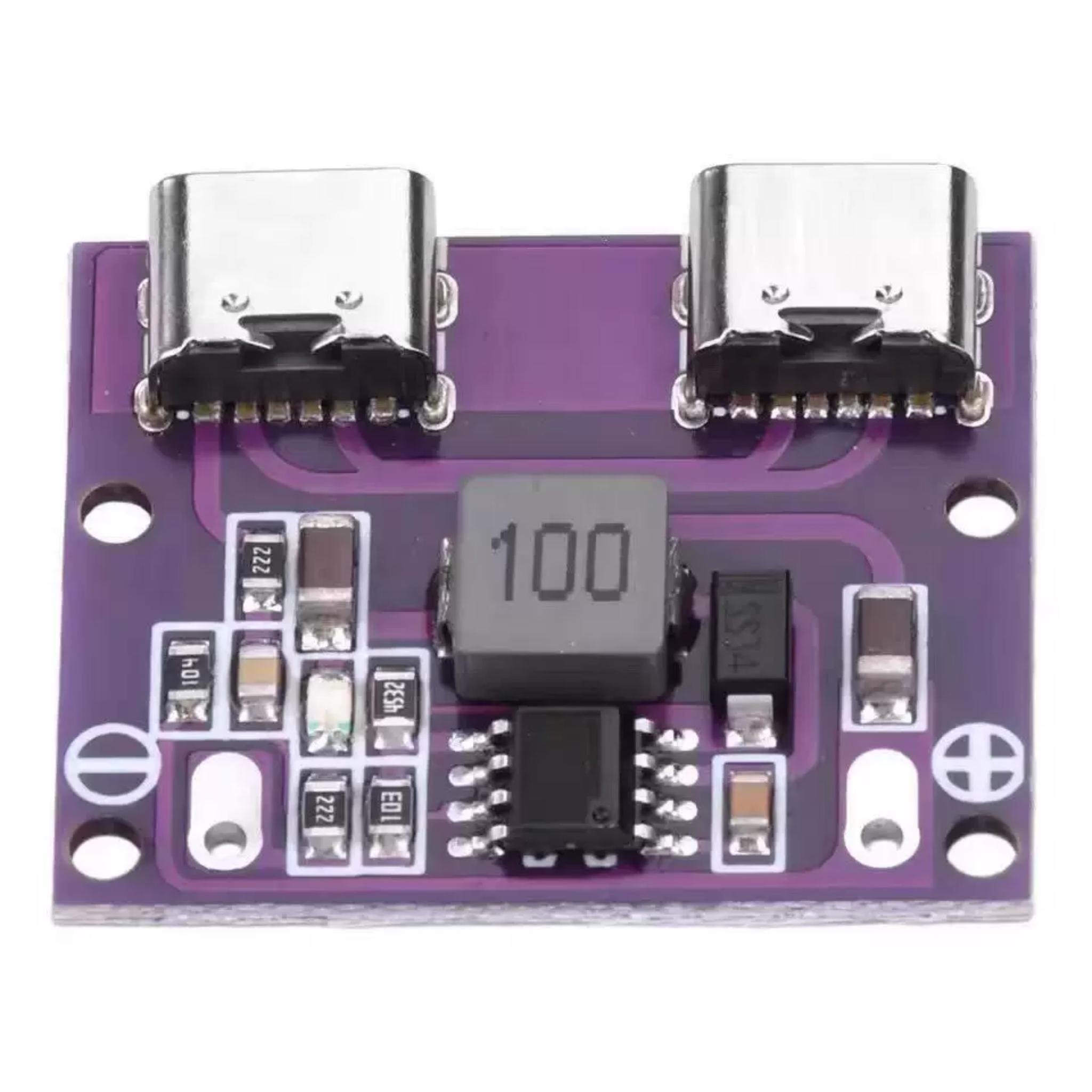
2.Hardware Structure Description
- Buck converter chip: Responsible for converting wide-range input voltage to 5V (core functional unit);
- Surface-mount components: Resistors, capacitors and other passive elements ensuring voltage stability and filtering;
- Inductor: The inductor marked “100” in the diagram, used for energy storage and filtering in DC-DC conversion;
- Mounting holes: Circular apertures along the module’s periphery facilitate secure installation.
What are the applicable scenarios?
- DIY electronics projects: Powering microcontroller development boards such as Arduino and ESP32 while simultaneously charging mobile phones/tablets (e.g., outdoor maker projects);
- In-vehicle equipment: Utilises the vehicle’s 12V power supply, converting it to 5V to power dual devices such as mobile phones and dashcams;
- Industrial compact equipment: Provides stable 5V power for industrial sensors and small controllers (compatible with 24V industrial bus systems);
- Portable Device Modifications: Modifies power systems for handheld devices and small robots, enabling wide-voltage input compatibility.
Practical Guide: Wiring and Usage of Dual Type-C Buck Modules
(1) Required Materials
- Dual Type-C Buck Module × 1
- Input power source (e.g., 12V battery, 24V industrial power supply)
- 2 x Type-C data cables
- Device to be powered (e.g., mobile phone, microcontroller development board)
(2) Wiring Procedure
- Input Wiring: Connect the positive terminal of the external power source to the module’s input positive terminal (marked “+” in the diagram), and the negative terminal to the module’s input negative terminal (marked “-” in the diagram). ⚠️ Caution: Do not reverse the input polarity, as this will damage the module!
- Output Usage: Insert the Type-C data cable into the module’s Type-C port, connecting the other end to the device requiring power (e.g., mobile phone, development board).
- Status Check: Upon powering on, the module’s operational indicator light illuminates, confirming normal power supply.
(3) Precautions (Preventive Measures)
- Input voltage must not exceed 36V, otherwise the buck converter chip will be destroyed;
- While powered, avoid touching component pins on the module to prevent voltage fluctuations damaging equipment;
- For high loads (e.g., 3A output), it is advisable to install a heat sink to prevent module overheating and maintain stability.
FAQs
1. Module not functioning, indicator light not illuminating?
- First, verify that the positive and negative terminals of the input power supply are not reversed;
- Next, verify that the input voltage falls within the 6-36V range (both excessively low or high voltages will prevent module activation).
2. What should I do if the output voltage is unstable?
- Firstly, verify the stability of the input power supply (e.g., insufficient battery charge may cause input voltage fluctuations);
- Secondly, install a heat sink during high-load operation to prevent chip overheating causing output irregularities.
3. What should I do if the current is insufficient when using both interfaces simultaneously?
The combined output current from both interfaces must not exceed the module’s rated value (3A/2A). If the total power consumption of both devices is excessive, it is advisable to reduce the load or use a single interface.