

Blog
Miniature Digital Amplifier Board PAM8403
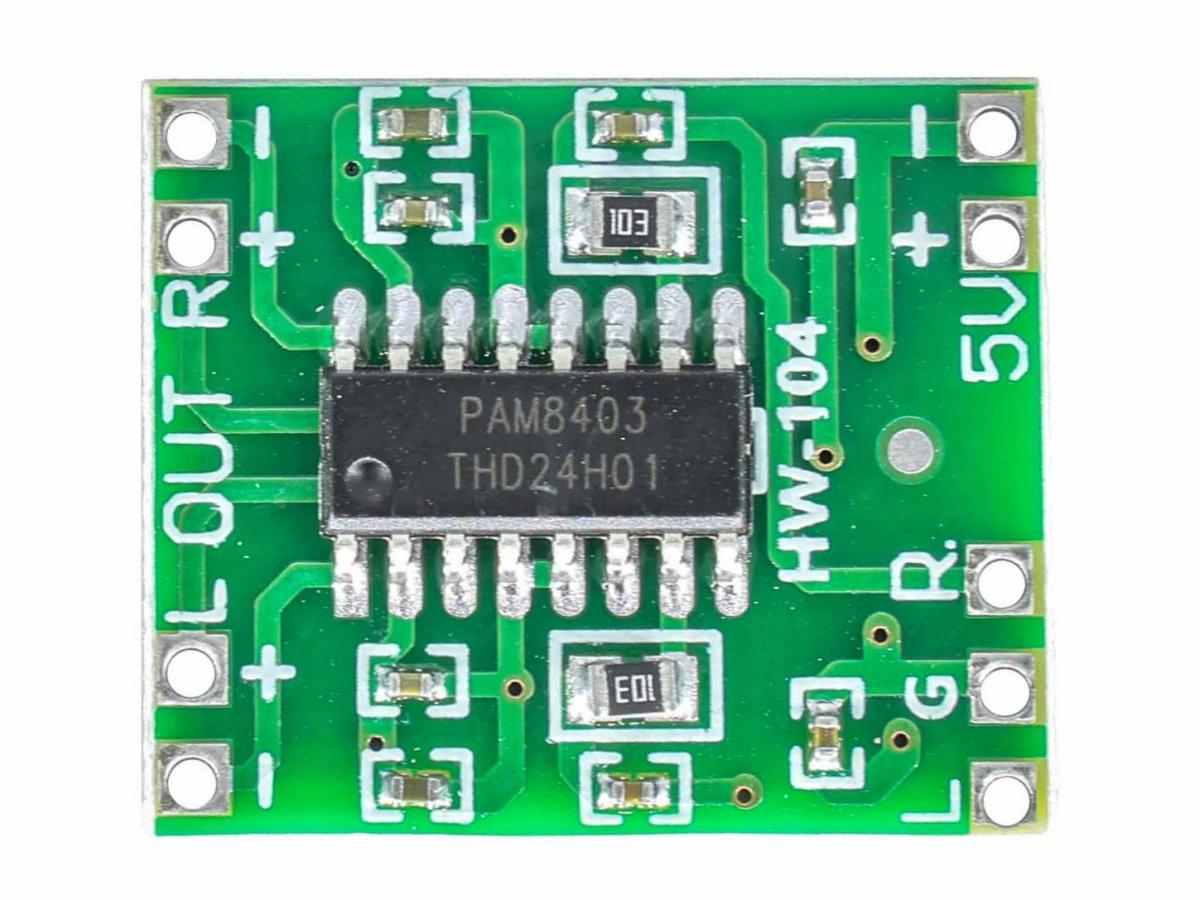
In the field of audio equipment, it has always been a challenge to achieve both “compact size” and “high performance”. Traditional amplifier boards are large in size and high in power consumption, making them difficult to adapt to miniature devices such as headphones, Bluetooth speakers, and smart wearables. On the other hand, ordinary miniature amplifiers often suffer from insufficient driving force and obvious distortion, which affects the sound quality experience.
However, the emergence of the PAM8403 miniature digital amplifier board has broken this dilemma. As a core component specially designed for miniature audio equipment, it has become a “rising star in audio amplification” in the consumer electronics and DIY fields due to its characteristics of “ultra-small size, low power consumption, and high fidelity”. Today, we will comprehensively interpret this “small-sized but high-powered” amplifier board from its principle, advantages, applications to usage skills.
What is PAM8403? – More Than Just a Small Circuit Board
Essentially, PAM8403 is a dual-channel Class D (digital) power amplifier chip. The “PAM8403 amplifier board” we often refer to is a modular product that integrates the PAM8403 chip with peripheral components such as input filter capacitors, output inductors, and feedback resistors. Its core mission is to provide efficient and low-distortion audio amplification for miniature devices, especially suitable for low-voltage power supply scenarios such as 3.7V lithium batteries and 5V USB. It perfectly solves the problem of “lack of high-quality amplifiers for miniature devices”.
Core Advantages of PAM8403
Ultra-Miniaturization for Narrow Spaces
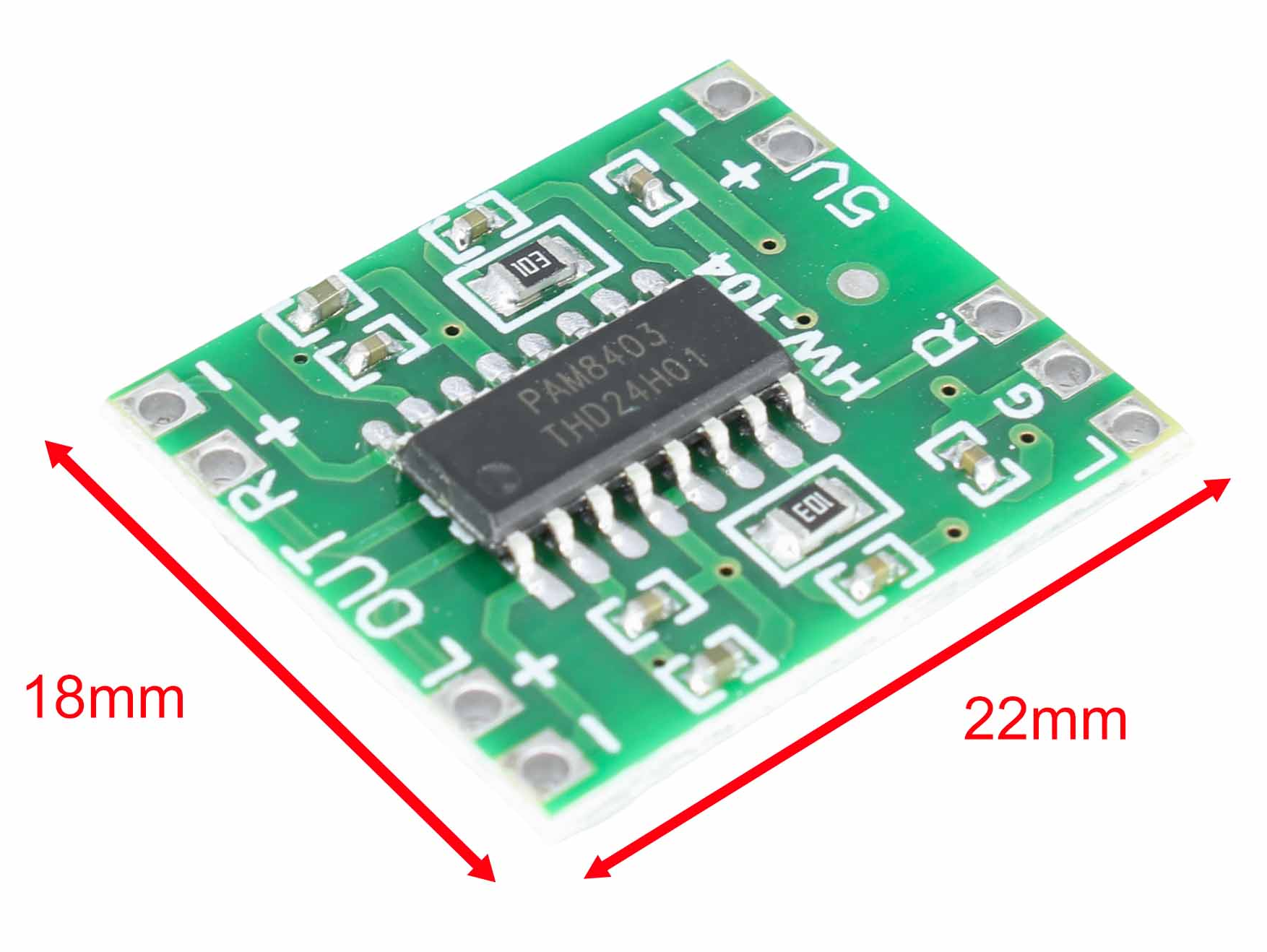
The size of a common PAM8403 amplifier board is only about 22mm × 18mm. Its compact size can be easily embedded in devices where space is extremely precious, such as TWS earbud charging cases, smart watch speaker modules, and miniature Bluetooth speakers, without the need to reserve additional space for the amplifier.
Wide-Range Low-Voltage Power Supply with Strong Compatibility
The power supply voltage range is usually 2.5V – 5.5V, which exactly covers the mainstream power sources of miniature devices: 3.7V lithium batteries (4.2V when fully charged), 5V USB interfaces (such as power banks and computer USB ports), and 2 dry batteries (3V) can all drive it directly. No additional voltage stabilization circuit is required, which reduces the design complexity.
High Power + Low Distortion for Reliable Sound Quality
Under 5V power supply, the rated output power of each channel of PAM8403 can reach 3W (with a 4Ω load). This driving force is sufficient to drive most miniature speakers (such as full-range speakers with a diameter of 20mm – 40mm). At the same time, its total harmonic distortion (THD+N) is as low as 0.1% (at 1kHz frequency), which is much lower than that of traditional analog amplifiers (usually 0.5% – 1%). It can restore clear and noise-free audio details and avoid problems such as “sound breakage” and “distortion”.
Ultra-Low Power Consumption + Overheating Protection for Safety and Durability
As a Class D digital amplifier, the conversion efficiency of PAM8403 is as high as over 90% (the efficiency of traditional Class A amplifiers is only 20% – 30%). This means that most of the electrical energy is converted into audio power rather than heat. Even when working at full power, the surface temperature of the module is only 5 – 10℃ higher than the ambient temperature, so no additional heat sink is needed. In addition, the chip has built-in overcurrent protection, overheating protection, and undervoltage protection functions. When the load is short-circuited, the temperature is too high, or the power supply is insufficient, it will automatically cut off the output to prevent the chip from being burned.
PAM8403 how to amplify the voice?——The Efficient Secret of Digital Amplifiers
Why can such a small amplifier board achieve high-power output under low voltage?The key lies in the Class D digital amplification technology it adopts, which is completely different from the “linear amplification” principle of traditional analog amplifiers (Class A/B). Its core is “Pulse Width Modulation (PWM) + Switching Amplification”, which is specifically divided into three steps:
Step 1: “Digitization” of Audio Signals – From Analog to Pulse
First, the input analog audio signal (such as the audio output from a mobile phone or a single-chip microcomputer) will be converted into a digital signal by the “Analog-to-Digital Converter (ADC)” inside PAM8403. Then, the “PWM modulation module” will generate a series of “pulse signals” according to the strength of the audio signal: the stronger the audio signal, the higher the “duty cycle” (the proportion of high-level time) of the pulse; the weaker the signal, the lower the duty cycle. For example, when playing high-pitched sounds, the high-level time of the pulse is long; when playing low-pitched sounds, the high-level time is short.
Step 2: Switching Amplification – Efficiently “Amplifying” Pulses
Next, the “switching tubes (MOS tubes)” inside PAM8403 will switch between “on/off” states at an extremely high frequency (usually 200kHz – 1MHz): when the pulse is at a high level, the switching tube is turned on, and the power supply voltage is directly applied to the output end; when the pulse is at a low level, the switching tube is turned off, and there is no voltage at the output end. Since the switching tube only has two states: “fully on” and “fully off” (no intermediate loss), there is very little waste of electrical energy. This is the core reason for the “high efficiency” of Class D amplifiers.
Step 3: Signal “Restoration” – From Pulse to Audio
Finally, the “low-pass filter” (composed of an inductor and a capacitor) at the output end will filter out the high-frequency components in the pulse signal, leaving only the low-frequency components consistent with the original audio signal, which are then transmitted to the speaker. The speaker vibrates according to the strength of the signal and finally emits clear sound. The whole process is like “using high-speed pulses to ‘depict’ the audio waveform, then filtering out impurities to restore the original sound”.
How to Use PAM8403? – Wiring and Debugging Guide
The PAM8403 amplifier board has a very low usage threshold. No complex circuit knowledge is required, and it can work with simple wiring. We will take the simple speaker solution of “5V USB power supply + PAM8403 + dual 4Ω miniature speakers” as an example to explain the specific operation:
Understanding Module Pins: Core Interfaces
A common PAM8403 amplifier board (dual-channel version) has the following core pins with clear and easy-to-understand labels:
- VCC:Positive terminal of the power supply (connected to the positive terminal of a 5V USB power supply or a 3.7V lithium battery);
- GND:Negative terminal of the power supply (connected to the negative terminal of the power supply, the negative terminal of the audio input device, and the negative terminal of the speaker; “common ground” is required);
- L_IN:Left-channel audio signal input terminal (connected to left-channel signal sources such as the mobile phone headphone jack or the audio output pin of a single-chip microcomputer);
- R_IN: Right-channel audio signal input terminal (connected to right-channel signal sources such as the mobile phone headphone jack or the audio output pin of a single-chip microcomputer);
- L_OUT+/-: Left-channel speaker output terminal (connected to the positive and negative terminals of the left speaker);
- R_OUT+/-: Right-channel speaker output terminal (connected to the positive and negative terminals of the right speaker).
Wiring Steps: Completed in Three Steps, Safety First
Wiring principle: Connect the power supply first, then the audio input, and finally the speaker (to avoid damage to components caused by instantaneous current impact):
1、Connect the power supply: Connect the positive terminal of the 5V USB power supply to VCC and the negative terminal to GND. Never reverse the positive and negative terminals! Otherwise, the PAM8403 chip will be burned directly.
2、Connect the audio signal: Use Dupont wires or audio cables to connect the left and right channel audio output terminals of a mobile phone (which needs to lead out left and right channel signals through a 3.5mm adapter cable) or a single-chip microcomputer to L_IN and R_IN respectively. At the same time, ensure that the GND of the audio device is connected to the GND of the amplifier board (“common ground” is the key to avoiding noise).
3、Connect the speaker: Connect the positive terminal of the left speaker to L_OUT+ and the negative terminal to L_OUT-; connect the positive terminal of the right speaker to R_OUT+ and the negative terminal to R_OUT-. After completing the wiring, you can play audio.
Debugging and Pitfall Avoidance: Key Notes
1、Match the speaker impedance: The optimal load impedance of PAM8403 is 4Ω – 8Ω. If a 16Ω high-impedance speaker is used, the output power will be significantly reduced; if a 2Ω low-impedance speaker is used, overcurrent protection may be triggered due to excessive current, resulting in no sound output.
2、Avoid “common ground noise”: If there is “current sound” or “noise” during playback, first check the “common ground” – ensure that the GND of the power supply, audio input device, and speaker are fully connected (you can try to directly connect the GND of each device with a wire).
3、Control the volume to avoid overload: Although PAM8403 has protection functions, long-term full-power playback (such as turning the volume to the maximum) will still accelerate the aging of components. It is recommended to control the volume at 70% – 80% during daily use (based on no distortion).
Typical Application of PAM8403
With the characteristics of “small size, low power consumption, and high fidelity”, the application scenarios of PAM8403 almost cover all “miniature audio devices”, and it can be found in both consumer electronics and DIY projects.
1、Consumer Electronics
- TWS earbud charging cases: The charging cases of some high-end TWS earbuds are equipped with built-in speakers (used to indicate battery level and connection status). PAM8403 can be directly powered by the 3.7V lithium battery in the charging case to drive the miniature speaker to emit clear prompt sounds.
- Smart wearable devices:The “incoming call reminder” and “alarm clock” functions of smart watches and bracelets can amplify audio signals through PAM8403 to make the sound louder (without relying on vibration).
- Miniature Bluetooth speakers:Most “palm-sized” Bluetooth speakers on the market use PAM8403 as the core of the amplifier. When matched with a 3.7V lithium battery and a 2 – 3-inch speaker, they can achieve “small size and large volume”.
2、DIY Projects
- Arduino/ESP32 audio projects: In DIY projects such as “voice broadcasters” and “simple radios”, PAM8403 can be directly connected to the audio output pin of a single-chip microcomputer to amplify the signal and then drive the speaker, without the need to design additional complex amplifier circuits.
- Emergency broadcasting equipment:Powered by a 5V power bank, combined with a microphone module and PAM8403, a simple emergency broadcaster can be made (such as a temporary notification device for campuses and construction sites).
- Car miniature speakers: Under the power supply of a car cigarette lighter (12V, which needs to be converted to 5V through a step-down module) or a car USB (5V), PAM8403 can drive miniature speakers to serve as auxiliary speakers for navigation prompts and music playback.
3、Industrial and Medical Fields
- Industrial alarm equipment: In industrial equipment such as sensors and controllers, PAM8403 can amplify alarm signals (such as the sound of buzzers) to ensure that staff in workshops and computer rooms can hear them clearly.
- Medical auxiliary equipment:The “voice broadcast result” function of some small medical equipment (such as blood glucose meters and blood pressure monitors) can realize low-power and distortion-free audio output through PAM8403, which is convenient for the elderly to use.
PAM8403 DATASHEET
Here is the PAM8403 data sheet for your reference.
PAM8403 vs. Similar Amplifiers: Why Choose It?
In the field of miniature amplifiers, PAM8403 is often compared with chips such as TPA3116 (high power) and PAW8403 (same type). Its core competitiveness lies in “balance” – it takes into account size, power, and power consumption, and is especially suitable for low-voltage miniature devices.
| Comparison Dimension < | PAM8403 < | TPA3116 < | PAW8403 |
|---|---|---|---|
| Size | Small (about 22mm×18mm) |
Larger (about 25mm×18mm) |
Ultra-small (about 15mm×10mm) |
| Power Supply Voltage | 2.5V – 5.5V (low-voltage compatible) | 8V – 26V (high-voltage, high-power) | 2.5V – 5.5V |
| Output Power (5V) | 3W×2 (4Ω, dual-channel) | Unable to drive (insufficient voltage) | 3W×2 (4Ω, dual-channel) |
| Efficiency | 90%+ | 85%+ | 90%+ |
| Distortion (THD+N) | 0.1% (1kHz) | 0.01% (but requires high voltage) | 0.1% (1kHz) |
| Application Scenario | Miniature low-voltage devices (headphones, bracelets) | Medium and high-power devices (desktop speakers) | Miniature low-voltage devices (more compact scenarios) |
It is not difficult to see: If you need “low-voltage, miniature, dual-channel high-power“, PAM8403 is an excellent choice; if you pursue ultra-high power (such as desktop speakers), you need to choose TPA3116; if the device space is extremely compact, PAW8403 is more suitable, but its power is similar to that of PAM8403.
Summary: The "Irreplaceability" and Limitations of PAM8403
The core value of PAM8403 lies in accurately solving the pain point of “lack of high-quality amplifiers for miniature low-voltage devices” – it not only meets the installation requirement of “small size” but also ensures the sound quality experience of “low distortion and high power”, while taking into account low power consumption and safety. It has become a “standard component” for miniature audio devices.
However, it also has limitations: it does not support high-voltage power supply (it will be burned if the voltage exceeds 5.5V) and cannot be used in high-voltage scenarios such as 12V car speakers and 220V desktop speakers.For electronics enthusiasts or engineers, PAM8403 is not only a practical amplifier board but also an excellent carrier for understanding the “principle of digital amplifiers”. Through it, you can directly feel how technologies such as “PWM modulation” and “switching amplification” are applied in miniature devices. If you are designing a miniature audio device or want to DIY a small speaker, PAM8403 is definitely worth a try – it will let you understand that “small size” can also have “great power”.
Good effort overall! I鈥檒l definitely recommend this to others.!
Thank you!