

Blog
AGS10 TVOC Air Quality Gas Sensor Module Complete Guide
Introduction
In scenarios like indoor environment monitoring, smart homes, and portable air quality detectors, accurate detection of TVOC (Total Volatile Organic Compounds) is often a core part of evaluating air quality. The AGS10 TVOC Air Quality Gas Detection Sensor Module stands out as a top choice for DIY enthusiasts, electronic developers, and small-device integration, thanks to its I2C communication interface, high-sensitivity detection performance, and compact size. It can replace the traditional AGS02MA module to enable more convenient air quality monitoring. This article will comprehensively analyze the module’s practical value from aspects including product definition, competitor comparison, working principle, and hands-on guide.
What is the AGS10 TVOC Air Quality Gas Detection Sensor Module?
The AGS10 TVOC Air Quality Gas Detection Sensor Module is a high-precision sensor module specifically designed to detect the concentration of Total Volatile Organic Compounds (TVOC) in the air. It adopts advanced semiconductor sensing technology, which can quickly and accurately respond to changes in TVOC levels in the environment. It outputs detection data via an I2C digital interface, making it easy to integrate with various microcontrollers or development boards for real-time air quality monitoring and data analysis. Its compact size and low-power consumption make it ideal for scenarios with strict space and energy requirements.
Core Features
- High-Precision TVOC Detection:The module supports accurate detection of TVOC concentrations with excellent sensitivity and accuracy. It is widely used in indoor air quality monitoring, in-vehicle environment detection, and other scenarios to provide reliable data support for users.
- Standard I2C Communication Protocol:The interface is simple and easy to use, enabling direct and quick connection to common microcontroller development boards (likeArduino, ESP32). This greatly facilitates embedded development and prototype building.
- Compact SMD Design:With a small and lightweight overall structure, the module is highly suitable for integration into embedded systems or various portable projects that have high space requirements, offering strong engineering adaptability.
- Direct Replacement for AGS02MA:It is fully compatible with the AGS02MA sensor in terms of electrical performance and structure. It also provides a more user-friendly experience, significantly reducing replacement and upgrade costs.
AGS10 Module vs Traditional AGS02MA Module Comparison
As an alternative to the AGS02MA, the AGS10 module has significant advantages in terms of interface and integration. The detailed comparison is as follows:
| Function Dimension | AGS10 TVOC Sensor Module | Traditional AGS02MA Module |
|---|---|---|
| Communication Interface Type | I2C digital interface (simple wiring, only SDA/SCL required) | Mostly UART interface (requires additional level matching) |
| Integration Level | SMD module (built-in peripheral circuit, ready to use) | Bare chip (needs self-built driving circuit) |
| Size & Volume | Mini SMD size (fits compact projects) | Larger size (high integration difficulty) |
| Compatibility | Directly compatible with mainstream MCUs (Arduino/ESP32) | Requires additional communication parameter configuration, limited compatibility |
| Usage Threshold | Low (no extra circuit needed, direct wiring) | High (requires circuit design and driver development skills) |
How does the AGS10 module work?
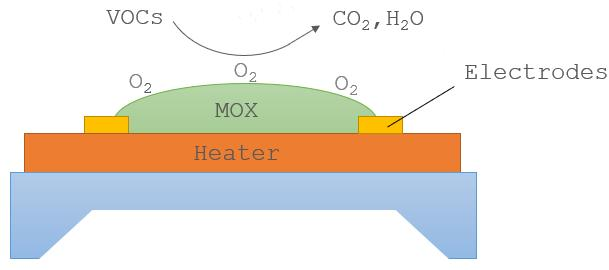
The AGS10 module uses semiconductor gas-sensing detection technology to measure TVOC concentrations, following three main steps:
1.When the semiconductor gas-sensing element in the gas-sensing reaction module comes into contact with TVOC gas in the air, the resistance of the gas-sensing material changes with the TVOC concentration (the higher the concentration, the more obvious the resistance change).
2.The signal processing circuit in the signal conversion module converts the resistance change of the gas-sensing element into an electrical signal, and then an AD conversion module converts the analog signal into a digital signal.
3.Finally, the data output module processes these digital signals through an internal MCU and outputs standardized TVOC concentration data (usually numerical data corresponding to different concentration ranges) via the I2C interface for external devices to read and analyze.
Here is the professional explanation:
An advanced MEMS technology is adopted in the sensor to fabricate a micro-thermal plate on a silicon
substrate, and the gas-sensitive material used is a metal oxide semiconductor material with low conductivity
in clean air. When the sensor works in an air environment, the conductivity of the gas-sensitive material
changes with the concentration of the gas being detected in the air. The higher the concentration of the gas
being detected, the higher the conductivity of the gas-sensitive material will be. Based on this principle, a
special integrated circuit is adopted to convert the change in conductivity into an output signal corresponding
to the concentration of the gas.
Core Parameters and Hardware Details of the AGS10 Module
1.Core Technical Parameters
| Parameter | Specification |
|---|---|
| Operating voltage | 3.0±0.1 V DC |
| Operating current | 28±5 mA |
| Typical power consumption | 75 mW |
| Sampling period | ≥2 s |
| Output mode | I²C slave mode (≤15 kHz) |
| Preheating time | 120 s |
| Working temperature | 0~50 ℃ |
| Working humidity | 0~95%RH |
| Life span | >5 years (@25℃, clean air) |
| Sensor category | Semiconductor sensor |
| Output unit | ppb |
| Measuring range | 0~99999 ppb |
| Typical Accuracy (25℃/50%RH) | 25% reading |
| Standard test gas | Ethanol |
2.Datasheet
Here we provide the AGS10 datasheet for your reference:
3.Hardware Structure Description
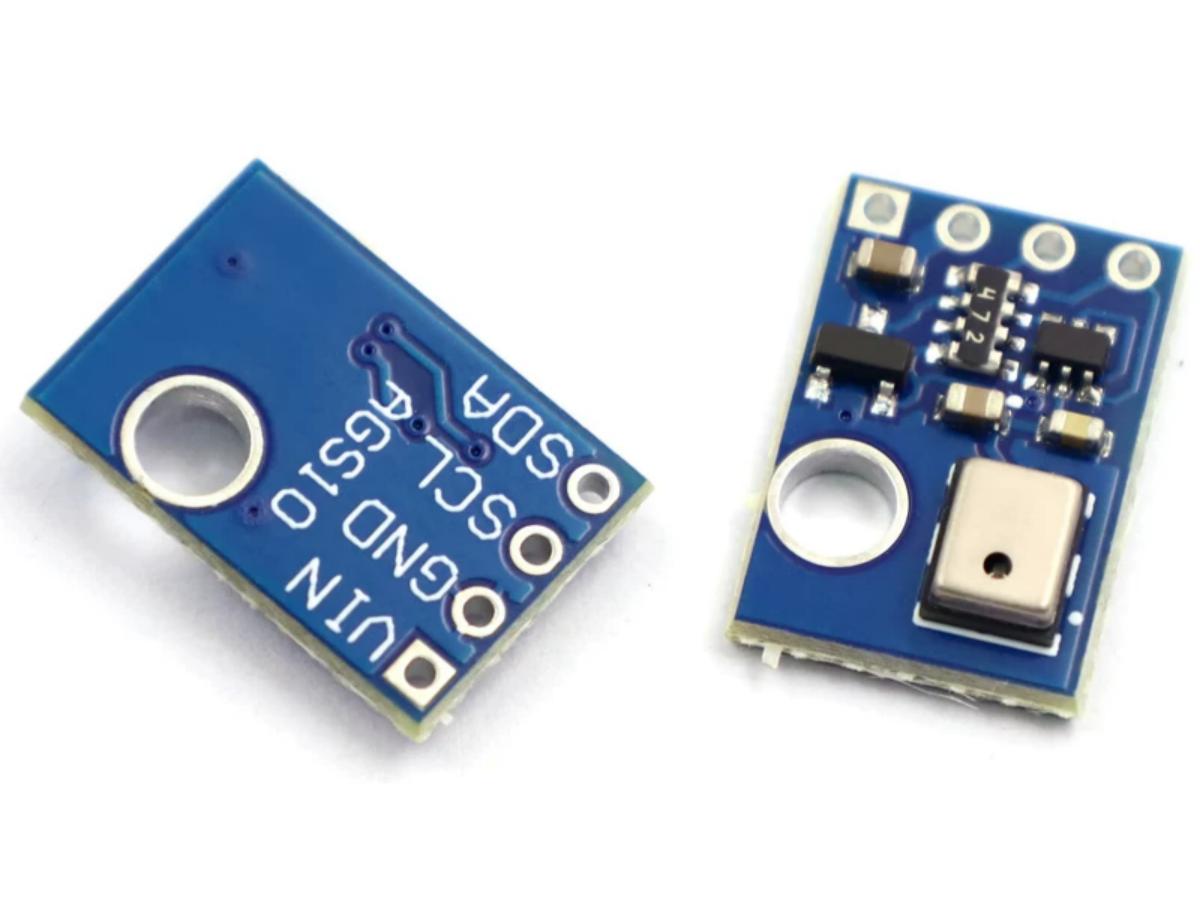
As seen from the physical diagram of the module, the core interfaces include:
- VCC: Power input pin (3.3V~5V)
- GND: Ground pin
- SDA: I2C data pin
- SCL: I2C clock pin
The module adopts an SMD design and is equipped with mounting holes on the edges for easy fixing and integration.
Product Advantages and Application Scenarios
(1) Core Advantages
- High Compatibility: The I2C interface is compatible with most microcontrollers and can directly replace the AGS02MA module.
- Low Usage Threshold: It has built-in peripheral circuits, requiring no additional design—just wire it up to use.
- Compact and Easy to Integrate:Its mini size makes it suitable for portable devices, embedded projects, and other compact spaces.
- Real-Time Detection:It has a fast response speed and can output TVOC concentration data in real time.
(2) Application Scenarios
- Smart Home Devices:Integrate into smart air conditioners or air purifiers to enable linked control based on air quality.
- DIY Air Quality Detectors: Pair with Arduino/ESP32 to build portable TVOC detection devices.
- In-Vehicle Environment Monitoring: Detect in-vehicle TVOC concentrations and link with the vehicle’s ventilation system.
- Small Industrial Monitoring Devices:Used for simple air quality monitoring in workshops, warehouses, and similar scenarios.
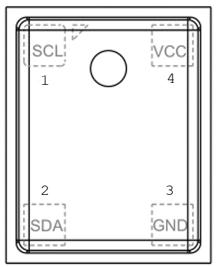
Interface definition Pins definition
| Pin | Name | Description |
|---|---|---|
| 1 | SCL | Serial clock |
| 2 | SDA | Serial data |
| 3 | GND | Ground |
| 4 | VCC | Power supply |
Practical Guide: AGS10 Module Wiring and Data Reading with Arduino
(1) Required Materials
- 1 x AGS10 TVOC sensor module
- 1 x Arduino development board (e.g., Uno)
- Several jumper wires
- 1 x USB data cable
(2) Hardware Wiring Steps
Connect the AGS10 module to the Arduino as follows:
| AGS10 Module Pin | Arduino Pin | Description |
|---|---|---|
| VCC | 5V | Module power input |
| GND | GND | Common ground for power supply |
| SDA | A4 | I2C data pin (A4 on Uno) |
| SCL | A5 | I2C clock pin (A5 on Uno) |
Sample code
					#include <Wire.h>

// Assume the I2C address of AGS10 is 0x5A (refer to the module manual for details)
#define AGS10_ADDR 0x5A

void setup() {
  Serial.begin(9600);
  Wire.begin(); // Initialize I2C bus
}

void loop() {
  Wire.beginTransmission(AGS10_ADDR);
  Wire.write(0x00); // Send read command (adjust according to module manual)
  Wire.endTransmission();

  Wire.requestFrom(AGS10_ADDR, 2); // Request 2 bytes of data
  if (Wire.available() >= 2) {
    uint16_t tvocData = Wire.read() << 8 | Wire.read(); // Read TVOC data
    Serial.print("Current TVOC concentration: ");
    Serial.print(tvocData);
    Serial.println(" ppb");
  }

  delay(1000); // Read data every second
}
FAQS
1.Module has no data output?
- Check if the I2C address is correct (refer to the module manual).
- Ensure the wiring is secure and the SDA/SCL pins are not reversed.
- Verify that the module’s operating voltage is within the 3.3V~5V range.
2.Detection data fluctuating wildly?
- Make sure the module is in a stable environment (avoid air flow or sudden temperature changes).
- Extend the data reading interval or take the average of multiple readings.
3.Data inconsistent with actual air quality?
- The module needs to preheat for a period (usually 5~10 minutes) before detection.
- Confirm that the module is used within its effective detection range (avoid over-range usage).