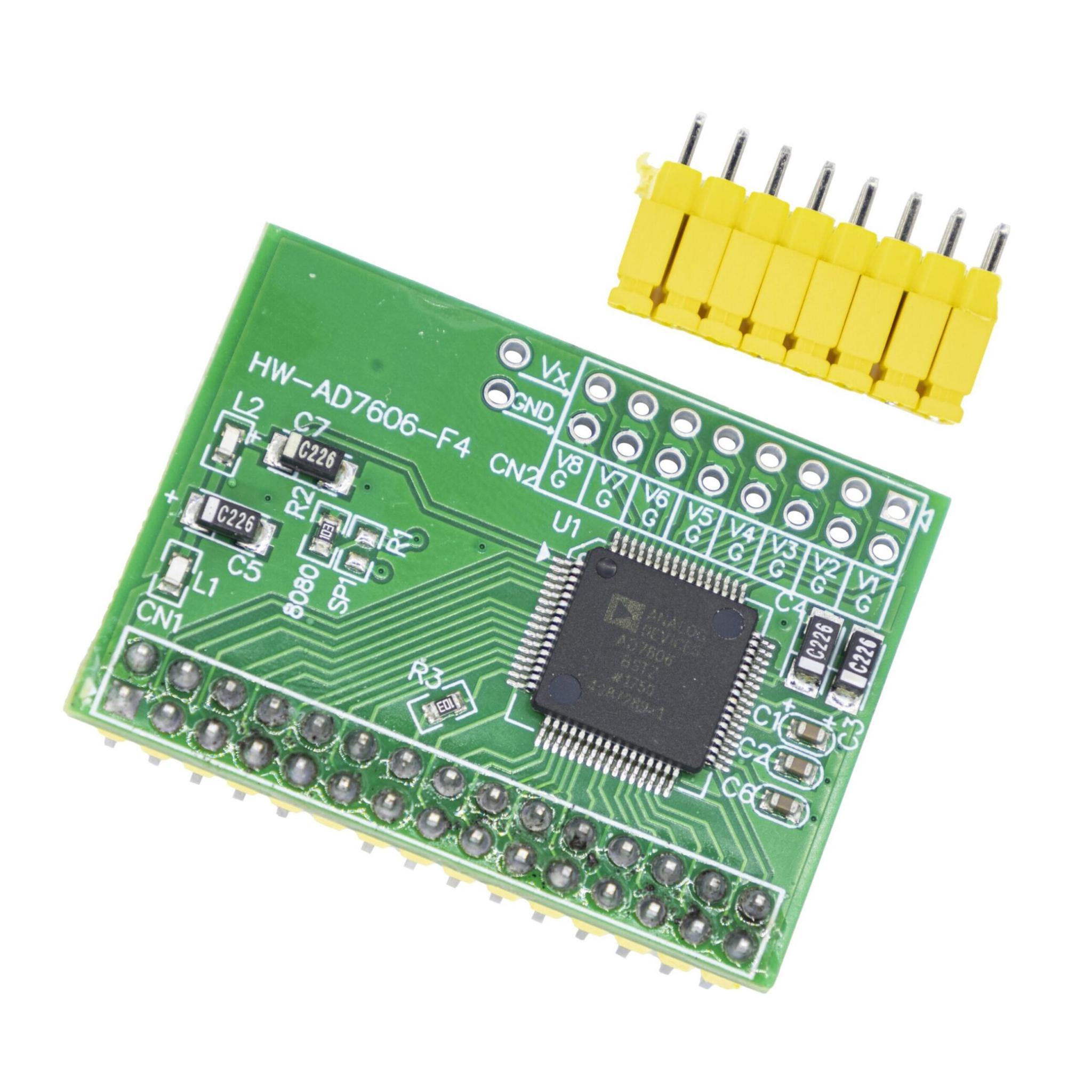
AD7606 Data Acquisition Module

$16.661pcs

AD7606 data acquisition module features 8-channel simultaneous sampling and 16-bit precision, capturing true signals without distortion at high speed!

Dimensions 41.0 × 30.3 mm
Brand

easyelecmodule

5742 in stock

Category:
DESCRPIPTION AND FEATURES

AD7606 Introduction

The AD7606 is a new generation 16-bit, 8-channel, synchronous sampling, bipolar input analog-to-digital converter ADC launched by ADI Company.

The AD7606 multi-channel integrated circuit can conveniently realize the measurement and monitoring of multiple I&V (current and voltage) in intelligent substations. This enables the power line monitoring system to monitor and manage various abnormal events occurring on the power grid in real time, achieving the comprehensive integration of intelligent substation functions, digitization of system protection, control, and measurement devices, intelligent operation management, adapting to the development of the power market.

AD7606 Feature

  1. Use the AD7606 high precision 16-bit ADC chip
  2. 8 analog inputs. Impedance 1M Ohm. (No need for negative power supply, no need for front-end analog amplifier circuit, can directly connect to sensor output)
  3. Input range ±5V, ± Can be controlled by IO to set the range.
  4. Resolution 16 bits.
  5. Maximum sampling frequency 200Ksps. Supports 8-level oversampling settings (can effectively reduce jitter)
  6. Built-in benchmark
  7. 5V power supply
  8. SPI interface or 16-bit bus interface. Interface IO level can be 5V or 3.3V

Module Function

  1. Data acquisition: The data acquisition module is responsible for collecting data from various data sources, which can be either real-time or offline.
  2. Data transmission: The data acquisition module sends the collected data through the transmission interface to the backend system.
  3. Data processing: The data acquisition module conducts preliminary processing on the received data, such as cleaning, noise reduction, and formatting, to prepare for subsequent analysis.
  4. Data storage: The data acquisition module stores the processed data in local or cloud-based databases for subsequent querying and usage.
  5. Data analysis: The data acquisition module supports various data analysis methods, such as statistical analysis, machine learning, and deep learning, to help users extract valuable information from massive data.
  6. Data visualization: The data acquisition module provides a variety of data visualization tools, such as charts, maps, and dashboards, to help users present data and trends in an intuitive manner.

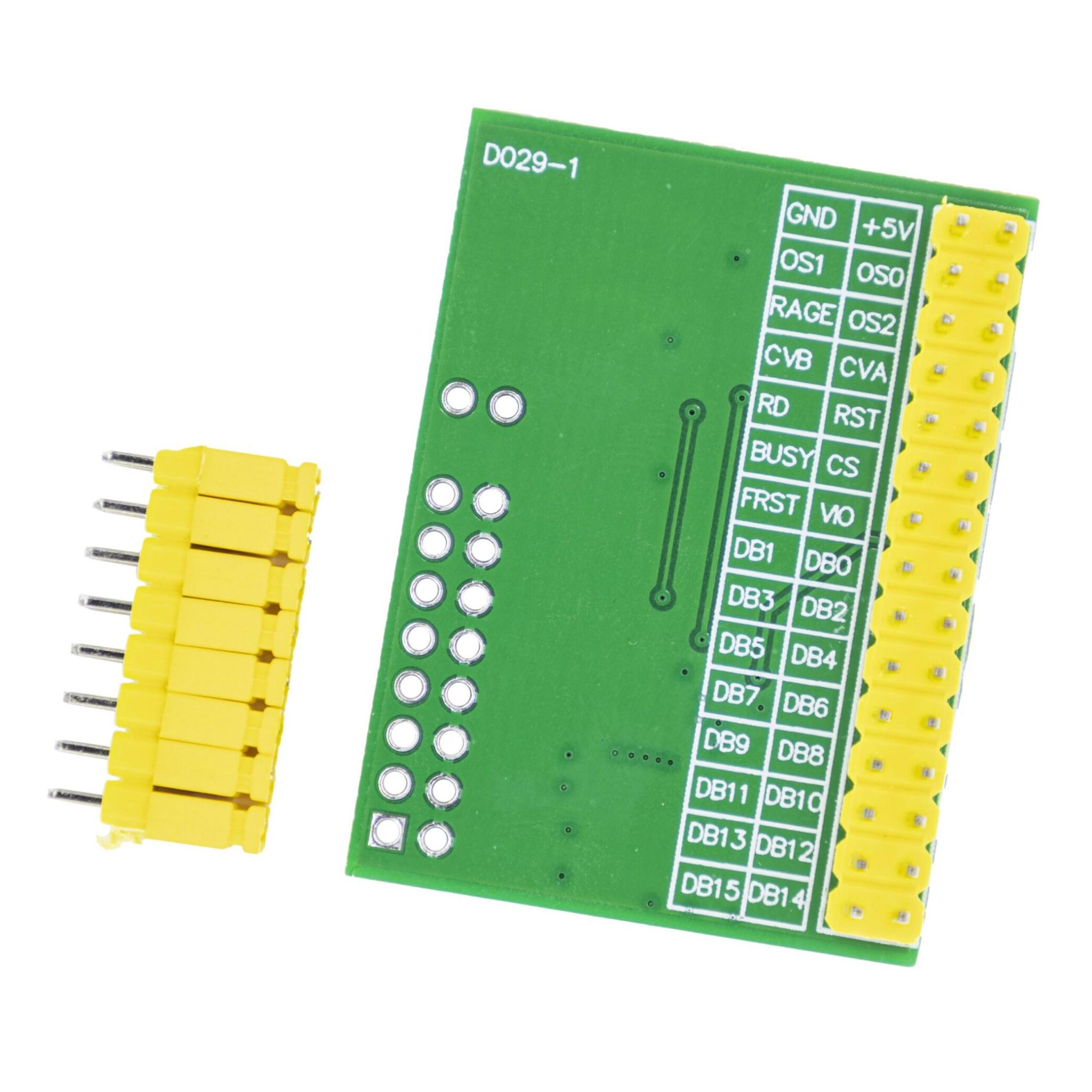
AD7606 Pin Function

AD7606 Schematic Diagram

Pin

Description

AVcc

Simulated voltage source, ranging from 4.75V to 5.25V

AGNG

Grounding

OS[2:0]

Over-sampling mode pin. Logical input. These inputs are used to select the over-sampling rate. OS2 is the MSB control bit, while OS0 is the LSB control bit.

PAR(Low level is active)/SER/BYTE SEL

Parallel/Serial/Byte interface selection input. If this pin is connected to a logic low level, then the parallel interface is selected. If this pin is connected to a logic high level, then the serial interface is selected.

RANG

Select the input range for analog input. If this pin is connected to a logic high level, the analog input range for all channels is +10V. If this pin is connected to a logic low level, the analog input range for all channels is +5V.

CONVST A / CONVST B

Activate the conversion signal. CONVST A activates channels 1, 2, 3, and 4; CONVST B activates channels 5, 6, 7, and 8.

RESET

Reset input. When set to a logic high level, the rising edge of RESET resets; the typical width of the high pulse of RESET is 50ns. If a RESET pulse is applied during the conversion, the conversion will be interrupted. If a RESET pulse is applied during the read operation, the content of the output register will be reset to 0.

RD(Low level is active)/SCIK

When choosing the parallel interface, it is the parallel data read control input (RD_); when choosing the serial interface, it is the serial clock input (SCLK). In parallel mode, if both CS_ and RD_ are at a logical low level, the output bus will be enabled. In serial mode, this pin is used as the serial clock input for data transmission. The falling edge of CS causes the data output lines DoutA and DoutB to exit the tri-state mode, and sequentially outputs the most significant bit (MSB) of the conversion result. The rising edge of SCLK sequentially transmits all subsequent data bits to the serial data output DoutA and DoutB. Reset input. When set to a logic high level, the rising edge of RESET resets; the typical width of the RESET high pulse is 50ns. If a RESET pulse is applied during the conversion, the conversion will be interrupted. If a RESET pulse is applied during the read operation, the content of the output register will be reset to 0.

CS

Chip Select. This low level signal is effective. In parallel mode, if both CS and RD are at logic low levels, it enables the output of the bus DB[15:0]. In serial mode, CS enables the transmission of serial data frames and outputs the most significant bit (MSB) of the serial output data one by one.

BUSY

Output busy signal. After both CONVST A and CONVST B reach the rising edge, this pin becomes a logic high level, indicating that the conversion process has begun. The BUSY output remains at a high level until the conversion process of all channels is completed. The falling edge of BUSY indicates that the conversion data is being latched into the output data register, and it becomes available for reading after a time t₄. The data reading operation performed when BUSY is at a high level should be completed before the falling edge of BUSY. When the BUSY signal is at a high level, the rising edge of CONVST A or CONVST B has no effect.

FRSTDATA

The FRSTDATA output signal indicates when to read back the first channel V1 on the parallel, byte, or serial interface. In parallel mode, the falling edge of the RD signal corresponding to the V1 result will subsequently set the FRSTDATA pin to a high level, indicating that the output data bus can provide the result of V1. After the next falling edge of RD, the FRSTDATA output returns to a logic low level. In serial mode, FRSTDATA becomes a high level at the CS falling edge because at this time the MSB of V1 will be output on DoutA. After the 16th falling edge of SCLK after the CS falling edge, it returns to a low level.

DB0 – DB15

Read data bus

Matters Need Attention

1. The AD7606 module we manufacture has an 8080 parallel interface. If using the SPI interface mode, the configurations of R1 and R2 resistors need to be modified.

2. Parallel interface jumper: R1 is left unconnected (not attached), R2 is attached with a 10K resistor.

SPI interface jumper: R1 is attached with a 10K resistor, R2 is left unconnected (not attached).

3. The configuration of AD7606 is very simple. It has no internal registers. The range and oversampling parameters are controlled by external IO. The sampling rate is controlled by the pulse frequency provided by the MCU or DSP.

4. The AD7606 must be powered by a single 5V supply.

The communication interface level between AD7606 and the MCU is controlled by the VIO pin. That is to say, VIO must be connected to the power supply of the microcontroller, which can be 3.3V or 5V.

Product Application

  1. Internet of Things: A large amount of data generated by IoT devices needs to be collected and processed through data collection modules in order to achieve remote monitoring and management of the devices.
  2. Industrial Automation: Sensors and actuators in industrial production generate a large amount of real-time data. Data collection modules can collect this data in real time and perform analysis to improve production efficiency and product quality.
  3. Smart Cities: Various sensors and cameras in cities generate a large amount of data. Data collection modules can collect and process this data to support urban planning and management.
  4. Financial Risk Control: Financial institutions need to monitor and analyze real-time data of customers’ transaction behaviors and credit status to provide better services.
  5. Medical Health: Medical institutions need to collect and analyze data such as patients’ physiological parameters and medical records to provide better medical services.
  6. Transportation Logistics: Logistics companies need to monitor and analyze information such as vehicle locations, speeds, and goods, and data collection modules can help logistics companies improve operational efficiency and service quality.
  7. Energy Management: Energy companies need to collect and analyze data such as the operation status of the power grid and equipment performance to optimize energy allocation and reduce operating costs.

In summary, data collection modules have broad application prospects in various fields, and their functions and application scenarios are constantly expanding and improving. With the continuous advancement of technology, we have reason to believe that future data collection modules will be more intelligent, efficient, and convenient.

Relative Information

Reviews (0)

Reviews

There are no reviews yet.

Be the first to review “AD7606 Data Acquisition Module”

Your email address will not be published. Required fields are marked *

Shipping and Delivery

Shipping Cost

We only ship to the United States. Shipping costs are calculated based on the total order amount.

Shipping Method And Delivery Time

All orders will be processed and shipped within 72 hours of placing the order (excluding weekends and holidays). They will ship from Shenzhen, China, primarily via 4PX logistics. Depending on the destination and logistics conditions, other carriers such as DHL, FedEx, UPS, USPS, etc., may also handle the delivery. Estimated shipping time is 7-12 business days, with actual delivery occurring in 10-17 business days, depending on logistics conditions.

Payment:

We accept Visa, Master card, Maestro, American Express, JCB, Dinner's Club, Discover, Paypal, Apple Pay, Google Pay .