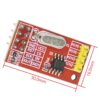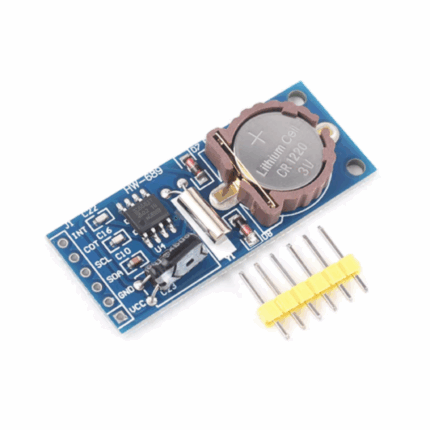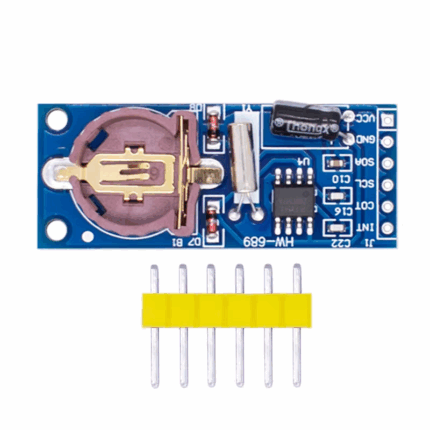
AD7705 Data Acquisition Module
$3.331pcs
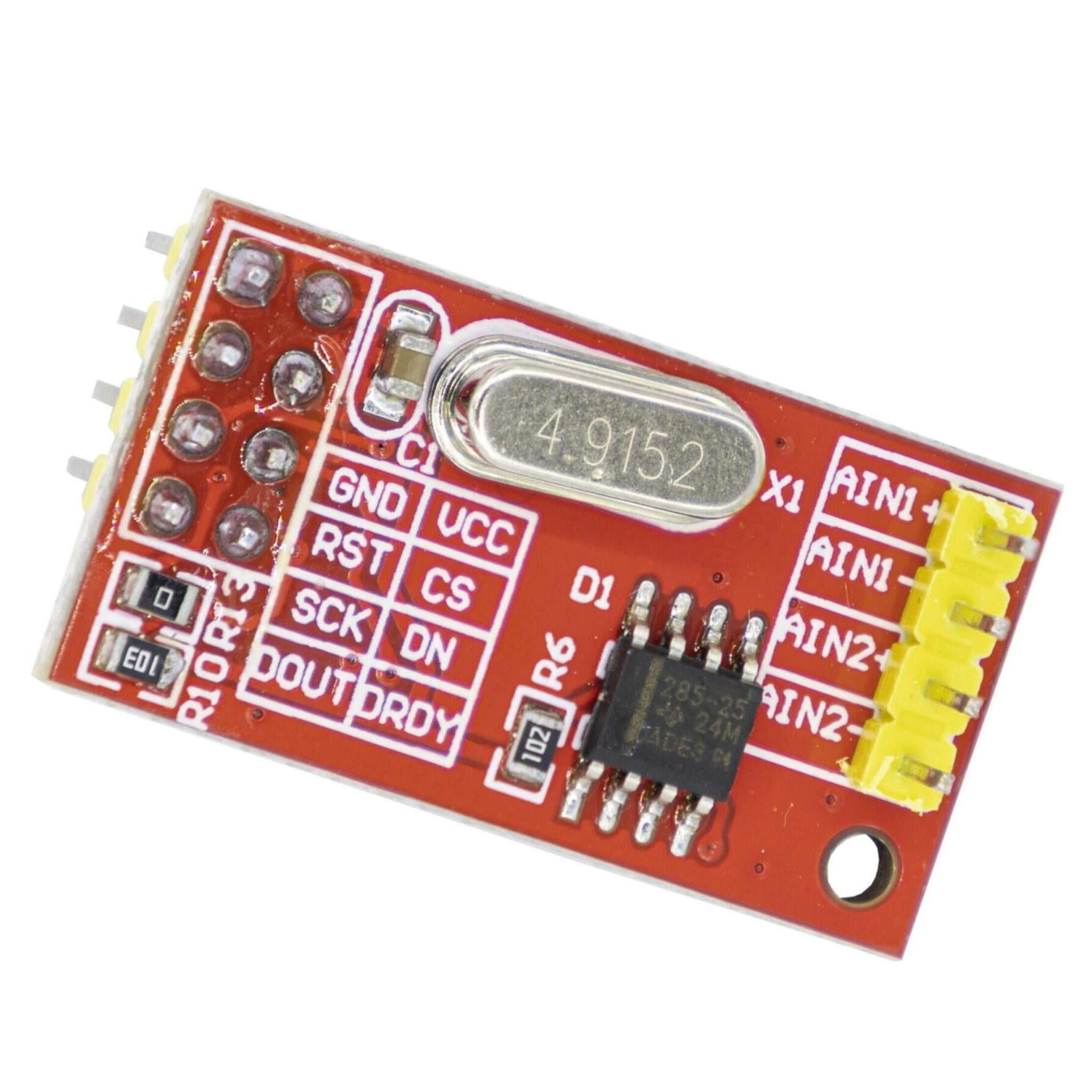
AD7705 module delivers 16-bit high precision and ultra-low noise, faithfully restoring faint signals! Simple SPI interface easily links to sensors.
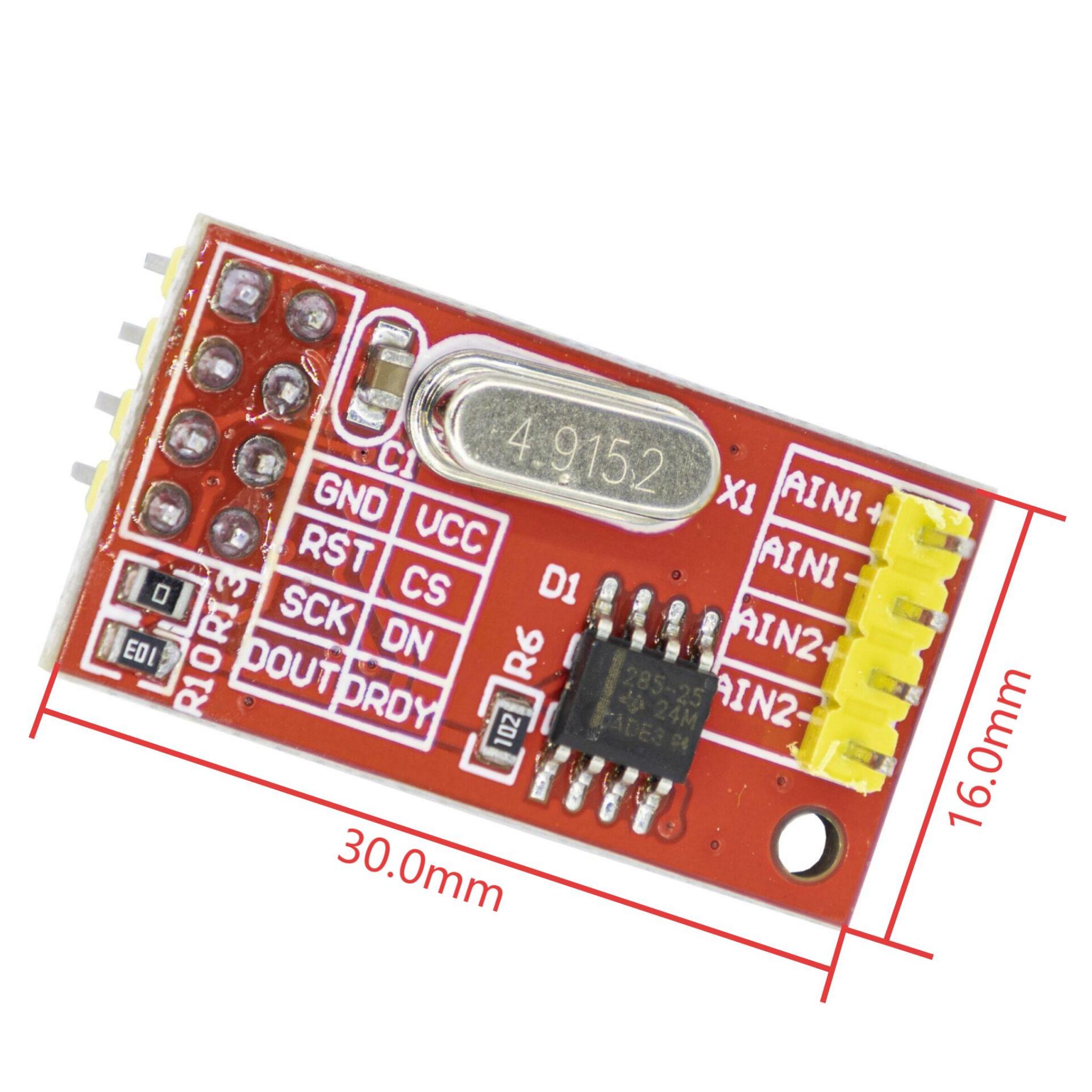
| Dimensions | 30.0 × 16.0 mm |
|---|---|
| Brand |
easyelecmodule |
6550 in stock
AD7705 Introduction
The AD7705 is an ideal circuit for microcontrollers and digital signal processors systems, which can further reduce costs, shrink size, and decrease the complexity of the system. It is applied in microprocessors , digital signal processing systems, handheld instruments, and distributed data acquisition systems. The AD7705 has a serial clock and Schmitt logic input. Connect an external serial clock to this input port to access the serial data of the AD7705/7706. When transmitting data with the microcontroller, the control clock provides the main clock signal to the converter.
AD7705 Feature
- 3.3V or 5V DC power supply.
- MCU interface: SPI
- Main ADC chip: TM7705 (a brand-new chip, fully compatible with the AD7705 chip)
- External LM285-2.5 reference voltage.
- Input circuit with divider resistance and R-C filtering, facilitating customers to adjust the gain range by themselves.
- The chip has a programmable gain amplifier, with a gain range of 1 – 128 times.
- The chip has an internal input buffer amplifier, allowing direct connection to the sensor.
Module Function
- Data acquisition: The data acquisition module is responsible for collecting data from various data sources, which can be either real-time or offline.
- Data transmission: The data acquisition module sends the collected data through the transmission interface to the backend system.
- Data processing: The data acquisition module conducts preliminary processing on the received data, such as cleaning, noise reduction, and formatting, to prepare for subsequent analysis.
- Data storage: The data acquisition module stores the processed data in local or cloud-based databases for subsequent querying and usage.
- Data analysis: The data acquisition module supports various data analysis methods, such as statistical analysis, machine learning, and deep learning, to help users extract valuable information from massive data.
- Data visualization: The data acquisition module provides a variety of data visualization tools, such as charts, maps, and dashboards, to help users present data and trends in an intuitive manner.
AD7705 Pin Function
Pin | Function |
SCLK | Serial Clock. An external serial clock is applied to the Schmitt-triggered logic input to access serial data from the AD7705/AD7706. This serial clock can be a continuous clock with all data transmitted in a continuous train of pulses. Alternatively, it can be a noncontinuous clock with the information transmitted to the AD7705/AD7706 in smaller batches of data. |
MCLK IN | Master Clock Signal. This can be provided in the form of a crystal/resonator or external clock. A crystal/resonator can be tied across the Pin MCLK IN and Pin MCLK OUT. Alternatively, the MCLK IN pin can be driven with a CMOS-compatible clock with the MCLK OUT pin left unconnected. The parts can be operated with clock frequencies in the range of 500 kHz to 5 MHz. |
MCLK OUT | When the master clock for these devices is a crystal/resonator, the crystal/resonator is connected between Pin MCLK IN and Pin MCLK OUT. If an external clock is applied to Pin MCLK IN, Pin MCLK OUT provides an inverted clock signal. This clock can be used to provide a clock source for external circuitry and is capable of driving 1 CMOS load. If the user does not require this clock externally, Pin MCLK OUT can be turned off via the CLKDIS bit of the clock register. This ensures that the part does not unnecessarily burn power driving capacitive loads on Pin MCLK OUT. |
| /CS | Chip Select. Active low logic input used to select the AD7705/AD7706. With this input hardwired low, the AD7705/AD7706 can operate in its 3-wire interface mode with Pin SCLK, Pin DIN, and Pin DOUT used to interface to the device. The CS pin can be used to select the device communicating with the AD7705/AD7706. |
| /RESET | Logic Input. Active low input that resets the control logic, interface logic, calibration coefficients, digital filter, and analog modulator of the parts to power-on status. |
AIN2(+) | Positive Input of the Differential Analog Input Pair AIN2(+)/AIN2(−) for AD7705. Channel 1 for AD7706. |
AIN2(-) | Negative Input of the Differential Analog Input Pair AIN2(+)/AIN2(−) for AD7705. Channel 3 for AD7706. |
AIN1(+) | Positive Input of the Differential Analog Input Pair AIN1(+)/AIN1(−) for AD7705. Channel 2 for AD7706. |
AIN1(-) | Negative Input of the Differential Analog Input Pair AIN1(+)/AIN1(−) for AD7705. COMMON input for AD7706 with Channel 1, Channel 2, and Channel 3 referenced to this input. |
REFIN(+) | Reference Input. Positive input of the differential reference input to the AD7705/AD7706. The referenceinput is differential with the provision that REF IN(+) must be greater than REF IN(−).REF IN(+) can lie anywhere between VDD and GND. |
REFIN(-) | Reference Input. Negative input of the differential reference input to the AD7705/AD7706. The REF IN(−) can lie anywhere between VDD and GND, provided that REF IN(+) is greater than REF IN(−). |
| /DRDY | Logic Output. A logic low on this output indicates that a new output word is available from the AD7705/AD7706 data register. The DRDY pin returns high upon completion of a read operation of a full output word. If no data read has taken place between output updates, the DRDY line returns high for 500 × tCLK IN cycles prior to the next output update. While DRDY is high, a read operation should neither be attempted nor in progress to avoid reading from the data register as it is being updated. The DRDY line returns low after the update has taken place. DRDY is also used to indicate when the AD7705/AD7706 has completed its on-chip calibration sequence. |
DOUT | Serial Data Output. Serial data is read from the output shift register on the part. The output shift register can contain information from the setup register, communication register, clock register, or data register, depending on the register selection bits of the communication register. |
DIN | Serial Data Input. Serial data is written to the input shift register on the part. Data from the input shift register is transferred to the setup register, clock register, or communication register, depending on the register selection bits of the communication register. |
VDD | Supply Voltage. 2.7 V to 5.25 V operation. |
GND | The ground potential reference point of the internal circuit. |
Product Application
- Internet of Things: A large amount of data generated by IoT devices needs to be collected and processed through data collection modules in order to achieve remote monitoring and management of the devices.
- Industrial Automation: Sensors and actuators in industrial production generate a large amount of real-time data. Data collection modules can collect this data in real time and perform analysis to improve production efficiency and product quality.
- Smart Cities: Various sensors and cameras in cities generate a large amount of data. Data collection modules can collect and process this data to support urban planning and management.
- Financial Risk Control: Financial institutions need to monitor and analyze real-time data of customers’ transaction behaviors and credit status to provide better services.
- Medical Health: Medical institutions need to collect and analyze data such as patients’ physiological parameters and medical records to provide better medical services.
- Transportation Logistics: Logistics companies need to monitor and analyze information such as vehicle locations, speeds, and goods, and data collection modules can help logistics companies improve operational efficiency and service quality.
- Energy Management: Energy companies need to collect and analyze data such as the operation status of the power grid and equipment performance to optimize energy allocation and reduce operating costs.
In summary, data collection modules have broad application prospects in various fields, and their functions and application scenarios are constantly expanding and improving. With the continuous advancement of technology, we have reason to believe that future data collection modules will be more intelligent, efficient, and convenient.
Relative Information
Shipping Cost
We only ship to the United States. Shipping costs are calculated based on the total order amount.
Shipping Method And Delivery Time
All orders will be processed and shipped within 72 hours of placing the order (excluding weekends and holidays). They will ship from Shenzhen, China, primarily via 4PX logistics. Depending on the destination and logistics conditions, other carriers such as DHL, FedEx, UPS, USPS, etc., may also handle the delivery. Estimated shipping time is 7-12 business days, with actual delivery occurring in 10-17 business days, depending on logistics conditions.
Payment:
We accept Visa, Master card, Maestro, American Express, JCB, Dinner's Club, Discover, Paypal, Apple Pay, Google Pay .

Reviews
There are no reviews yet.