STM32F103C8T6 Core Board Development Board Small System Board 

Price range: $1.90 through $2.301 pcs

Dimensions N/A
Brand

easyelecmodule

SKU: N/A Category: Tag:
DESCRIPTION AND FEATURES

Introduction

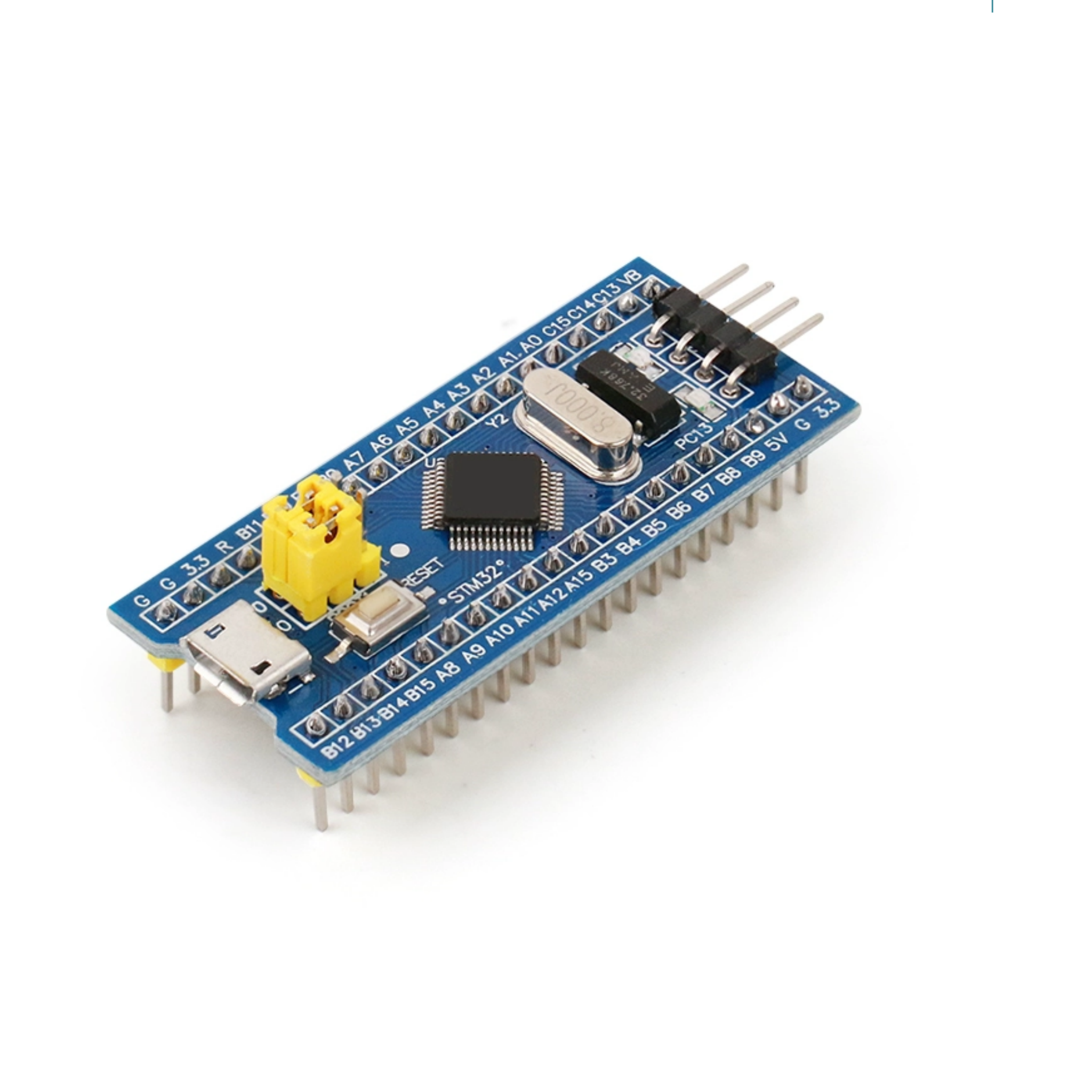
The STM32F103C8T6 Blue Pill development board is a classic choice in the field of embedded development. Boasting high cost-effectiveness and stable performance, it has become the preferred solution for entry-level learning, project prototype verification, and small-batch production products.

It is more than just an “entry-level board”: Beginners can easily implement basic projects like blinking LEDs and UART communication to quickly grasp embedded programming logic. For experienced developers, it can be used to build project prototypes such as smart cars, home automation systems, and data acquisition devices—even for direct use in small-batch production.Equipped with an SWD debugging interface and an AMS1117-3.3V voltage regulator circuit, the board offers simple wiring and fast program downloading. It is compatible with mainstream development environments like STM32CubeIDE and Arduino, and can be quickly set up with an ST-Link V2 debugger for immediate use.

Product Information

STM32F103C6T6 has half the capacity of STM32F103C8T6, while other performances are the same.

Difference STM32F103C8T6 STM32F103C6T6
FLASH 64K 32K
RAM 20K 10K
Timers 4 3 (No Timer 4)
UARTs 3 2 (No UART 3)

STM32F103C8T6 Parameter Specification

Specification Details
Product Name STM32F103C8T6
Number of Pins 48
Core Cortex-M3
Operating Frequency 72MHz
Memory Resources 64K Byte Flash, 20KByte SRAM
Interface Resources 2x SPI, 3x USART, 2x I2C, 1x CAN, 37x I/O Ports
Analog-to-Digital Conversion 2x ADC (12-bit/16-channel)
Timers 3 General-Purpose Timers, 1 Advanced Timer
Debugging and Downloading Supports Debugging and Downloading via JTAG/SWD Interfaces, Supports IAP

STM32F103C8T6 Small System Board

  1. Fully compatible with the STM32F103C8T6 chip in terms of pins. Some programs can be used without any modification!
  2. No need for jumpers. To change the startup mode, just press the BOOT0 and RST buttons. Release RST first, and then you can switch the startup mode.
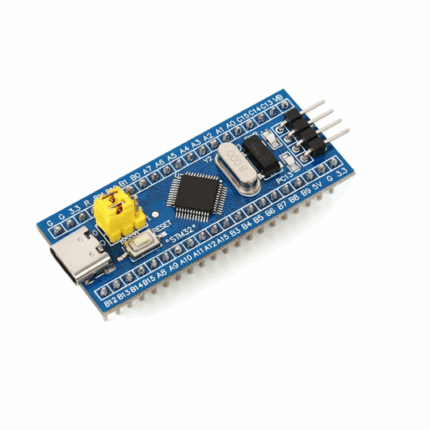
  3. Micro-USB interface with a standard USB communication circuit. Pull-up resistors have been added, making it convenient for USB communication experiments.
  4. Compatible with mainstream core boards on the market. The IO expansion pins are fully compatible with common core boards available now, allowing for one-click replacement!
  5. High-quality surface-mounted crystal oscillators are used. Both 8MHz and 32.768KHz crystal oscillators are of high quality, ensuring the stable operation of the core board.
  6. Standard SWD debugging interface. A 4-wire SWD interface is adopted, making it convenient for debugging and program downloading.

Hardware Resources:

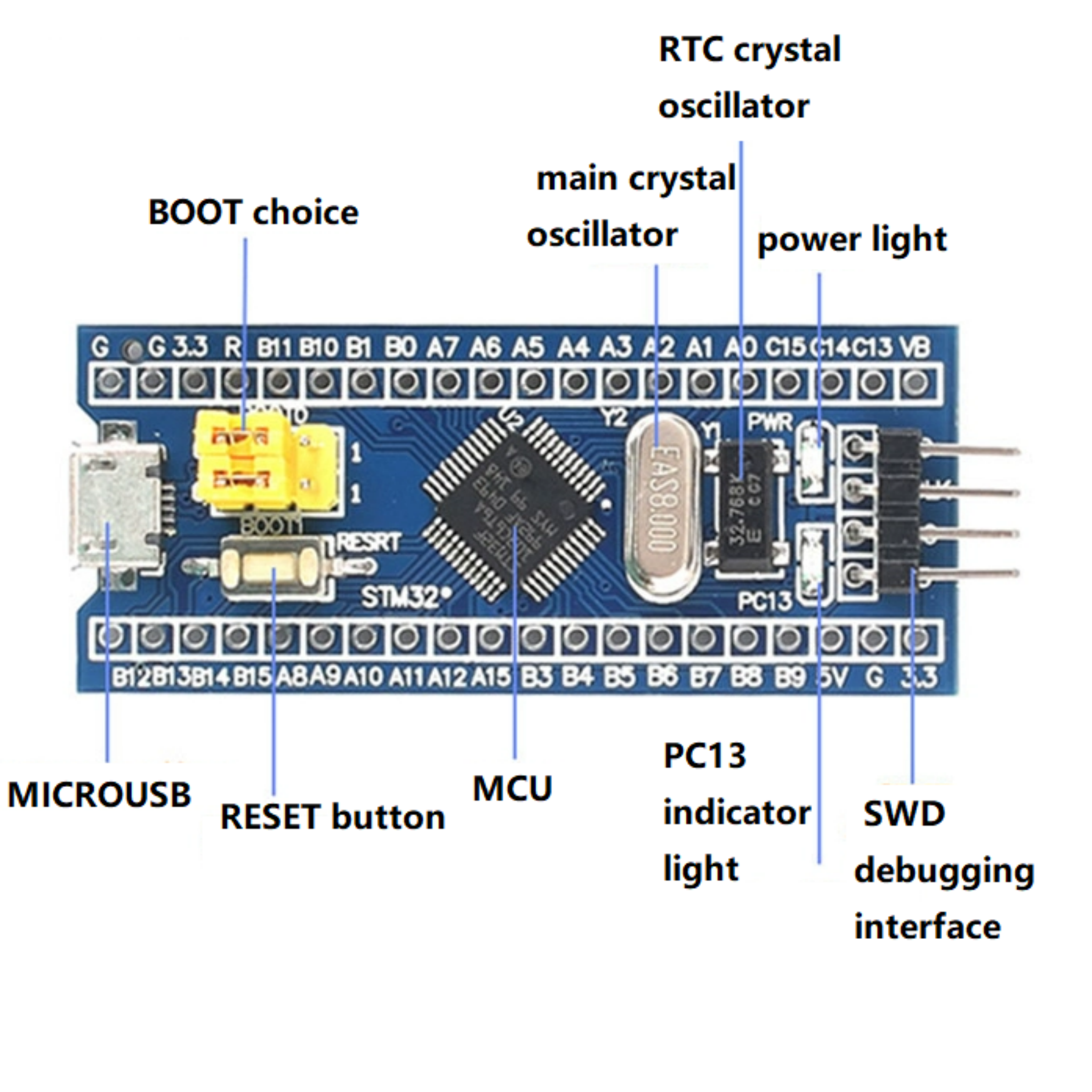
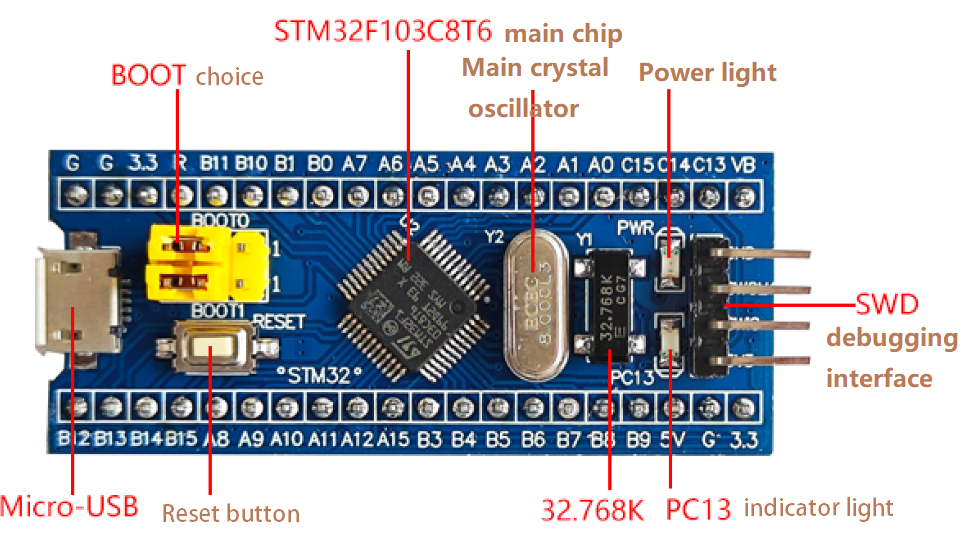
  1. One STM32F103C8 main chip
  2. An 8M surface-mounted crystal oscillator (capable of reaching up to 72M via the internal PLL of the chip) – ST official standard parameter
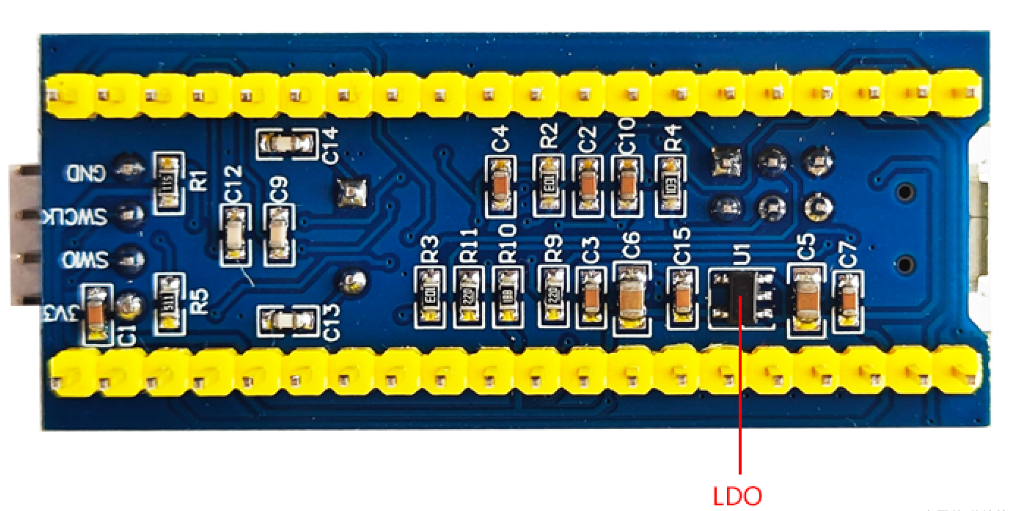
  3. A 3.3V voltage regulator chip, providing a maximum current of 800mA
  4. One MICRO interface, which can power the system and reserves USB communication function
  5. A reset button
  6. One standard SWD port, supporting JLink, STLink, and JLINK OB
  7. A BOOT selection port
  8. Two 20-pin IO expansion headers
  9. One power indicator light
  10. One function indicator light, used to verify the basic functions of IO ports
  11. A reserved UART interface, convenient for connecting with 5V development boards and enabling program downloading via UART
  12. A high-performance EPSON 32768Hz crystal oscillator, which costs 10 times that of through-hole crystal oscillators and is easy to start oscillating
  13. 20K RAM, 64K ROM, TQFP48 package

STM32F103C8T6 Datasheet

If you want to learn more STM32F103C8T6 details, you can refer to this:https://easyelecmodule.com/wp-content/uploads/stm32f103c8-datasheet-1.pdf

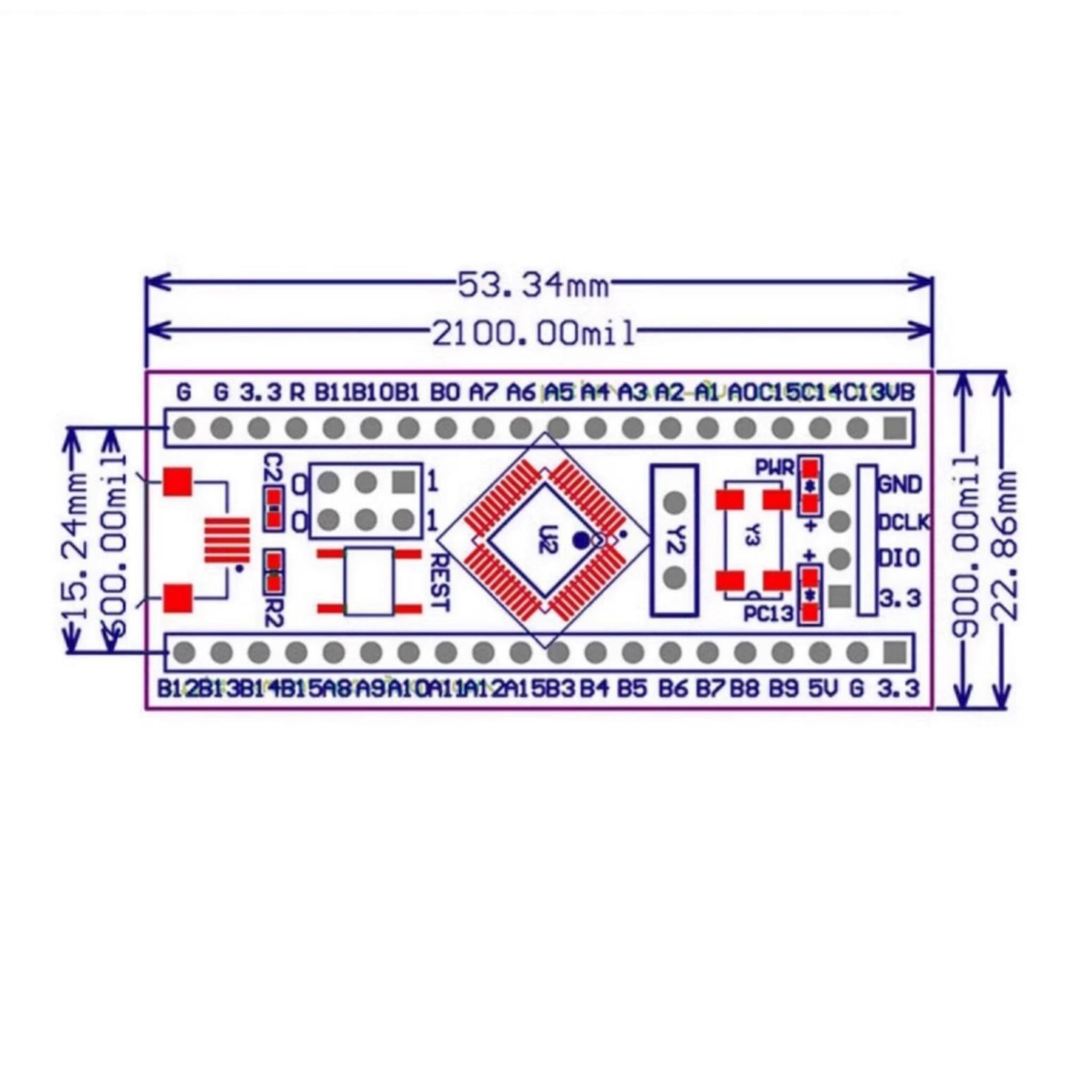
Hardware Diagram

STM32F103C8T6 B;UE PILL

Simulation Debugging

To program the STM32F103C8T6 and C6T6 minimum system boards, you need to pair them with a CMSIS-DAP emulator or a USB-TTL module. Make sure to get one if you don’t have it, to avoid unnecessary troubles!
 
When you plug the USB port directly into a computer, it may prompt “no device” or “unrecognized device, not working properly”. This is because the microcontroller needs USB protocol development to be recognized.
 
  • A USB-TTL module only has UART programming functionality.
  • A CMSIS-DAP has both UART programming and simulation debugging functions, making it convenient for development and learning with high cost-effectiveness.

STM32F103C8T6 Pinout Definition

STM32F103C8T6 Pinout

STM32F103C8T6 Chip Information

Core

  • ARM 32-bit Cortex™-M3 CPU
  • Maximum operating frequency up to 72MHz
  • Single-cycle multiplication and hardware division

Memory

  • Flash program memory from 64K or 128K bytes
  • SRAM up to 20K bytes

Clock, Reset and Power Management

  • 2.0~3.6V supply for I/O pins
  • Power-On/ Power-Down Reset (POR/PDR), Programmable Voltage Detector (PVD)
  • 4~16MHz crystal oscillator
  • Factory-trimmed 8MHz RC oscillator
  • Factory-trimmed 40kHz RC oscillator
  • PLL for generating CPU clock
  • 32kHz RTC oscillator with calibration function

Low Power

  • Sleep, Stop and Standby modes
  • V BAT supplies RTC and backup registers

Analog-to-Digital Conversion (ADC)

  • 2×12-bit ADCs, 1μs conversion time (up to 16 channels)
  • Conversion range: 0 to 3.6V
  • Dual sampling and hold function
  • Temperature sensor

IDMA

  • 7-channel DMA controller
  • Supported peripherals: Timers, ADC, SPI, I2C and USART

Fast I/O Ports (up to 80)

  • 26/37/51/80 I/O ports, all can be mapped to 16 external interrupts
  • Almost all ports are 5V-tolerant

Timers (up to 7)

  • 3×16-bit timers, each with up to 4 channels for input capture/output compare/PWM or pulse counting, and incremental encoder input
  • 1×16-bit advanced control timer with dead-time control and emergency stop for motor control PWM
  • 2×watchdog timers (independent and window)
  • System time timer: 24-bit down-counter

Communication Interfaces (up to 9)

  • Up to 2×I2C interfaces (support SMBus/PMBus)
  • Up to 3×USART interfaces (support ISO7816, LIN, IrDA and modem control)
  • Up to 2×SPI interfaces (18Mbit/s)
  • CAN interface (2.0B active)
  • USB 2.0 full-speed interface

Debug Mode

  • Serial Wire Debug (SWD) and JTAG interfaces

CRC and Chip ID

  • CRC calculation unit, 96-bit unique chip code

Additional Notes

  1. Debug Download: Supports SWD interface debugging download and UART program download.
  2. AMS1117-3.3: 3.3V voltage regulator chip, maximum output 300mA.
Reviews (0)

Reviews

There are no reviews yet.

Be the first to review “STM32F103C8T6 Core Board Development Board Small System Board ”

Your email address will not be published. Required fields are marked *

Shipping and Delivery

Shipping Cost

We only ship to the United States. Shipping costs are calculated based on the total order amount.

Shipping Method And Delivery Time

All orders will be processed and shipped within 72 hours of placing the order (excluding weekends and holidays). They will ship from Shenzhen, China, primarily via 4PX logistics. Depending on the destination and logistics conditions, other carriers such as DHL, FedEx, UPS, USPS, etc., may also handle the delivery. Estimated shipping time is 7-12 business days, with actual delivery occurring in 10-17 business days, depending on logistics conditions.

Payment:

We accept Visa, Master card, Maestro, American Express, JCB, Dinner's Club, Discover, Paypal, Apple Pay, Google Pay .