

Blog
Basic Introduction to the PD3.1 Trigger Module

What Is the PD Protocol?
The PD protocol is a universal fast-charging and power delivery protocol defined by USB-IF.
Based on the USB Type-C interface, it communicates with power-consuming devices through the CC pins to achieve variable voltage, variable current, and bidirectional power delivery.
The PD protocol allows users to dynamically request different output voltages and power levels according to their needs, such as 5V, 9V, 12V, 15V, and 20V.
It offers high versatility and strong compatibility, while also supporting over-voltage, over-current, and over-temperature protection, ensuring high safety.
PD3.1 is an enhanced fast-charging standard based on USB PD.
It increases the supported output voltage to 28V, 36V, and 48V, and raises the maximum power from 100W to 240W.
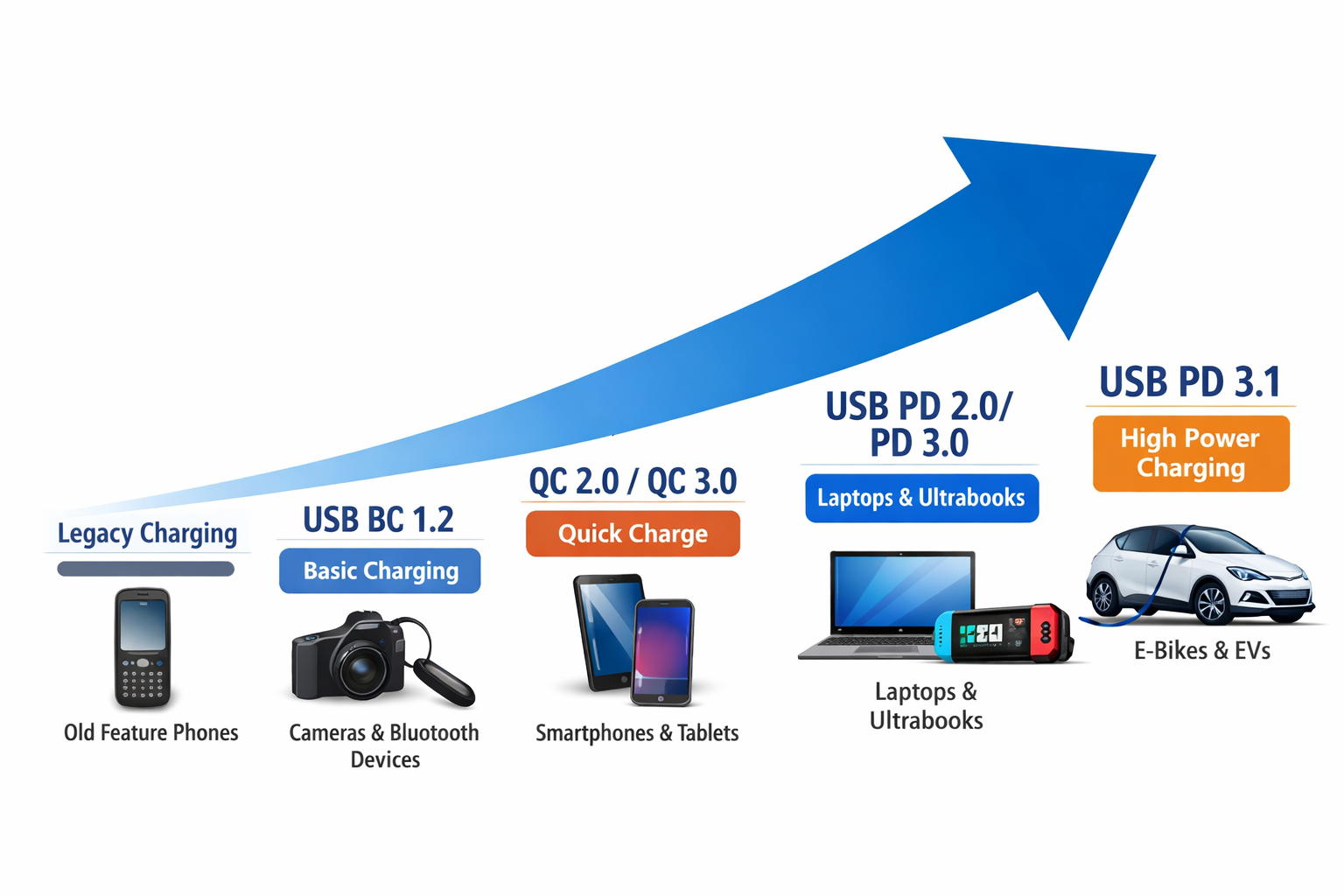
Basic Concept of the PD3.1 Trigger Module
A PD3.1 trigger module is a device that negotiates with a charger through the USB Power Delivery protocol.
It can request and output a specified voltage without the need for a main control chip, with a maximum power of up to 240W, converting a standard USB charger into an adjustable DC power supply.
Basic Working Principle of the PD3.1 Trigger Module
The PD3.1 trigger module simulates a load device and completes PD/QC protocol handshaking to perform protocol transmission and confirmation.
The protocol is mainly determined by the internal chip, and the negotiation result is indicated through LED indicators.
Functions of the PD3.1 Trigger Module
In general, a PD3.1 trigger module not only supports the PD3.1 protocol, but also provides backward compatibility.
Some PD + QC trigger modules are compatible with additional protocols, including PD3.0, PD2.0, QC3.0, QC2.0, FCP, AFC, and others.
Applications of PD Trigger Modules
PD trigger modules are widely used in PD power supply production testing, mass-production burn-in testing, and product monitoring.
They are commonly applied in batch testing scenarios to ensure proper protocol communication.
Specific Application
There are many types of PD3.1 trigger modules available on the market.
In this example, the JJD-898 model is used as a demonstration.
The JJD-898 PD3.1+QC trigger module features power-off memory, integrated manual and auto modes, and adjustable output voltage.

The video below demonstrates its application scenario.
As shown, after the PD trigger module is connected to the power supply, it automatically detects the maximum supported voltage and provides feedback through LED indicators.
JJD-898 Electrical Specifications
| Item | Description |
|---|---|
| Model | JJD-898 |
| Product Name | PD3.1 + QC Memory Adjustable Voltage Multi-Function PD Trigger |
| Supported Protocols | PD 3.1 / PD 3.0 / PD 2.0 / QC 3.0 / QC 2.0 / AFC / FCP |
| Input | USB Type-C connector |
| Output | USB-A female / DC5525 male / Terminal block / Solder pads |
| Maximum Power | 140W (Max 28V 5A) |
| Dimensions | 44.5 × 18.0 × 1.6 mm |
| PCB Material | FR4 |
| Applications | PD power supply development, production testing, mass production aging, product quality inspection |
FAQ
What is the difference between PD3 0 and PD3 1?
Below is a comparison table of common fast charging protocols.
| Protocol Name | Promoted By | Max Voltage | Max Current | Max Power | Communication Method | Typical Voltage Levels | Main Applications |
|---|---|---|---|---|---|---|---|
| USB PD 2.0 | USB-IF | 20V | 5A | 100W | CC communication | 5V / 9V / 15V / 20V | Smartphones, tablets, laptops |
| USB PD 3.0 | USB-IF | 20V | 5A | 100W | CC communication | 5V / 9V / 12V / 15V / 20V | Mainstream USB-C devices |
| USB PD 3.1 (EPR) | USB-IF | 48V | 5A | 240W | CC communication | 5V / 9V / 15V / 20V / 28V / 36V / 48V | High-power devices, industrial power supply |
| QC 2.0 | Qualcomm | 12V | 2A | 24W | D+ / D− | 5V / 9V / 12V | Early Android smartphones |
| QC 3.0 | Qualcomm | 20V | 3A | 60W | D+ / D− | 3.6V–20V continuous adjustment | Android smartphones |
| QC 4 / 4+ | Qualcomm | 20V | 5A | 100W | PD compatible | Same as PD levels | Smartphones, fast-charging adapters |
| AFC | Samsung | 12V | 2A | 24W | D+ / D− | 5V / 9V / 12V | Samsung smartphones |
| FCP / SCP | Huawei | 22V | 5A | 100W+ | Private protocol | Multiple / continuous levels | Huawei devices |
| VOOC / SuperVOOC | OPPO | 10V | 6.5A | 65W+ | Private protocol | Low voltage, high current | OPPO / realme devices |
| PE / PE+ | MediaTek | 20V | 3A | 60W | D+ / D− | Multiple levels | MTK platform smartphones |
Can a PD trigger module be used as a power supply with a USB charger?
Yes. A PD trigger module is designed to convert a USB charger into an adjustable DC power supply.
It can therefore be used as a replacement for 12V / 15V / 20V / 28V power supplies. However, no additional filtering is applied by default. If the load is sensitive to voltage noise, external filtering is recommended.