

Blog
Build a 2.4A Dual-Output Power Bank in 15 Mins
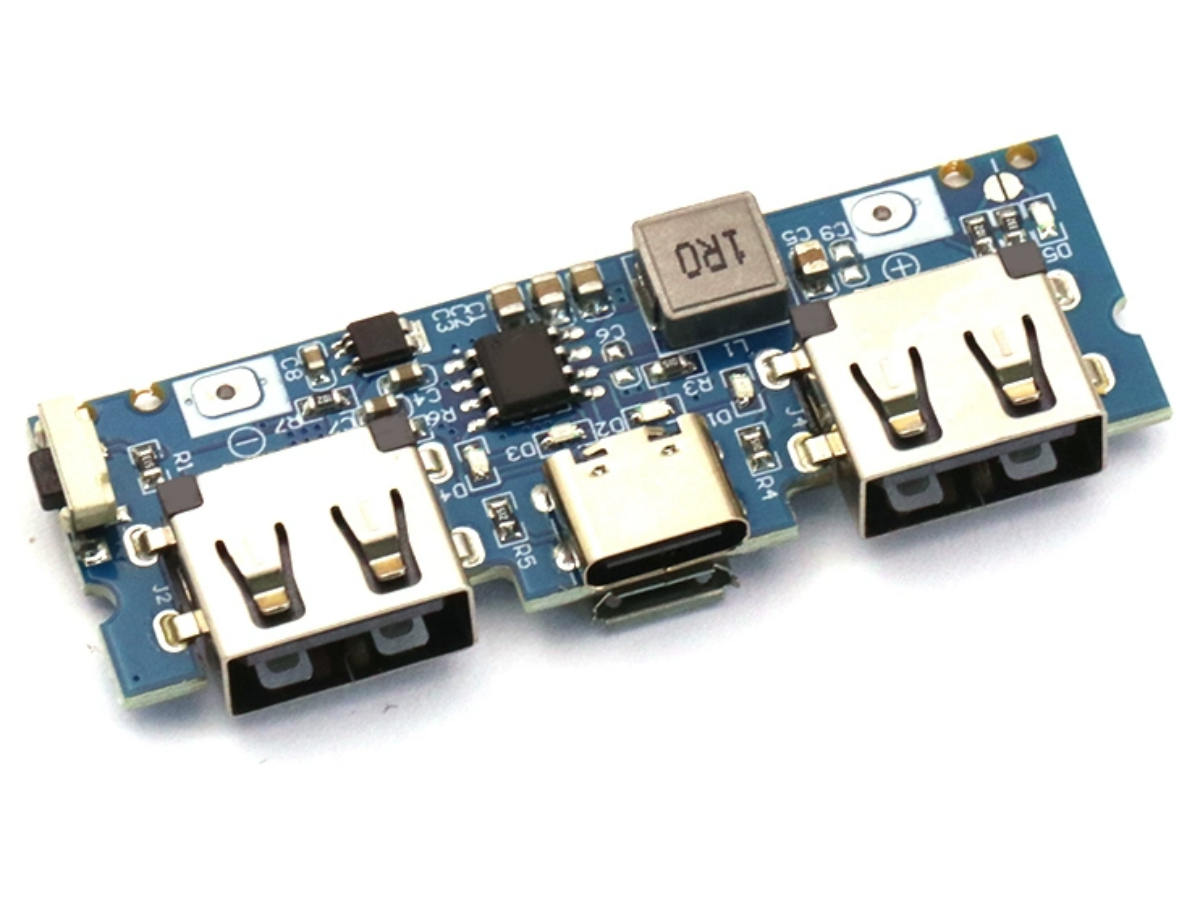
Introduction
When you run out of phone battery while being out and about, a power bank is a total “life-saver”—but the power bank you carry around every day doesn’t have to be an expensive ready-made one! Today, we’ll show you how to use the IP5407 3-in-1 mobile power module with NTC temperature detection (5V 2.4A) to create a safe, durable power bank at a low cost. It’s completely beginner-friendly, and you’ll nail it on your first try!
Why Choose the IP5407 Module for a DIY Power Bank?
There’s a huge variety of power banks on the market, ranging from tens to hundreds of dollars in price. But their core principle is actually simple: it’s just a combination of a “lithium battery + charging management + boost output”. The IP5407 module is a “no-fuss solution” that integrates complex charging, discharging, and protection circuits—you don’t need to understand complicated power bank circuit diagrams, nor do you have to design your own power bank PCB. With just one module, a lithium battery, and a case, you can assemble a professional-grade power bank.
It supports 2.4A fast charging output, NTC temperature protection, and real-time battery level display. Best of all, it’s affordable and requires only a small number of BOM components, making it perfect for “low-cost DIY”. Whether you want to save money or enjoy the fun of DIY, this module is the way to go!
What exactly is the IP5407 module?
The IP5407 is a multi-functional power management chip module that integrates charging management, boost output, and temperature protection. Simply saying, it’s the “brain and heart” of a power bank.

It delivers three core functions: first, 2.0A synchronous switch charging to safely recharge lithium batteries; second, 2.4A synchronous boosting to convert the 3.7V voltage of lithium batteries to the 5V required by mobile phones; third, built-in NTC temperature detection to prevent battery overheating and fire risks. It also supports LED battery level display, so you always know how much power is left at a glance.
As a chip specifically designed for power bank modules, it also supports simultaneous charging and discharging, and can automatically identify mobile phone charging currents (via DCP function). No additional chips are needed—your DIY power bank can have all the functions of a ready-made one, offering unbeatable value for money.
IP5407 vs. Other Modules in the Same Series: Why It’s the Top Pick for DIY
Injoinic’s IP series of power management chips includes models like the IP5303, IP5406, and IP5207. Let’s look at their key differences to see why the IP5407 is ideal for beginner DIY projects:
| Chip Model | Discharge Current | Charging Current | Core Advantages | Ideal Use Case |
|---|---|---|---|---|
| IP5303 | 1.0A | 1.2A | Pin-compatible, lowest price | Entry-level low-power power banks |
| IP5406 | 2.4A | 2.1A | Basic fast charging, no NTC | Simple builds with no temperature protection needs |
| IP5407 | 2.4A | 2.1A | With NTC temperature detection and intelligent DCP recognition | DIY projects prioritizing safety + fast charging |
| IP5207 | 1.2A | 1.2A | Supports Type-C, complex packaging | Advanced builds requiring Type-C ports |
In comparison, the IP5407 offers a 2.4A discharge current, supports power bank module fast charging, and comes with built-in NTC temperature protection—balancing safety and practicality perfectly. Plus, its ESOP8 packaging requires only a few peripheral components, making soldering easy even for beginners.
How to use the IP5407 module?
The IP5407 module works just like a ready-made power bank, and its operation is simpler than you might think:
1.Charging: Connect a 5V adapter via the Micro-B port. The module will automatically charge the lithium battery at 2.0A, with LED lights flashing to show charging progress.
2.Discharging: Connect your phone to the module via the Type-A port. The module automatically identifies the phone’s charging needs (via DCP function) and delivers up to 2.4A fast charging—no manual switching required.
3.Special Functions: Short-press the button to activate the battery level display; long-press for 2 seconds to turn on the flashlight (requires an external LED); double-click to enable output, with 60mV linear compensation to ensure stable voltage.
4.Protection Functions: If overcharging, over-discharging, short-circuiting, or overheating (detected by NTC) occurs, the module will automatically cut off power to protect the battery and connected devices.
Power Bank Parameter Specification
| Feature | Details |
|---|---|
| Input Ports | Type-C and Micro-USB |
| Output Ports | 2 high-quality USB ports (low current loss), max 2.4A |
| Battery Port | Supports 3.7V lithium batteries (4.2V when fully charged), with soldered wiring. Max battery charging current: 2.4A |
| Fast Charging Compatibility | Recognizes 1C fast charging for devices like iPhones and Samsung phones, maximizing the 2.4A current (note: 2.1A/2.4A fast charging requires compatible protocols on the phone) |
| Efficient Design | Up to 90% charge/discharge efficiency |
| Compact Size | Ultra-small and thin, measuring 55×19×8mm |
IP5407 IC Schematic Diagram
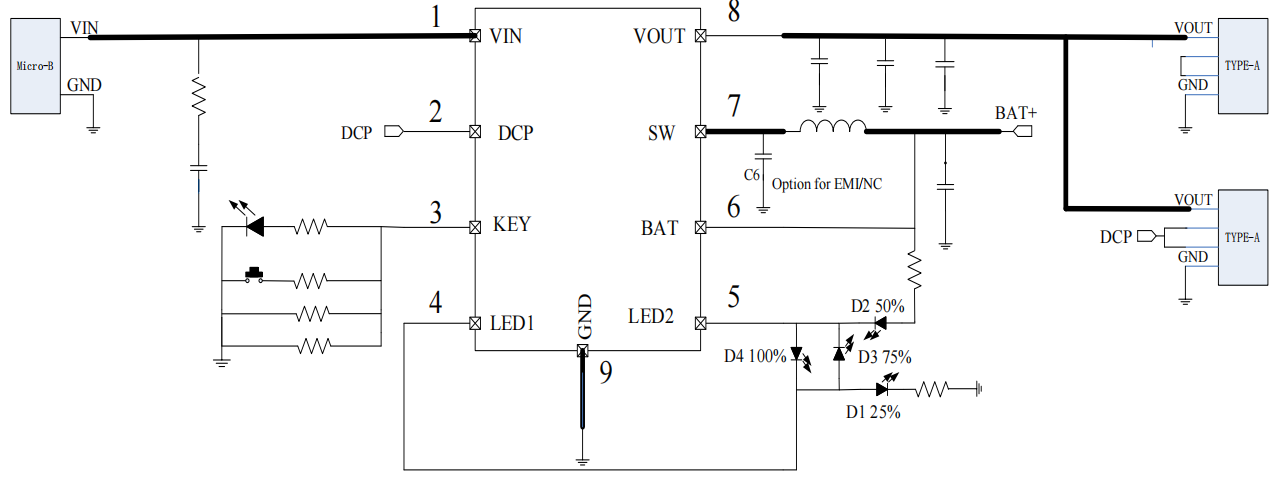

IP5407 Datasheet
If you want to learn more IP5407 power bank module details, you can refer to this datasheet.
Example: Weld-free dual-output fast-charging power bank
This IP5407 module comes with dual inputs (Type-C/Micro-USB), dual USB outputs, and 4-LED battery level display. It’s 100% solder-free—you can build a power bank that charges 2 devices at once in just 15minutes, with zero barriers for beginners!
Prepare Material
- IP5407 module with NTC temperature detection
- 18650 lithium battery
- Mini power bank case
Step-by-Step Instructions
1.Connect the Battery: Use solder-free connecting strips to connect 2 18650 batteries in parallel (positive to positive, negative to negative). Be careful not to reverse the polarity!
2.Secure the Module: Snap the module into the designated slot in the power bank case, using the case’s built-in clips to hold it in place.
3.Connect Battery to Module: Plug the positive and negative terminals of the parallel-connected batteries into the module’s “battery interface” (the module is clearly labeled with positive/negative signs—no guesswork needed).
4.Test the Functions:
- Connect a Type-C charging cable: 4 LED lights will flash to indicate the battery is charging.
- Plug 2 phones into the dual USB ports: 2.4A fast charging will start automatically, and the LEDs will show the real-time battery level.
5.Close the Case & Finish: Put the case lid on—your dual-output fast-charging power bank is ready to use!
FAQS
Can beginners with no soldering experience build this?
Absolutely! Just buy a power bank module kit (solder-free version). Use terminal blocks to connect the battery and module—no soldering iron needed, just plug and play.
Why is NTC temperature detection necessary?
Lithium batteries pose overheating risks if not protected. The NTC sensor monitors the battery temperature in real time and automatically cuts off power if it exceeds 60°C—it’s a critical safety feature for power bank batteries.
Can I use a higher-capacity battery?
Yes! Any 3.7V lithium battery (like 21700, 18650) works. A higher-capacity battery means longer runtime, and the module will automatically adjust the charging current to match.