

Blog
Introduction and Application of Timer Relay
What is a time relay?
A timer relay is a relay with a built-in clock. Simply put, it is a relay module that can set time. To understand timer relays, we first need to know what a relay is.
The Composition and Principle of Time Relay
A relay is an electrical component that controls on/off through an internal magnet. It consists of two parts: the power supply part and the control part. The control part has three interfaces: common terminal, normally open terminal, and normally closed terminal. When the magnet is not energized, it connects the common terminal and the normally closed terminal. When the power supply part is turned on, a magnetic field is generated inside the relay, changing the position of the magnet to connect the common terminal and the normally open terminal. Therefore, as long as it is energized, the connection position can be controlled, realizing the function of controlling the load switch with power supply.
A timer relay is based on a relay with the addition of a main control chip. It calculates and distinguishes time through the main control IC (some through an external clock circuit), and sets the current time and trigger time through the main control IC combined with keys or other components.
What does the timer relay module do?
Timer relays have a wide range of uses and play an irreplaceable role in industry, agriculture, home furnishings, and various systems that require time control. For example, in home automation, you can set timed on/off for lights and water heaters to improve user experience. In industrial automation, some equipment can be set to start or stop regularly to ensure automatic operation, avoid manual intervention, and some equipment needs to be turned on/off regularly to work at the optimal temperature and improve efficiency. Another example is that street lights can be automatically turned on at night through timer relays. In short, timer relays have numerous applications and can be used in any scenario that requires time control.
Specific examples of timer relay
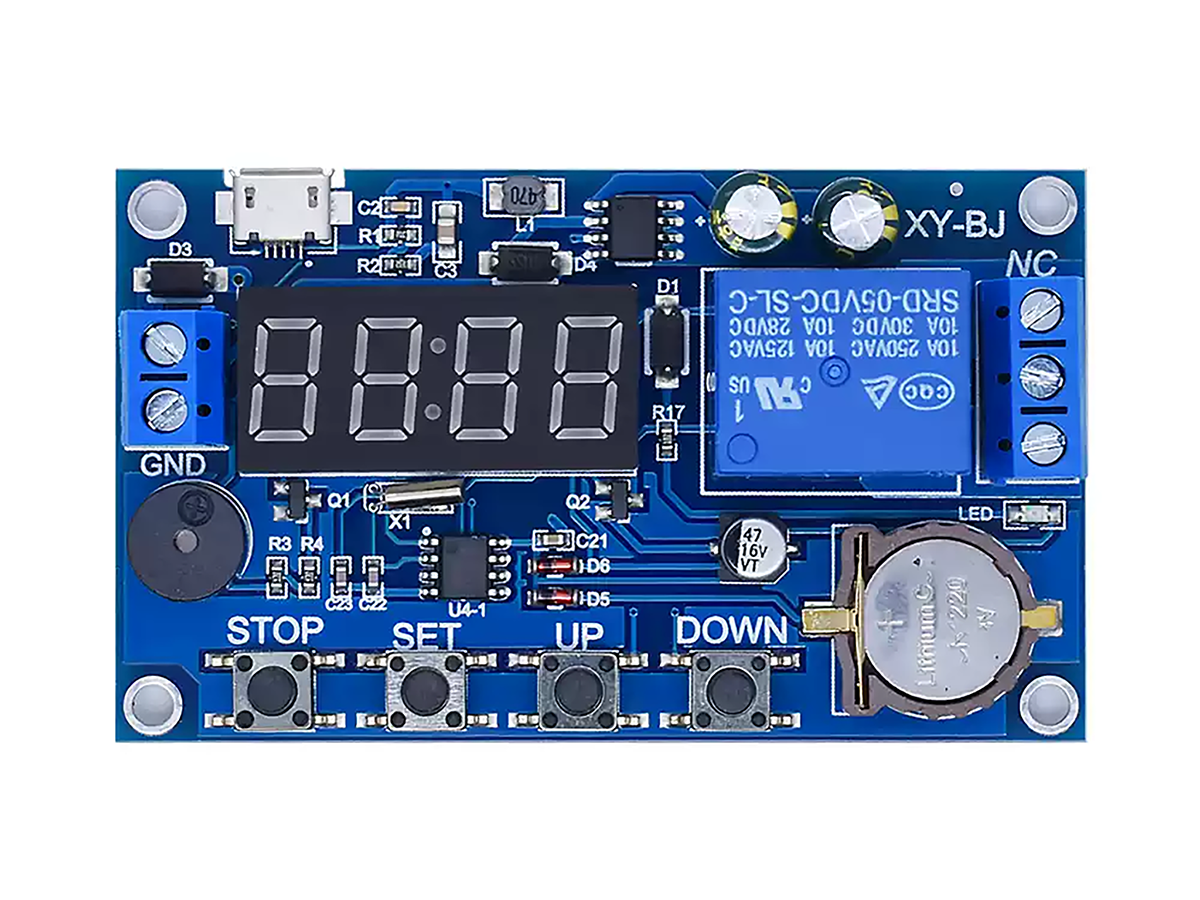
Taking this timing relay as an example, it allows date setting and features multiple control modes. Similarly, it consists of four main components: the main control IC, clock circuit, peripheral circuit, and relay. Settings can be modified via the buttons. The clock keeps time at all times with a button battery, ensuring that the clock circuit is not affected by external power supply interference.

Common Application Demonstration
Taking this module as an example, make a DIY street lamp by yourself.
As we all know, street lamps are turned on at night and off during the day, which is generally controlled by a timing relay. This simulation uses a timing relay module, a 12V power supply, a 5V power supply, and a 12V light bulb to make a small DIY street lamp. The specific demonstration is as follows:
Supplementary Notes
Generally speaking, a timing relay can be connected to either DC or AC power supply, and the typical wiring method is shown in the figure below.

The wiring methods of different timing relays may vary slightly, which need to be modified and adjusted according to the specification sheet; otherwise, the circuit may be damaged.
FAQ
What do you need to know about relay timer module?
The first thing you need to know about a timing relay is its electrical parameters, especially its maximum input voltage. Connecting a power supply with incorrect voltage may cause the timing relay to burn out immediately. Next are its dimensions and heat generation. Generally speaking, if you use it under high power conditions, additional heat dissipation measures are required.
How to tell if a time delay relay is bad?
The simplest method is to adjust the time manually. If the relay fails to trigger when the set time is reached, there must be a fault. For a detailed troubleshooting, you can check the external timing unit and the relay module. A multimeter can be used to measure whether the output terminal is conducting correctly. If the conduction is abnormal, the fault lies in the relay; if it is normal, the problem is with the main control IC or the peripheral circuit.
What are the most common signs and symptoms of a bad relay?
The most common failure of a relay is its inability to switch between normally closed and normally open states, which is generally caused by damage to the peripheral circuit. If you hear no click sound when the relay is energized, it indicates a fault with the internal electromagnet of the relay or the circuit itself.