battery-management-systems-BMS-8~20S
battery-management-systems-BMS-8~20S Price range: $89.47 through $117.53
Back to products
battery-management-systems-BMS-8~22S
battery-management-systems-BMS-8~22S Price range: $63.83 through $117.51

battery-management-systems-BMS-Relay-8~20S

Price range: $81.73 through $84.18

Dimensions N/A
Brand

easyelecmodule

SKU: N/A Category: Tag:
DESCRPIPTION AND FEATURES

Volume pricing is available starting at quantity 5 pieces. Inquire for details.

1. Product Overview

The 200A/400A intelligent relay BMS equipped with a comprehensive range of functions. These functions include cell voltage detection, temperature detection, and high-voltage detection for real-time monitoring of battery status; battery balancing to ensure consistent performance across battery cells; customizable communication interfaces supporting CAN (Controller Area Network), 485, and TTL (Transistor-Transistor Logic) protocols to adapt to diverse application scenarios; GPRS and Bluetooth connectivity (with mobile APP compatibility) for remote data transmission and user interaction; sleep-wake-up control and delayed power-off features for energy conservation and operational safety; State of Charge (SOC) estimation to accurately assess remaining battery capacity; and MOSFET  control for precise regulation of battery charging, discharging, and overall operation.

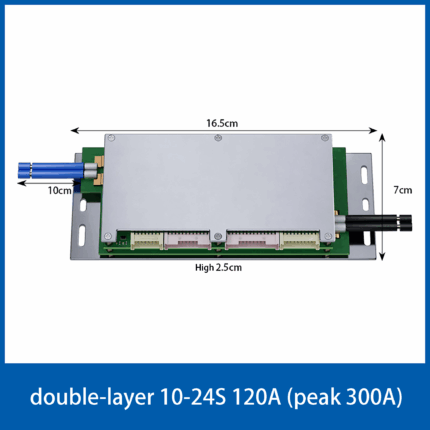
2. Product Display

Label content is subject to the physical product.

3.Core Features

Industry-leading stability and efficiency in BMS technology.
A wide range of models suitable for various scenarios.
Remote technical support available.
3. 1. Hardware
High-Reliability Connectors
Efficient Balancing Control
High Sensitivity Short-Circuit Protection
High-Precision Single-Cell Voltage Detection
Balancing and Sampling Time Division
Comprehensive Support for Preventing Overcharging
Compatible with WiFi and 4G Modules for Remote Communication
3. 2. Software
Customization Support for Special Requirements – DO and DI Customization
Customization Support for Mobile Apps and Mini Programs
Customization of 485, CAN, and TTL Communication Protocols
Supports embedding two sets of parameters with one-key user switching.
Supports idle duration delayed shutdown configuration.
Supports internal resistance compensation and inter-module jumper configuration.
3. 3. Appearance
Customized aluminum plate size.
Customized wire harness length.

4. Product Features

4.1 Serial battery cell voltage acquisition.
4.2 Serial battery cell balancing.
4.3 Current detection.
4.4 Short circuit protection.
4.5 Two-stage overcurrent protection.
4.6 Two-stage overvoltage protection.
4.7 Temperature protection.
4.8 Pre-discharge function.
4.9 Power consumption management.
4.10 Host computer monitoring (Bluetooth app, Windows host computer).

5.Block Diagram

6.System Topology

7.Key Components BOM List

Component TypeModelSupplier
Main ControlHC32L072Wuxi Huadong MCU
Acquisition ChipAN49522Zhongying Electronics
Power104R0NSSilan Microelectronics

8. Operation Modes

8. 1. Operating Mode   All BMS functions are enabled and operating normally.
8. 2. Standby Mode      At this time, all functions except GPS functionality are turned off in the MCU.
8. 3. Shutdown State    BMS shuts down, and all functions become unavailable.

9. Basic Functions

9. 1. Bluetooth Function
Allows viewing parameters via the app, setting different cell types, battery series, battery capacity, and displaying protection information, fault records, etc.
9. 2. Single-Cell Voltage Sampling
Supports real-time voltage sampling for up to 24 series individual cells, with a total voltage greater than 30V.
(Supports Li-ion 3-4 series, LiFePO4 3-4 series, Li-Titanate 3-4 series,Sodium-ion 3-4 series.)
9. 3. Temperature Sampling
Samples surface temperature of cells, ambient temperature, MOSFET temperature, and balance circuit temperature.
9. 4. SOC/SOH Calculation
Calculates remaining battery capacity and health status information, providing a more intuitive view of the battery pack’s operational status.
9. 5. MOSFET Drive
Controls power circuit by driving MOSFETs to turn on/off.
9.6 Total Voltage Detection
Can detect if pre-charging is complete and monitor the battery’s total voltage.
9.7 Current Detection
Enables real-time current detection, short circuit protection, sleep-wake functions, and more by measuring current.
9.8 Battery Balancing
Utilizes passive resistor-based energy balancing to effectively maintain the battery and improve consistency. Active balancing can be initiated once conditions are met, with a maximum current of 100mA per channel configurable.

Charging relay control,discharging relay control, pre-charging relay control, pre-charging detection, electric heating relay control.

10.1 Overcurrent Charging Protection
During charging, when the current exceeds the set maximum charging current, the corresponding charging MOSFET is turned off to achieve protection.
10.2 Overcurrent Discharge Protection
During discharge, when the current exceeds the set maximum discharge current, the corresponding discharge MOSFET is turned off to achieve protection.
10.3 Overvoltage Charging Protection
When the total voltage or single-cell voltage exceeds the set maximum value, the corresponding charging MOSFET is turned off to achieve protection.
10.4 Undervoltage Discharge Protection
When the total voltage or single-cell voltage falls below the set minimum value, the corresponding discharge MOSFET is turned off to achieve protection.
10.5 Overload Protection and Temperature Protection
When the internal temperature of the battery pack is detected to be below or above the set temperature range, the corresponding charging and discharge MOSFETs are turned off to interrupt charging and discharging processes to achieve protection.

11.1 CAN Communication
JN1939 protocol, CAN2.0A/B communication, used for communication with external devices such as vehicle controllers, motor controllers, instruments, and chargers.
11.2 RS485 Communication
Supports RS485 communication with 2500V isolation. Standard baud rate is 19200, and it supports customizing the baud rate. The protocol can be customized by the customer.
11.3 TTL Communication
Supports TTL communication with 2500V isolation. Standard baud rate is 19200, and the protocol can be customized by the customer. External power supply is required, and it provides isolation power supply. (485/TTL can only be chosen one; CAN and 485 share the same isolation power supply)
11.4 GPS port
Can be used with our company’s GPS module or third-party GPS modules that support our company’s protocol. Customized GPS interface to adapt to our company’s GPS module for remote monitoring, real-time battery status, parameter adjustments, firmware upgrades, etc.

FunctionContentRemarks
1 Built-in BluetoothSupports Android and iOS devicesConnects via Bluetooth to view parameters and configure BMS settings
2 Detectable Cell Count20S relay batteriesConnects via Bluetooth to configure the number of cells
3 Supported Cell TypesLithium-ion, lithium iron phosphate, lithium titaniumConnects via Bluetooth to configure the number of cells
4 Power SupplyBattery pack self-powered, 20-100V DC input<Automatically enters low-power mode>
5 Single Cell Voltage Detection0-5V, error within the entire working range < 20mV, typical error < 10mVResolution: 1mV
6 Single Cell Voltage Dropout DetectionSupported 
7 Balancing FunctionMaximum 100mA passive balancingActive balancing can be achieved by setting parameters based on conditions
8 Temperature Detection-40 ~ 125 ℃BMS has built-in balancing/MOS/2 channels and supports external 2 channels
9 Total Voltage DetectionDetection range 0-100V, <0.5% FSR (FSR = Full Scale Range) 
10 Current Detection-150A ~ 300A,<0.5% FSR 
11 SOC Estimation AccuracyError < 8% (operational conditions)Bluetooth connectivity for setting cell type (adaptive change in single-cell protection voltage)
12 Total Cycle AHAccumulated value, half of the charging and discharging values 
13 Short Circuit ProtectionSupported (adjustable)Can be configured
14 Fault RecordsSupported (400 cycle records)View system logs via Bluetooth, supports platform upload
15 Operating Power Consumption< 5mA(no communication)<15mA(485/CAN)
16  Standby power consumption< 2mAAutomatically wakes up upon charge/discharge detection
17 Operating Temperature-40 ~ 85 ℃ 
18 Operating Humidity5% ~ 95% 
19 Protection LevelIP30 
20 Weight< 400g 
21 CAN Interface1 channel, supports host computer managementSelectable between 485 and CAN
22 485 Interface1 channel, supports host computer managementSelectable between 485 and CAN
23 TTL Interface1 channel, supports host computer managementSelectable between 485 and TTL
24 GPS Interface1 channel, GPS and Bluetooth can be compatible simultaneously 
26 Accessory Package70CM balancing wires, two temperature control wires, 1 set of power switch wires (weight: 89g)

13.Interface Pin

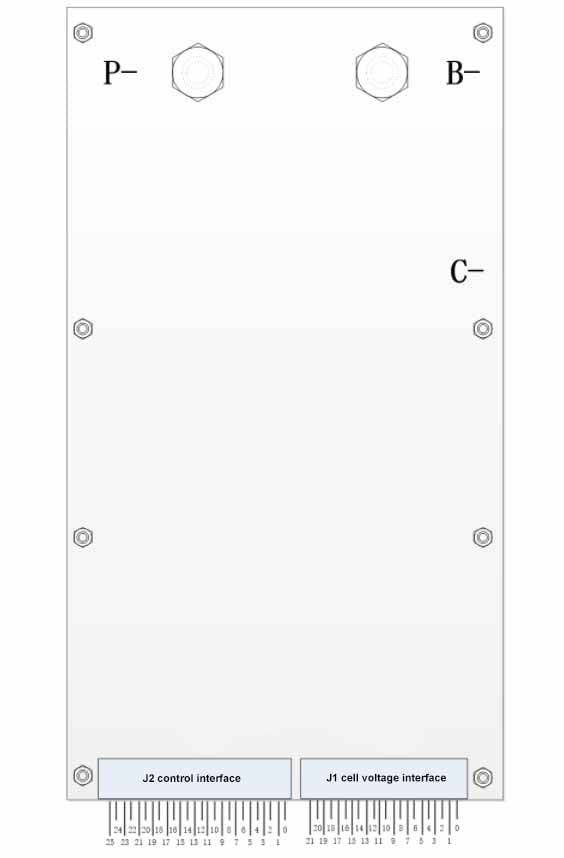
13.1 Battery negative pole

The connection label is B-, you need to first securely connect the battery’s negative terminal to the terminal, and then proceed with other operations.

The wiring label is C-, black wire. Same port MOS design, total charging and discharging negative is a single port.

 power output negative, connect relay.

Note: The relay control interface is passive and requires power for the relay to be connected from the ACC port or CH12 port.

13. Interface Definitions

13.1 Battery negative pole

The wiring mark is B-. You need to reconnect the battery to the terminal before performing other operations.

The connection is labeled C-, black. The same-port MOS design uses one port for both charging and discharging.

Power output negative, connected to relay.

Model: HY-11pin
Interface Name: Balancing Wire Interface

Pin

Label

Definition (English)

/

B-

Connect to the total negative pole of the battery pack

/

C-

Connect to the negative pole of the charger and load

1

B-

Battery Negative Sampling Wire (Connect Section 1 Battery Negative Terminal)

2

B1+

1st String Battery Sampling Wire (Connect Section 1 Battery Voltage)

3

B2+

2nd String Battery Sampling Wire (Connect Section 2 Battery Voltage)

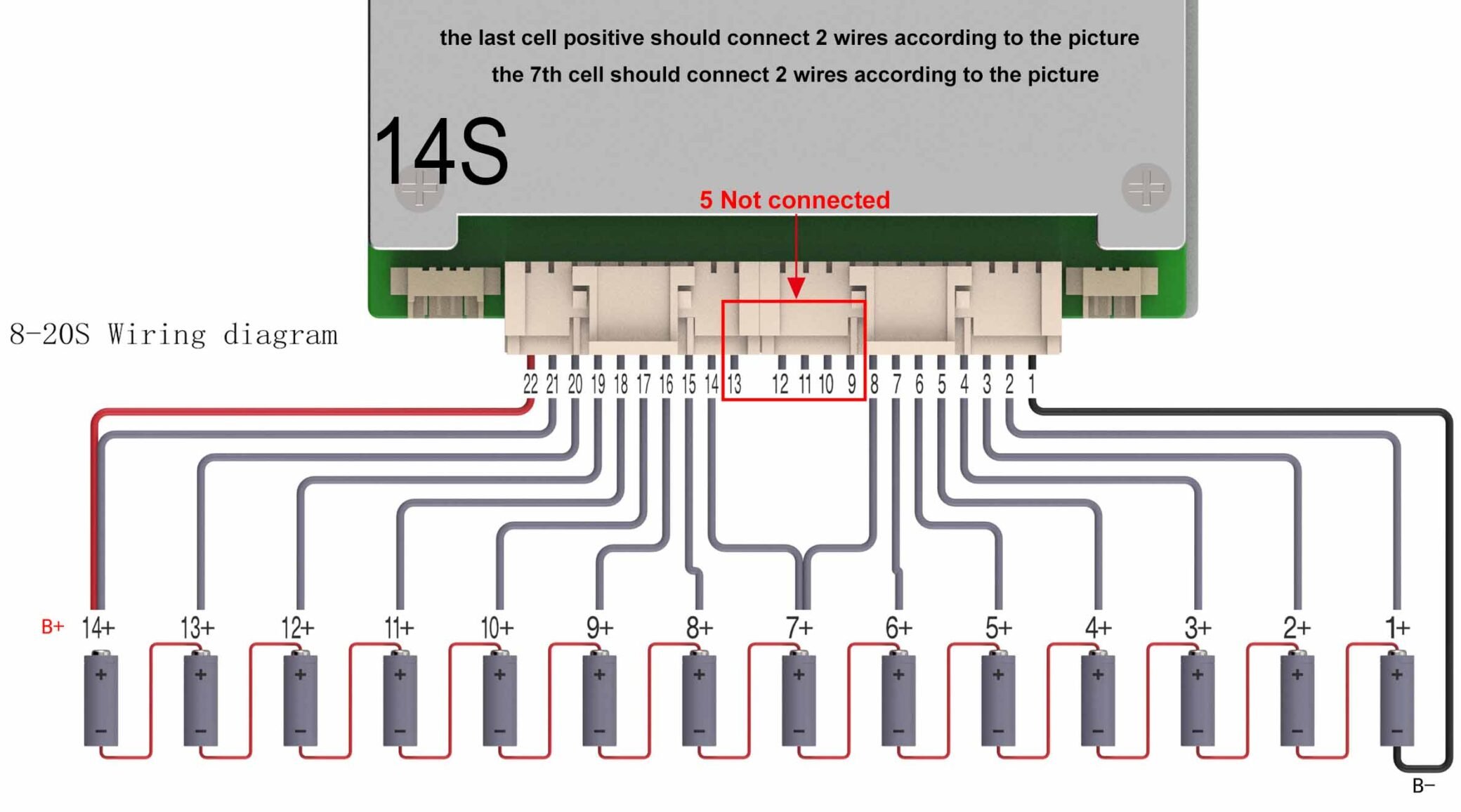
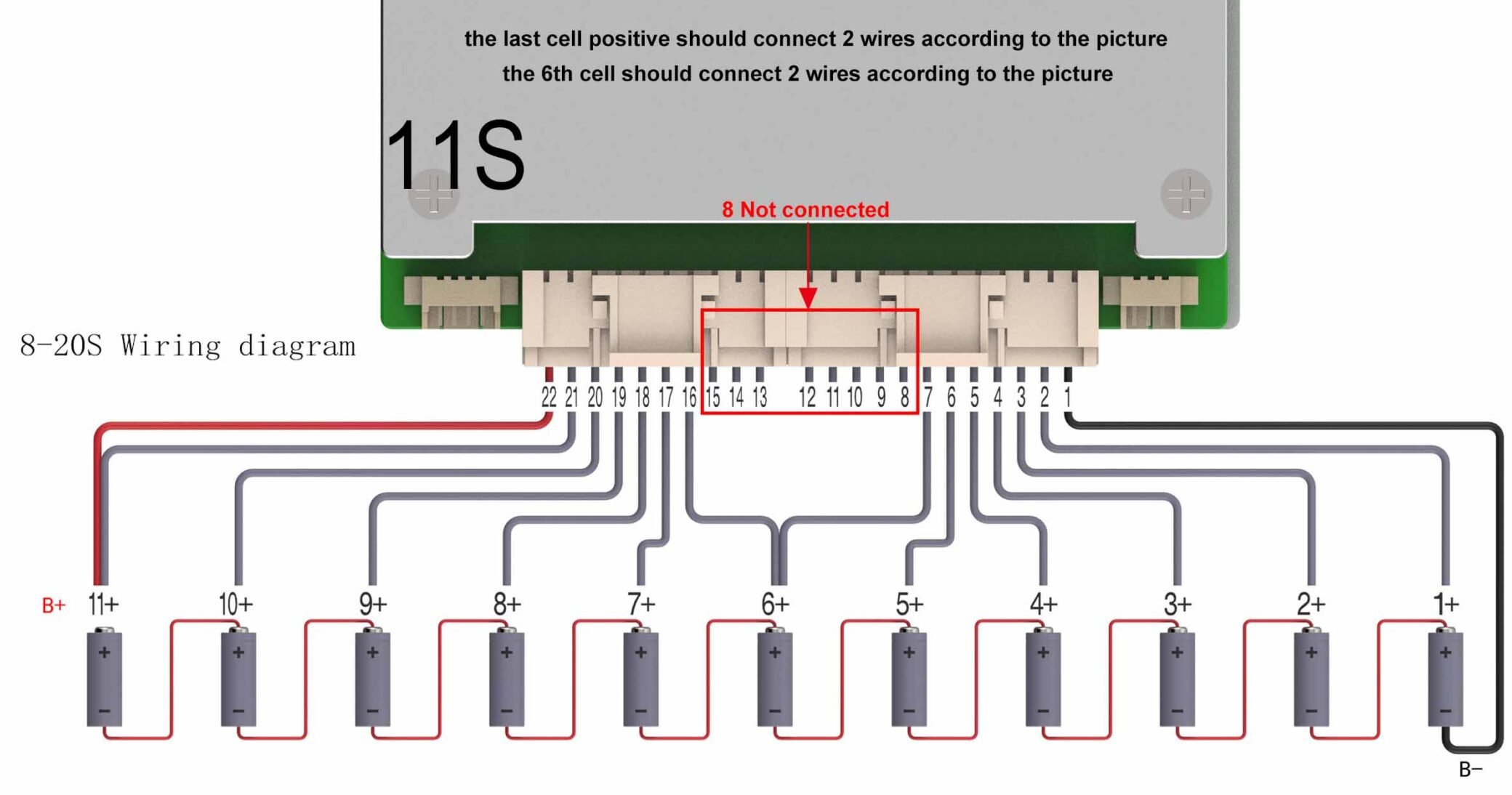
… (And so on, corresponding to the 3rd to 19th string battery sampling)

21

B20+

Connect to the positive pole of the last string battery

22

B+

Also connect to the positive pole of the last string battery (for BMS power supply; BMS = Battery Management System)

Model: HY-13pin
Interface Name: Control Interface

Pin

Label

Definition (English)

1

G

Temperature Sensing 1

2

T1

Temperature Sensing 1

3

G

Temperature Sensing 2

4

T2

Temperature Sensing 2

5

485-

485 Communication Power Supply Negative (485 = Serial Communication Standard)

6

485+

485 Communication Power Supply Positive (485 = Serial Communication Standard)

7

485B

485B (485 Communication Negative Wire)

8

485A

485A (485 Communication Positive Wire)

9

HV1

High Voltage Detection 1

10

HV2

High Voltage Detection 2

11

CANL

CANL (Controller Area Network Low Voltage Wire; CAN = Vehicle-mounted Communication Standard)

12

CANH

CANH (Controller Area Network High Voltage Wire; CAN = Vehicle-mounted Communication Standard)

13

ACC-

Activation Signal Negative

14

ACC+

Activation Signal Positive

15

CH12-

Charger 12V Activation Negative

16

CH12+

Charger 12V Activation Positive

17

REL-

Discharge Relay Negative

18

REL+

Discharge Relay Positive

19

PRE-

Pre-charge Relay Negative

20

PRE+

Pre-charge Relay Positive

21

FAN-

Fan Relay Negative

22

FAN+

Fan Relay Positive

23

CH-

Charging Relay Negative

24

CH+

Charging Relay Positive

25

HEA-

Heating Relay Negative

26

HEA+

Heating Relay Positive

14. Wiring Diagram

Typical wiring diagram

Low-cost wiring diagram

Among them: 1 Relay, needs to be purchased by the customer based on actual application; common brands: Tyco, BYD, Kunshan Guoli, etc.

2 DC/DC buck module, 72V to 12V, output current needs to be above 2A, needs to be purchased by the customer based on actual application.

3 Pre-charge resistor, generally choose a 100W, 10 ohm resistor, needs to be purchased by the customer based on actual application.

15. Protection Board Activation

It needs to be activated first after Protection Board boot up. There are generally three methods:

Activation through charging with a charger, our protection board has a charging activation function (the charger should be without the communication and voltage detection features).

Activation by connecting a 12V charger to the control interface CH12+ and CH12-;for details, please refer to section 13. Interface Definition.

Activation using a Multimeter in the diode mode, connect the red probe to the blue power line B- of the protection board, and the black probe to the black power line C-.

16. Host Computer Interface

17. Mobile App Interface

Reviews (0)

Reviews

There are no reviews yet.

Be the first to review “battery-management-systems-BMS-Relay-8~20S”

Your email address will not be published. Required fields are marked *

Shipping and Delivery

Shipping Cost

We only ship to the United States. Shipping costs are calculated based on the total order amount.

Shipping Method And Delivery Time

All orders will be processed and shipped within 72 hours of placing the order (excluding weekends and holidays). They will ship from Shenzhen, China, primarily via 4PX logistics. Depending on the destination and logistics conditions, other carriers such as DHL, FedEx, UPS, USPS, etc., may also handle the delivery. Estimated shipping time is 7-12 business days, with actual delivery occurring in 10-17 business days, depending on logistics conditions.

Payment:

We accept Visa, Master card, Maestro, American Express, JCB, Dinner's Club, Discover, Paypal, Apple Pay, Google Pay .