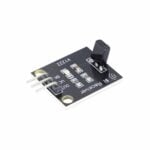
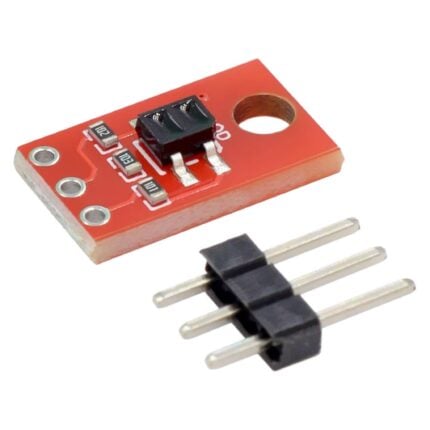
Infrared Receiver Module
$1.001 pcs
Wireless and unrestricted, interference-resistant and stable, low-cost adaptability, energy-efficient and lightweight, empowering diverse scenarios
| Dimensions | 23 × 20 mm |
|---|---|
| Brand |
easyelecmodule |
3421 in stock
Working principle of Infrared Receiver Module
The core operating principle of an infrared receiver module involves converting infrared light signals into electrical signals recognizable by circuits, followed by signal demodulation and shaping to meet the input requirements of host devices such as microcontrollers. This process can be broken down into four core steps:
Infrared Signal Reception and Photoelectric Conversion
The infrared photodiode (or phototransistor) at the module’s front end serves as the core sensing component. It is sensitive only to infrared light of a specific wavelength (typically 940nm, matching the wavelength of the infrared emitter). When the infrared emitter (e.g., a remote control) transmits modulated infrared light pulses, the photosensitive element generates a corresponding weak electrical current signal based on the intensity changes, achieving the conversion from optical signal to electrical signal.
Signal Amplification and Filtering
The photoelectric-converted electrical signal is extremely weak and contaminated by interference noise from ambient light (e.g., sunlight, artificial lighting). The internal operational amplifier amplifies this weak electrical signal through multiple stages while simultaneously filtering out interference signals at non-target wavelengths via a bandpass filter. This process retains only the valid signal matching the modulation frequency of the emitter (commonly 38kHz).
Signal Demodulation and Shaping
To resist interference, the infrared transmitter modulates control signals (e.g., remote control button codes) onto a 38kHz carrier for transmission. The demodulation circuit in the receiver module strips the 38kHz carrier to recover the original control encoding signal. Subsequently, shaping circuits (such as Schmitt triggers) convert the demodulated irregular signal into standard TTL-level signals (high level 5V/3.3V, low level 0V), eliminating signal glitches.
Output and Host Identification
The shaped TTL-level signal is output through the module’s output pin (typically labeled OUT) for direct reading by microcontrollers (e.g., Arduino, ESP32) or MCUs. The host device identifies the corresponding control commands (e.g., “Power On/Off,” “Volume Up”) by recognizing the timing patterns of high and low levels, then executes the appropriate actions.
Advantages of Capacitive Infrared Receiver Module
Capacitive infrared receiver modules (typically referring to infrared receiver modules with integrated capacitive components for optimized performance) offer core advantages over traditional infrared receiver modules in the following aspects:
Enhanced Interference Resistance
Built-in capacitive components work with filter circuits to more effectively eliminate interference from ambient light (such as sunlight or fluorescent lighting) and high-frequency electromagnetic signals, reducing signal misinterpretation. This makes them particularly suitable for complex lighting or electromagnetic environments.
Improved Signal Stability
Capacitive elements stabilize amplified electrical signals and eliminate ripple, resulting in more regular waveforms for demodulated output signals (TTL levels). This reduces signal parsing errors in host devices (e.g., microcontrollers).
Wide Voltage Input Adaptability
Certain capacitive modules support broader operating voltage ranges (e.g., 3V-5V) through capacitive energy storage and voltage regulation designs, ensuring compatibility with host systems of varying voltage specifications for enhanced versatility.
Optimized Response Speed
The charging/discharging characteristics of capacitive components facilitate rapid signal switching, shortening the response time from “signal reception” to “valid electrical signal output” and improving the real-time performance of infrared communication.
Compact Size and High Integration
Capacitive components are integrated with other circuits (amplification, demodulation) within a single package. This reduces module size, simplifies peripheral circuit design, and facilitates compact layouts in embedded devices.
Shipping Cost
We only ship to the United States. Shipping costs are calculated based on the total order amount.
Shipping Method And Delivery Time
All orders will be processed and shipped within 72 hours of placing the order (excluding weekends and holidays). They will ship from Shenzhen, China, primarily via 4PX logistics. Depending on the destination and logistics conditions, other carriers such as DHL, FedEx, UPS, USPS, etc., may also handle the delivery. Estimated shipping time is 7-12 business days, with actual delivery occurring in 10-17 business days, depending on logistics conditions.
Payment:
We accept Visa, Master card, Maestro, American Express, JCB, Dinner's Club, Discover, Paypal, Apple Pay, Google Pay .

Reviews
There are no reviews yet.