

Blog
LM4863: The “Silent” Audio Solution – Eliminate Turn-On/Off Pops for Good!
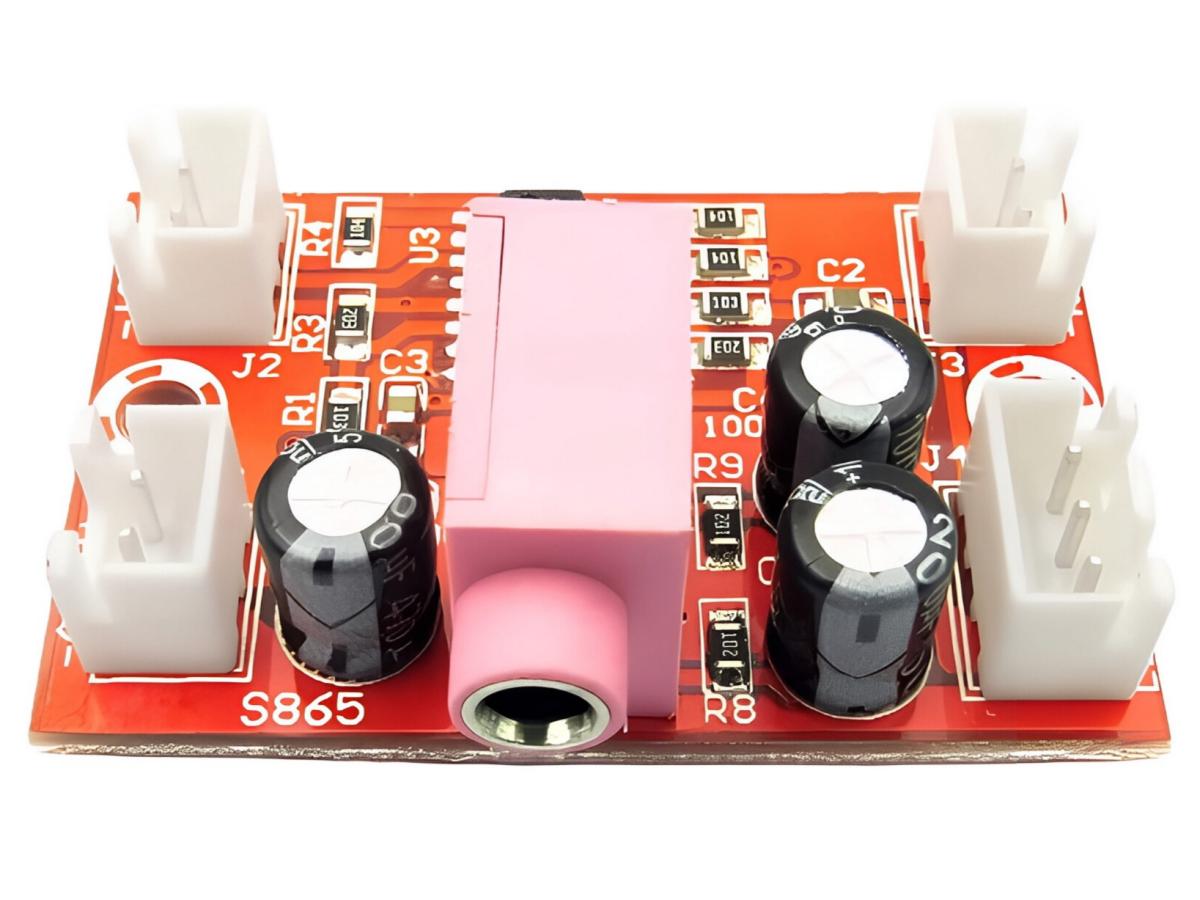
Introduction
LM4863 is an audio power amplifier IC (Integrated Circuit) designed for high-power, high-fidelity applications. It requires only a few external components and operates over an input supply voltage range of 2.0 V to 5.5 V.
LM4863 is a dual BTL (Bridge-Tied Load) audio power amplifier IC. With a 5 V supply, it delivers an average output power of 2.2 W into a 4 Ω load or 2.5 W into a 3 Ω load, with distortion not exceeding 1.0%. In addition, when operating in stereo headphone mode, the headphone input port allows the amplifier to run in SE (Single-Ended) mode.
Key Features of the LM4863
LM4863 is a dual BTL (Bridge-Tied Load) stereo audio power amplifier designed specifically for portable devices. It can drive speakers and also supports audio output in headphone mode. The following are its key features and specifications.
- Operating Supply Voltage Range: 2.5 V to 5.5 V.
- Output Power: Up to 3 W into a 4 Ω load with THD+N (Total Harmonic Distortion plus Noise) ≤ 10%.
- Headphone Mode Support: LM4863 supports SE (Single-Ended) operation, allowing it to switch easily to headphone drive mode to suit different application scenarios.
IC Positioning and Operating Modes
- Dual-channel audio power amplifier with default stereo BTL (Bridge-Tied Load) output; with a 5 V supply, it can deliver higher power into low-impedance speakers.
- Includes a headphone-mode control pin HP-IN (Headphone Input/Control): when headphones are plugged in or when HP-IN is driven high, the amplifier switches to SE (Single-Ended) output and mutes the BTL speaker outputs—ideal for “auto speaker cut-off when headphones are inserted.”
- Provides a SHUTDOWN (Shutdown) control: pulling it high enters micropower shutdown, with a typical shutdown current around 0.7 µA—well suited for battery-powered, low-power designs.
- Built-in Click/Pop (Click-and-Pop) suppression is implemented via soft-start on the BYPASS pin, allowing the internal bias to ramp up gradually and reducing power-on/power-off noise.
LM4863 Circuit Design Notes
1.Thermal Design for the Exposed DAP (Dual-in-Line Package) Pad
The exposed DAP (Dual-in-Line Package) pad of the LM4863 requires special attention to thermal design. Without proper heat dissipation, the LM4863 may enter thermal shutdown when driving a 4 Ω load. The exposed DAP pad on the bottom of the LM4863 must be soldered to a copper land on the PCB. Heat from the exposed DAP pad is spread through a copper area. If this copper area is not on the top layer of the PCB, use 8–10 thermal vias with a diameter ≤ 0.013 inch to thermally couple the exposed DAP pad to an internal copper plane.
2.Thermal Design for Driving a 4 Ω Load with LM4863
When the LM4863 drives a 4 Ω load, the required heatsink (copper heat-spreading) area should be at least 2.5 in². If the ambient temperature is higher than 25 °C, the heatsink area should be increased or a fan should be used to ensure the LM4863 junction temperature remains below the 150 °C thermal shutdown threshold.
3.Impact of Output-Pin Trace Resistance on LM4863
Because low-impedance loads are used, the trace resistance connected to the LM4863 output pins can have a significant impact on output power. The traces from the LM4863 outputs to the load (or the load connector) should be made as wide as possible. Any resistance in the output wiring will reduce the available output power.
4.Operating Principle of the BTL Configuration
The BTL (Bridge-Tied Load) configuration achieves differential drive using two amplifiers. The gain of the first amplifier is set by the external configuration network, while the second amplifier is internally fixed at unity gain and acts as an inverting stage. The two amplifiers generate signals with equal amplitude but a 180° phase difference.
5.Advantages of the LM4863 BTL Configuration
Compared with SE (Single-Ended) output, the BTL (Bridge-Tied Load) configuration offers several clear advantages. For example, BTL provides differential drive to the load, effectively doubling the output voltage swing. Under the same conditions, the output power of a BTL configuration can be up to four times that of an SE mode output.
6.Driving Different Loads with the LM4863
Driving 3 Ω and 4 Ω loads requires different thermal design and PCB layout considerations. If the ambient temperature is high, a higher-airflow fan or a larger heatsink (copper heat-spreading) area may be needed to prevent the device from entering thermal shutdown.
7.Factors Affecting LM4863 Output Power
The LM4863 output power also depends on the supply source. To avoid supply voltage droop at high output power, the power traces should be made as wide as possible.
8.LM4863 Closed-Loop Gain Adjustment
The closed-loop gain of the LM4863 can be set by adjusting the ratio between Rf and Ri. Meanwhile, the gain of the second amplifier is fixed by two 20 kΩ resistors.
Headphone Driving Capability
The LM4863 is designed with full consideration for headphone driving requirements. Below is an evaluation of its headphone driving capability from a technical perspective.
- Compatible with a wide range of headphone impedances: headphone impedance typically ranges from 16 Ω to 600 Ω. Even at lower supply voltages, LM4863 maintains stable output performance, making it suitable for most common headphone impedances.
- Low Distortion and High Fidelity: To ensure audio quality, LM4863 includes functions to reduce power-on noise and is stable at unity gain, helping maintain low nonlinear distortion under different load conditions.
- Shutdown Mode for Power Optimization: When headphone drive or other peripherals are not needed, the device can be placed into SHUTDOWN (Shutdown) mode to further reduce power consumption to a typical value of 2 µA, making it well suited for battery-powered applications.
Practical Advantages in Real-World Applications
Compared with traditional discrete-component solutions, LM4863 offers a more highly integrated and more reliable option. This is reflected in the following aspects:
- Simplified Circuit Design: Only a minimal number of external components are required to implement a complete audio power amplification function, significantly reducing PCB area and design complexity.
- Multi-Function Integration: A single IC can support both speaker output and headphone playback, reducing BOM (Bill of Materials) cost while improving system flexibility.
Typical Audio Amplifier Application Circuit
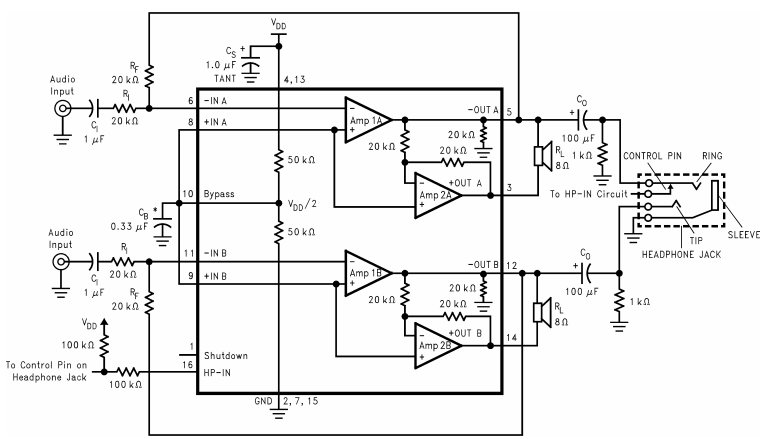
Ri: Inverting terminal input resistor, which sets the gain together with Rf; forms a high-pass filter with Ci, where fc = 1/(2πRiCi).
Ci: Input coupling capacitor for DC blocking; together with Ri it sets the low-frequency cutoff.
Rf: Feedback resistor; together with Ri it sets the gain.
Cs: Supply decoupling capacitor; place it close to the supply pin. It affects noise, PSRR (Power Supply Rejection Ratio), and stability.
CB (BYPASS): Key capacitor for mid-supply bias filtering and soft-start; it affects PSRR (Power Supply Rejection Ratio), click/pop noise, and startup time.
Application Scenario
- Portable Bluetooth Speakers and Mini Portable Audio Systems
With 5V power supply being common, the LM4863 can drive small-sized speakers louder in BTL (Bridge-Tied Load) configuration without requiring a voltage boost. This makes it suitable for applications such as battery-powered box speakers, mini desktop audio systems, and gift speakers.
2.Built-in Speakers for Monitors, Projectors, and Set-Top Boxes
These devices typically operate on 5V or 3.3V power supplies and require minimal peripheral components, low cost, and clean startup audio. The LM4863 is well-suited for driving external stereo speakers for such applications.
- Multimedia Learning Devices, Reading Pens, and Voice Broadcast Terminals
These applications require clear voice output, low background noise, and power-saving standby modes. By utilizing the SHUTDOWN function, the LM4863 enables “long standby + key-press wake-up” functionality for voice prompt devices.
- Human-Machine Prompt Tones for Industrial Control Equipment and Instruments
Examples include alarms, measuring instruments, control panels, and access control systems. These applications require reliability and stable startup. The LM4863 can drive prompt tone speakers while enabling mute/shutdown control functionality.
- Small Automotive Amplifiers and Auxiliary Tone Modules
When powered by a 5V converted automotive power supply, the LM4863 can drive small speakers for navigation prompts, reversing alarms, voice announcements, and similar functions. However, careful attention must be paid to decoupling and noise-resistant layout design.
- Toys, Electronic Gifts, and Interactive Devices
Commonly powered by 3 AA batteries or lithium cells, these applications are space-constrained and cost-sensitive. With its minimal external components, the LM4863 is well-suited for “talking/singing” interactive products.
- Headphone and External Speaker Switching for Head-Mounted Devices/Amplifiers
Utilizing the HP-IN feature, the LM4863 enables automatic external speaker cut-off when headphones are plugged in. This is suitable for products requiring both “external speaker” and “headphone” usage modes.
- Audio Expansion for Single-Board Computers/Development Boards
Examples include external speaker expansion boards for Raspberry Pi, ARM boards, and ESP32 audio projects. Using the LM4863 enables quick setup of dual-channel amplifier output, making it suitable for educational purposes and prototype validation.
Relative Information
FAQ
1.Why is a BTL configuration louder than a single-ended output?
Since BTL (Bridged) makes the “effective voltage swing across the speaker become twice that of single-ended,” with the same speaker impedance, power increases with the square of the voltage. Therefore, theoretically, the power becomes four times greater, making it sound “louder and more powerful.”
Single-Ended: The speaker is connected between the “output and ground.” The output can only swing between 0 and VDD (minus the saturation voltage drop), resulting in limited AC voltage across the speaker.
BTL (Bridge-Tied Load): The speaker is connected between “+OUT and -OUT.” Both outputs have equal amplitude but opposite phases (180° phase difference). As a result, the voltage across the speaker is the difference between the two outputs. The differential gain formula for bridge connection is: AVD = 2 × (Rf/Ri) (the differential gain in bridge mode is twice that of the single-ended stage), which is one of the circuit-level reasons why BTL sounds “louder.”
BTL speakers have almost no DC voltage difference, so there is no need for large electrolytic output coupling capacitors like those required in single-supply single-ended configurations. This also avoids the long-term presence of half-supply DC voltage across the speaker, reducing the risk of additional losses or even potential damage.
2.Can two LM4863 ICs be connected in parallel to drive higher power?
It is not recommended and generally not feasible. The reason is straightforward: The speaker output of the LM4863 is a BTL (Bridge-Tied Load) differential output (with the speaker connected between +OUT and -OUT). If the output pins of two chips are “hard-paralleled” (e.g., connecting the +OUT pins of both chips together and the -OUT pins together, or connecting the BTL outputs of both chips to the same speaker), the output voltages, phases, and biases of the two chips cannot be perfectly matched. This will cause mutual “fighting” currents (circulating currents), leading to distortion, overheating, triggering of protection mechanisms, or even device damage. The datasheet clearly states that in BTL mode, the load is “differentially driven” by two 180° out-of-phase outputs, and this configuration does not support paralleling outputs to share a load.
The correct approach for “higher power or driving more speakers” is as follows:
One LM4863 can drive two speakers (one on channel A and one on channel B). Thus, two LM4863 chips would provide four independent channels to drive four speakers. This is the most stable and widely adopted solution.