

Blog
4-Pin Photoresistor Sensor Module
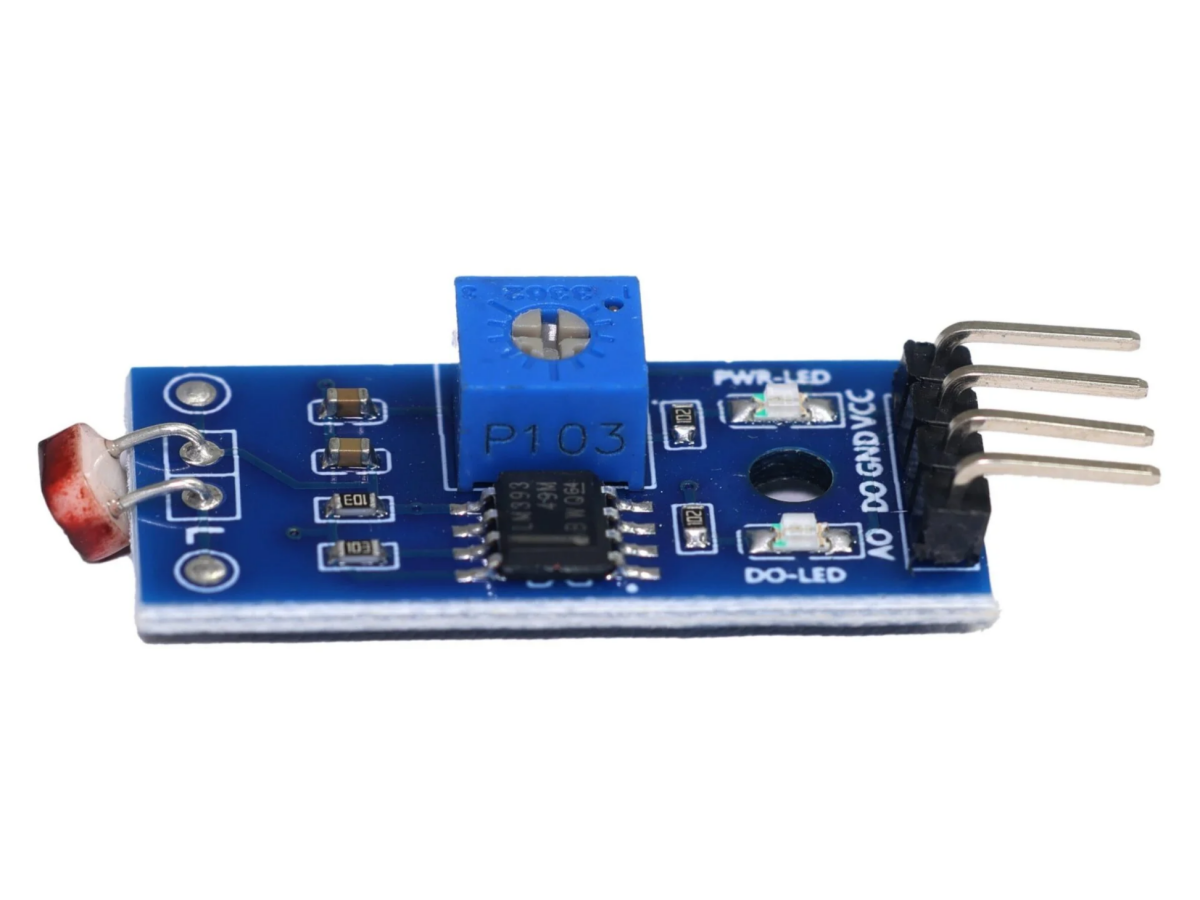
4-Pin Photoresistor Sensor Module
In DIY electronic projects, light detection is a common functional requirement. And the 4-pin photoresistor sensor module, as a cost-effective tool, is easy to operate and widely used.
Let’s talk about this compact and practical electronic component — the photoresistor sensor module.
If you are researching light detection or are working on a project that requires sensing the intensity of ambient light, then this small module is definitely worth your in-depth exploration!
What is the photoresistor sensor module?
The photoresistor sensor is a remarkable component that can change its own resistance in response to changes in light intensity. It has the advantages of small size, low cost, low power consumption and ease of use. It can be used to adjust the brightness of equipment, detect day and night, or activate light switch, etc. It is widely applied in automatic lighting systems, photocontrol switches, and various intelligent devices.
Module Composition
The 4-pin photoresistor sensor module is a small circuit module designed based on the principle of photoresistor sensors. Its core component is a photoresistor, which is a special type of semiconductor material. The module is mainly composed of a photoresistor, a potentiometer, LM393 and four connection pins.

Working Principle
The working principle of the photoresistor sensor module is based on the photoconductive effect. The resistance of the photoresistor changes with the variation of the incident light intensity.
When the light intensity increases, charge carriers are generated and participate in conduction, and then they drift in the applied electric field. At this time, electrons flow to the positive terminal of the power supply, and holes flow to the negative terminal of the power supply. The resistance of the photoresistor rapidly decreases, and it can be as low as below 1kΩ.
However, in the absence of light, it presents a high resistance state. At this time, the resistance value can generally reach 1.5MΩ.
The module can output digital signals or analog signals. It is convenient to connect and use with controllers such as microcomputers.
The characteristic curve of the photoresistor usually shows a non-linear relationship, that is, the relationship between the light intensity and the resistance value is not a simple linear proportion. In practical applications, calibration and processing need to be carried out according to specific requirements and the characteristic curve.
Module Schematic Diagram

Feature
- Use sensitive photoresistor sensor.
- Using a wide voltage LM393 comparator output, with clean signals, good waveform, strong driving ability, more than 15mA.
- Equipped with fixed bolt holes M3, small in size, convenient for installation.
- Adjustable sensitivity via potentiometer.
- Comes with LED indicators for POWER and OUTPUT.
- Output mode: offers analog signal output and digital signal output, enabling flexible interfaces.
Pin Functions and Wiring Methods
Pin Functions
| PIN | FUNCTION |
|---|---|
| VCC | Supply power to the module |
| GND | Ground |
| DO | Digital signal output: If the signal exceeds the light threshold, output 1 (high level); otherwise, output 0. |
| A0 | Analog signal output |
Wiring Methods

Parameters
| Working Voltage | 3.3V to 5V |
| Output Current | >15mA |
| Power Consumption | 100mW |
| Working Temperature | -30°C to +70°C |
| Size Dimension | 32mm*14mm*8mm |
Photoresistor Sensor 3-pin VS 4-pin
There are two main types of photoresistor sensor commonly available on the market: 3-pin interface and 4-pin interface.
Among them, the 3-pin interface module includes VCC, GND and SIG (signal output), which is suitable for most basic projects.
The 4-pin interface module compatible with UNO R3 has added additional functional pins, such as AO (analog output), enabling it to better integrate into complex circuit designs.
For beginners, the 3-pin module is sufficient to meet the basic light detection requirements. For advanced users who need more flexibility and expandability, the 4-pin module compatible with UNO R3 undoubtedly offers more possibilities.
Photoresistor VS Photodiode
| Model | Photresistor | Photodiode |
|---|---|---|
| Response Speed | Millisecond level | It can achieve microsecond level. |
| Spectral Response | Sensitive wavelengths are usually in the visible light range (400 – 700 nm). | The sensitive wavelength range can be extended to the near-infrared range (1100 nm). |
| Application Scenarios | It is suitable for applications with low requirements for dynamic response, such as low-cost photoelectric switch and illuminance meter, etc. Its large resistance change characteristic is convenient for circuit design. | It is mainly used in scenarios that require rapid response and wide dynamic range, such as optical fiber communication and spectral analysis, etc. When combined with operational amplifiers, it can achieve precise light intensity measurement. |
4-Pin Photoresistor Sensor Module with Arduino
This sensor can works with analog and digital mode. You can connect the analog output (AO) pin to Arduino to read the intensity of light, or digital output (DO) to sense the threshold light intensity. Adjust the potentiometer to set the digital output sensitivity.
The following example uses the digital output mode.
Physical Wiring Diagram
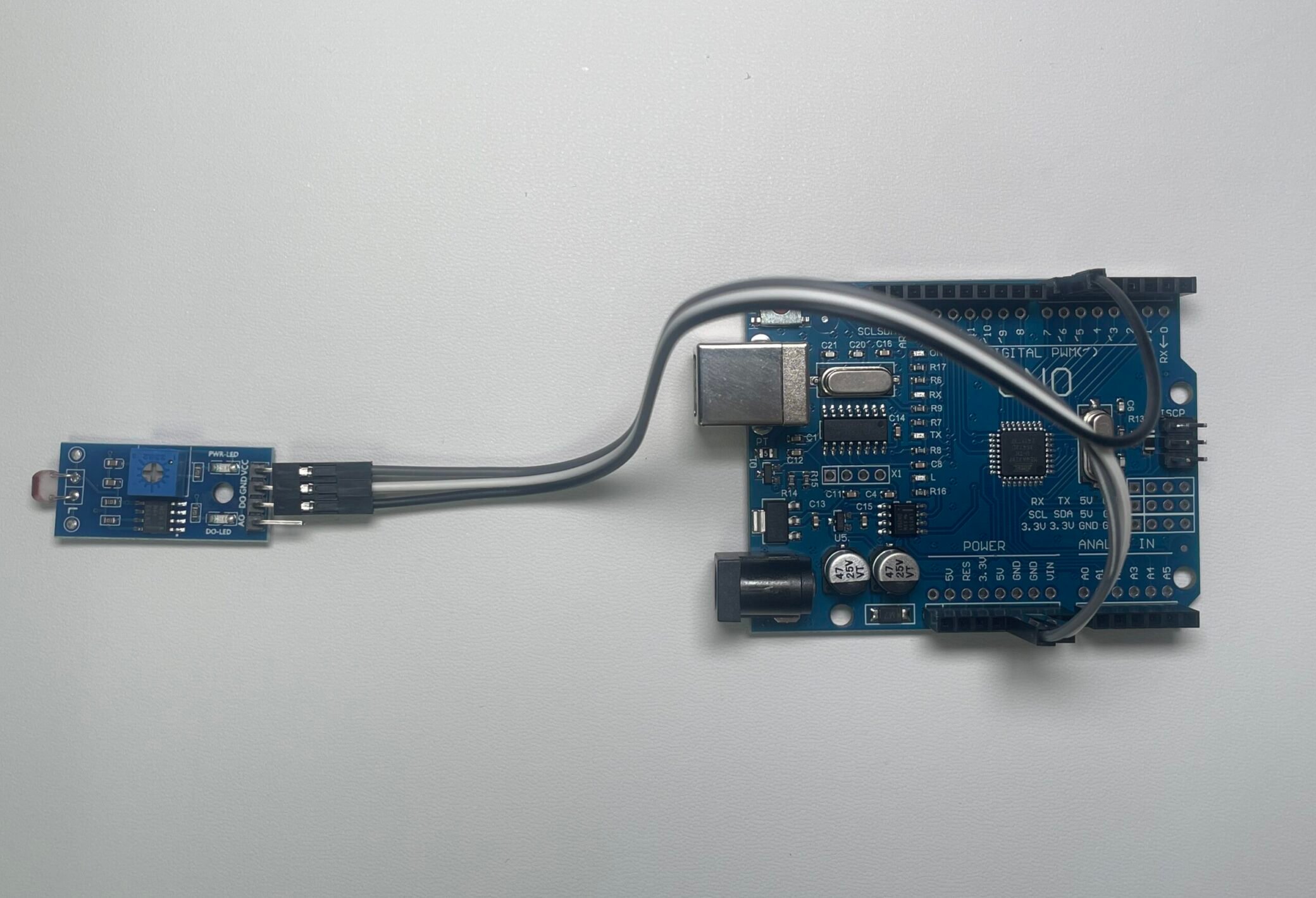
Connect the VCC to the 5V pin of the Arduino. Connect GND to the GND pin of the Arduino. The DO pin can be selected from one of the IO pins of the microcontroller. Here, Pin 7 is chosen.
Sample Code
					/*
  This code reads the digital value from a photoresistor sensor connected to
  pin 7 and prints it to the serial monitor every 50 milliseconds.
  When the light intensity exceeds the threshold, a low level is output;
  conversely, when the light intensity is below the threshold, a high level is output.

  Board: Arduino Uno R4 (or R3)
  Component: Photoresistance Sensor Module
*/

// Define the pin numbers for the photoresistance sensor module
const int sensorPin = 7;

void setup() {
  pinMode(sensorPin, INPUT);  // Set sensorPin as input
  Serial.begin(9600);         // Start serial communication at 9600 baud rate
}

void loop() {
  Serial.println(digitalRead(sensorPin));  // Read the digital value from the sensor and print it to the serial monitor
  delay(50);
}
Video tutorial
Usage Instructions
- The photoresistor module is the most sensitive to environmental light. It is generally used to detect the brightness of the surrounding environment and trigger the microcontroller or relay module, etc.
- When the environmental light brightness does not reach the set threshold, the DO pin outputs a high level. When the external environmental light brightness exceeds the set threshold, the DO pin outputs a low level.
- The DO outputcan be directly connected to the microcontroller. Through the microcontroller, the high and low levels can be detected, thereby detecting the change in environmental light brightness.
- The DO outputcan directly drive the relay module, thus forming a light control switch.
- The analog output AO of the module can be connected to the AD module. Through AD conversion, more accurate values of environmental light intensity can be obtained.
- It should be noted that when using this module, avoid direct exposure to strong light to prevent damage to the internal components.
Application Scenarios
Photoresistor sensors have many application scenarios. Let me give you a few examples:
- Automatic night light system: By setting an appropriate threshold, when it gets dark at night, the module will activate the relay to control the lighting to turn on, so we won’t have to turn on the lights in the dark anymore.
- Intelligent Curtain Control: By integrating servo motors or other driving devices, the degree of curtain opening and closing can be adjusted according to the position of the sun. This way, we don’t have to manually adjust the curtain’s opening and closing when we are exposed to the sunlight, making it extremely intelligent.
- Plant Growth Monitoring: For those who enjoy growing plants, it is crucial to monitor the light conditions of the plants in real time. With this module, you can accurately record the duration and intensity of sunlight each day, thereby providing better care for the plants.
Of course, the application fields of photoresistor sensors are far beyond these. You can use your imagination to come up with more interesting application scenarios.
Relative Information
The Photoresistor Sensor Module Purchase Link
FAQ
How to tell if a photoresistor is bad?
In the case of damage, if the resistance shows no significant change, a very small change, or no regularity in the resistance fluctuation, the photoresistor is considered damaged.
Where to place a photoresistor sensor?
The photoresistor sensor should be placed in a location where there are significant changes in light and the environment is relatively stable, but it should avoid direct exposure to strong light.
Do photoresistor sensors need to be cleaned?
Yes, the photoresistor sensor needs to be cleaned regularly. If it is not cleaned for a long time, dust will accumulate on its surface and optical components, resulting in a decrease in sensitivity.
Why is my photoresistor sensors not working in my outdoor light?
Because the outdoor light conditions are highly variable, the anti-interference ability of ordinary photoresistors is relatively weak, and they may be damaged after being exposed to strong light.