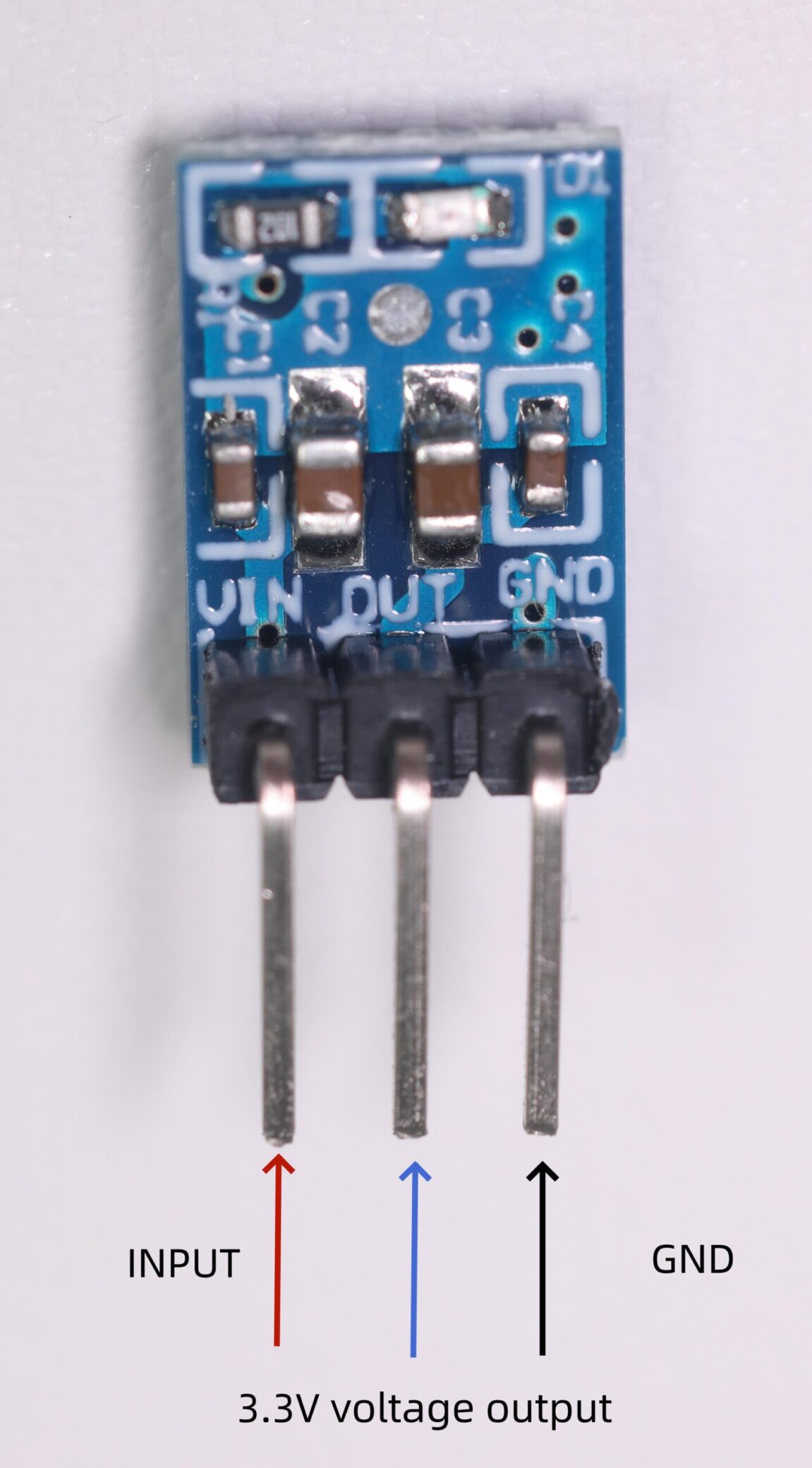
What is the AMS1117?
The AMS1117 is a voltage regulator with three ports (input, output, and ground). Its key features include a compact size, allowing it to be installed in many modules, and excellent stability—it maintains a steady output voltage even when the voltage difference between the input and output is small. Another major advantage is its adjustable voltage options: it can provide fixed voltages such as 1.5V, 1.8V, and 3.3V to meet the needs of different circuits.The
AMS1117 3.3 V power supply module is one of them.
What is the working principle of AMS1117?
The AMS1117 operates based on the physical properties of a Pmos transistor: the higher the voltage difference (Vgs) between the gate and source, the greater the on-resistance between the source and drain. When the input voltage suddenly increases, the sampling circuit connected to the gate (linked to the output/drain) adjusts this resistance, converting excess voltage into heat. This process relies entirely on material properties, resulting in minimal fluctuations in the output voltage.
What is the composition of the AMS1117?
Internally, it consists of a Pmos transistor and a sampling circuit (some models also include overcurrent and high-temperature protection). Externally, it only requires two capacitors for filtering.
What is the function of AMS1117?
It outputs a stable, fixed voltage (typically 3.3V or 5V). Some models offer adjustable voltages. Even when the external voltage fluctuates significantly, its output remains stable (with almost no ripple).
AMS1117-3.3 Module pinout
The AMS1117 module has three pins:
- INPUT: Input voltage
- 3.3V Output: Outputs 3.3V voltage
- GND: Ground
Product Parameter Sheet for AMS1117
| Specification |
Description |
| Input Voltage |
4.2V – 10V |
| Output Voltage & Current (for 3.3V adjustable version) |
3.3V, 800mA |
| Operating Temperature |
0 – 125°C |
| Adjustable Voltage Options |
1.5V, 1.8V, 2.5V, 2.85V, 3.3V, and 5V (our module uses 3.3V) |
| Product Size |
13mm x 9mm |
What are the application scenarios for the AMS1117?
Since its voltage regulation principle converts excess voltage into heat, it has limited input voltage and current ranges, making it ideal for voltage-sensitive devices like MCUs.
What is compatible with AMS1117?
Many development boards, such as Arduino, MCU, STM32, ARM7, ARM9, and MSP430, are compatible with the AMS1117.
How to test the stability of AMS1117?
We can connect the AMS1117 to an oscilloscope and determine its stability by adjusting the size of the input voltage and observing the changes in the output waveform
FAQ
What is the maximum input voltage for AMS1117?
Typically 12V. Excessively high voltage will cause overheating and damage.
How much current does the AMS1117 draw?
AMS1117 is connected in series with the circuit, and the current is consistent with the actual current consumed by the circuit.However, it will consume excess voltage. For example, if the input is 5V and the output is 3.3V, 1.7V of voltage will be consumed and converted into heat energy.
What is the acceptable voltage limit?
The minimum input voltage must not be lower than +1.5V of the output value, and the maximum must not exceed +7V of the output value. If the output is 3.3V, the minimum input requirement is 4.8V and the maximum is around 10V.