

Blog
28BYJ-48 – How This 4-Phase 5-Wire Stepper Motor Works in Real World

What is a Stepper Motor
A stepper motor is an electric motor that converts electrical pulses into angular or linear displacement. Under normal conditions, the motor’s speed and rotation distance depend solely on the frequency and number of pulse signals, unaffected by load variations. Its rotation mode can be controlled via microcontrollers, making it widely applicable in most scenarios requiring precise control.

stepper motor pdf
What is the working principle of stepper motor?
The core principle of a stepper motor is the interaction between electromagnetic induction and magnetic fields, causing the rotor to rotate step by step at specific angles. Typically, precise angular control is achieved by sequentially energizing the stator windings. In a four-phase configuration, this means the stepper motor has two coils with a total of four lead wires, designated as phases A, B, C, and D. Energizing each phase rotates the motor by a corresponding angle, determined by the motor’s step angle and driving method.
What is a stepper motor used for?
Stepper motors are widely used in applications requiring precise motion control. For example, in printers and copiers, they control the movement of print heads or scanning heads. In industrial applications, they are commonly used in lathes and engraving machines to position tools accurately. Overall, stepper motors are utilized in consumer electronics, industrial automation, medical equipment, automotive and aerospace fields, and smart home systems.
What is the difference between a stepper motor and a normal motor?
| PARAMETER | STEP MOTOR | CONVENTIONAL DC MOTOR | CONVENTIONAL AC MOTOR |
|---|---|---|---|
| Working Principle | Pulse signal control, electromagnetic step-by-step rotation | Continuous voltage drive, electromagnetic field rotation | Alternating magnetic field drives rotor |
| Control Method | Digital pulses (PUL/DIR), open-loop control | PWM speed control, typically requires closed-loop | Variable frequency control, complex regulation |
| Positioning Accuracy | High (precise step angle, e.g. 1°) | Low (requires encoder for positioning) | Low (not suitable for precise positioning) |
| Low-Speed Torque | High (ideal for start-stop applications) | Medium | Low (requires gear reduction) |
| High-Speed Performance | Poor (prone to losing steps) | Excellent | Excellent |
| Response Speed | Fast (instant start/stop) | Relatively fast | Relatively slow |
| Energy Efficiency | Low (consumes power when stationary) | Relatively high | High |
| Noise/Vibration | Noticeable (vibration at low speeds) | Moderate | Minimal |
| Control Complexity | Simple (step+direction control) | Medium (requires PID tuning) | Complex (requires VFD control) |
| System Cost | Low (motor + driver) | Medium (requires encoders) | High (VFD cost significant) |
| Typical Applications | 3D printers, CNC, precision instruments | Drones, EVs, home appliances | Industrial pumps, fans, heavy machinery |
| Maintenance Needs | Low (brushless design) | Medium (brushed types need maintenance) | Low |
| Service Life | Long | Medium (shorter for brushed types) | Longest |
What are the three types of stepper motors?
Stepper motors are divided into three main types: Permanent Magnet stepper motors (PM), Variable Reluctance stepper motors (VR), and Hybrid stepper motors (Hybrid).
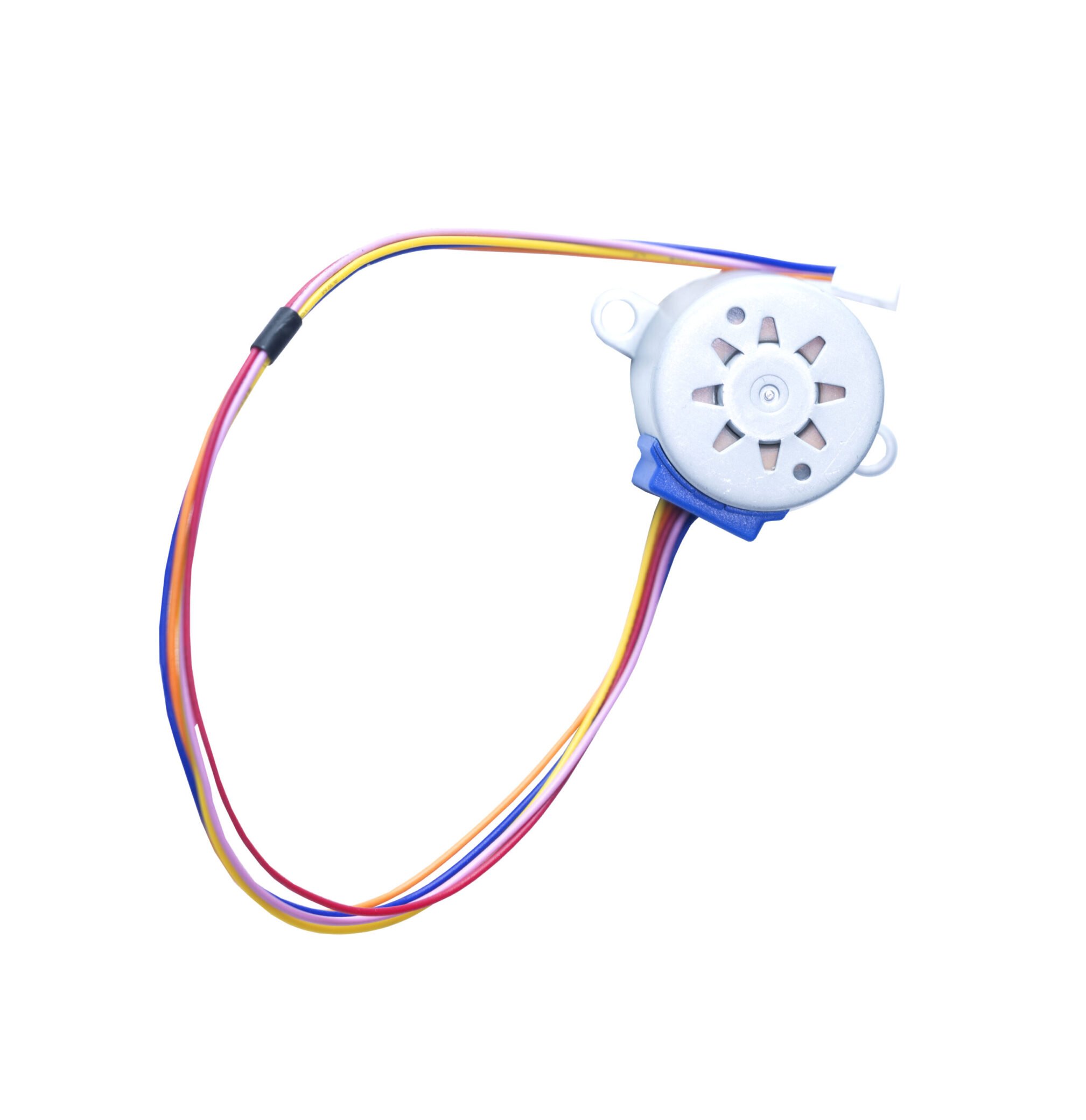


What is a 4/5 phase stepper motor?
4-phase stepper motor refers to a stepper motor that adopts 4 groups of independent coils (phases A, B, C, D), and each group of coils generates a magnetic field when energized. Similarly, a 5-phase stepper motor adopts 5 groups of independent coils (phases A, B, C, D, E). The use of multiple groups of independent coils can make the operation more stable, with a smaller step angle, smaller torque fluctuation, and better high-speed performance. Relatively, its cost is higher, the control circuit will be more complex, and there will be fewer optional models.
What is 28BYJ-48
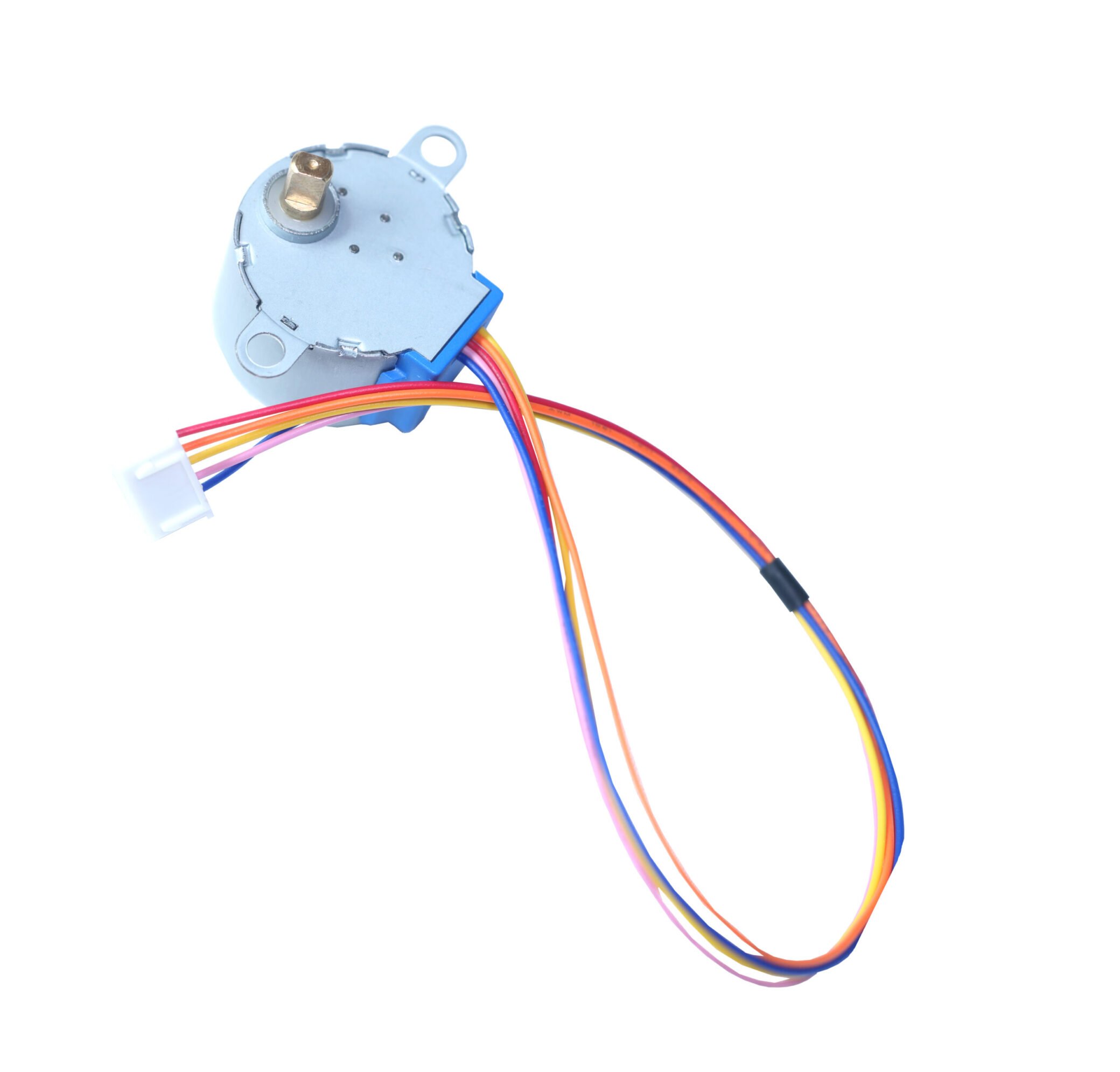
28BYJ-48 Performance Parameters
| Parameter Category | Specific Parameters | Precautions |
|---|---|---|
| Motor Type | Permanent magnet stepper motor (Unipolar 5-wire) | Bipolar modification requires cutting PCB connections and recalculating current |
| Step Angle | – Full-step: 5.625° (64 steps/rev) – Reduced step angle: ≈0.0879° (4096 steps/rev) | Actual steps affected by gear backlash; calibration needed for high-precision applications |
| Reduction Ratio | 1:64 (common) | Some models may be 1:16 – verify motor label |
| Rated Voltage | 5V DC | Overvoltage (e.g. 12V) requires current limiting to prevent coil burnout |
| Phase Current | 100-150mA/phase | Driver IC (e.g. ULN2003) must match current capability |
| Coil Resistance | ≈50Ω/phase (5-wire) | Resistance may vary slightly between batches |
| Stall Torque | 30-50 mN·m | Allow margin for loaded startups to avoid stalling |
| No-load Speed | 10-15 RPM (5V drive) | Higher voltage increases speed but reduces lifespan |
| Wire Count | 5-wire (4 phases + 1 common) | 5-wire requires common terminal (Vcc) connection |
| Drive Method | ULN2003 (Unipolar), A4988 (Bipolar) | Microstepping (e.g. 16x) improves smoothness but reduces torque |
| Operating Temperature | -10°C ~ +50°C | Extended operation requires heat dissipation measures |
| Gear Backlash | Approx. 3°-5° (mechanical play) | Requires software compensation or closed-loop drive solution |
28BYJ-48 Model Size

stepper motor 5 wires
Red: common wire
Blue: phase A
Pink: phase B
Yellow: phase C
Orange: phase D
Introduction to ULN2003 driver board
ULN2003 is a Darlington transistor array chip used to drive high-current loads, which can serve as an interface between single-chip microcomputers and high-power devices.
Its maximum output current per channel can reach 500mA, and the maximum output voltage can reach 50V (suitable for driving 12V/24V loads), suitable for scenarios such as driving relays, stepper motor driving, LED arrays, logic level conversion, etc.
Simple 28BYJ-48 Usage Tutorial: Controlling 4-Phase 5-Wire Stepper Motor with Arduino

5 wire stepper motor wiring diagram
After the connection is completed, connect the Arduino to the computer and open the Arduino IDE.

Select the corresponding serial port, then write the code.
					#include <Stepper.h>

// Define stepper motor parameters
const int stepsPerRevolution = 2048;  // 28BYJ-48 motor steps per revolution

// Initialize stepper motor, specify pin order
Stepper myStepper(stepsPerRevolution, 5, 4, 3, 2);

void setup() {
  // Set rotation speed (unit: RPM)
  myStepper.setSpeed(10);

  // Initialize serial communication
  Serial.begin(9600);
  Serial.println("Stepper motor demonstration started");
}

void loop() {
  // Rotate one full turn clockwise
  Serial.println("Rotating clockwise");
  myStepper.step(stepsPerRevolution);
  delay(1000);

  // Rotate one full turn counterclockwise
  Serial.println("Rotating counterclockwise");
  myStepper.step(-stepsPerRevolution);
  delay(1000);

  // Rotate half a turn clockwise
  Serial.println("Rotating half a turn clockwise");
  myStepper.step(stepsPerRevolution/2);
  delay(1000);

  // Rotate half a turn counterclockwise
  Serial.println("Rotating half a turn counterclockwise");
  myStepper.step(-stepsPerRevolution/2);
  delay(1000);
}
After writing the code, the stepper motor will run cyclically according to the written code:
- Rotate one full turn clockwise
- Rotate one full turn counterclockwise
- Rotate half a turn clockwise
- Rotate half a turn counterclockwise
- There is a 1-second pause after each action.
Video of the application in gas poisoning prevention system (curtain opening and closing part)
FAQ
1.stepper motor vs servo motor
| Characteristic | Stepper Motor | Servo Motor |
|---|---|---|
| Control Accuracy | Medium (depends on step angle) | High (depends on encoder resolution) |
| Speed Range | Good at low speed, may lose steps at high speed | Wide speed range, excellent high-speed performance |
| Torque Characteristic | High torque at low speed, drops quickly at high speed | Stable torque across all speeds |
| Response Speed | Relatively slow | Extremely fast |
| Overload Capacity | Poor (risk of lost steps) | Strong (can handle temporary overload) |
| Operation Smoothness | Vibration and noise present | Very smooth operation |
| Position Holding | Maintains position without power | Requires continuous power to maintain position |
| Cost Efficiency | Lower cost solution | Higher cost system |
| System Complexity | Simple control system | Complex control requirements |
