
Blog
How to quickly use DC-DC converters?

What is the meaning of DC to DC?
The input DC voltage is converted into a stable required DC voltage, and the input voltage or the output load can vary within a certain range while maintaining a constant output. For instance, if you want to charge your phone at 5V but the charger you have is 12V, 24V or 36V, with a DC-DC module, you can convert 12V, 24V or 36V to 5V to charge your phone. The DC-DC circuit is relatively simple and convenient to integrate, and it can be classified into switch-mode and linear types. There are many types of switch-mode circuits, including boost and buck, with a wide range of parameters to choose from and a broad range of application scenarios.
The composition of 1 DC to DC
A DC-DC converter is generally composed of a DC-DC converter IC and peripheral circuits. The converter IC is mainly responsible for sampling and controlling the PWM (Pulse Width Modulation) duty cycle to stabilize the output voltage. The peripheral components, inductors and capacitors, are mainly responsible for storing and releasing electrical energy. When the load requires a larger current or the input voltage increases, the PWM will automatically adjust the duty cycle to achieve the function of stabilizing the output voltage.
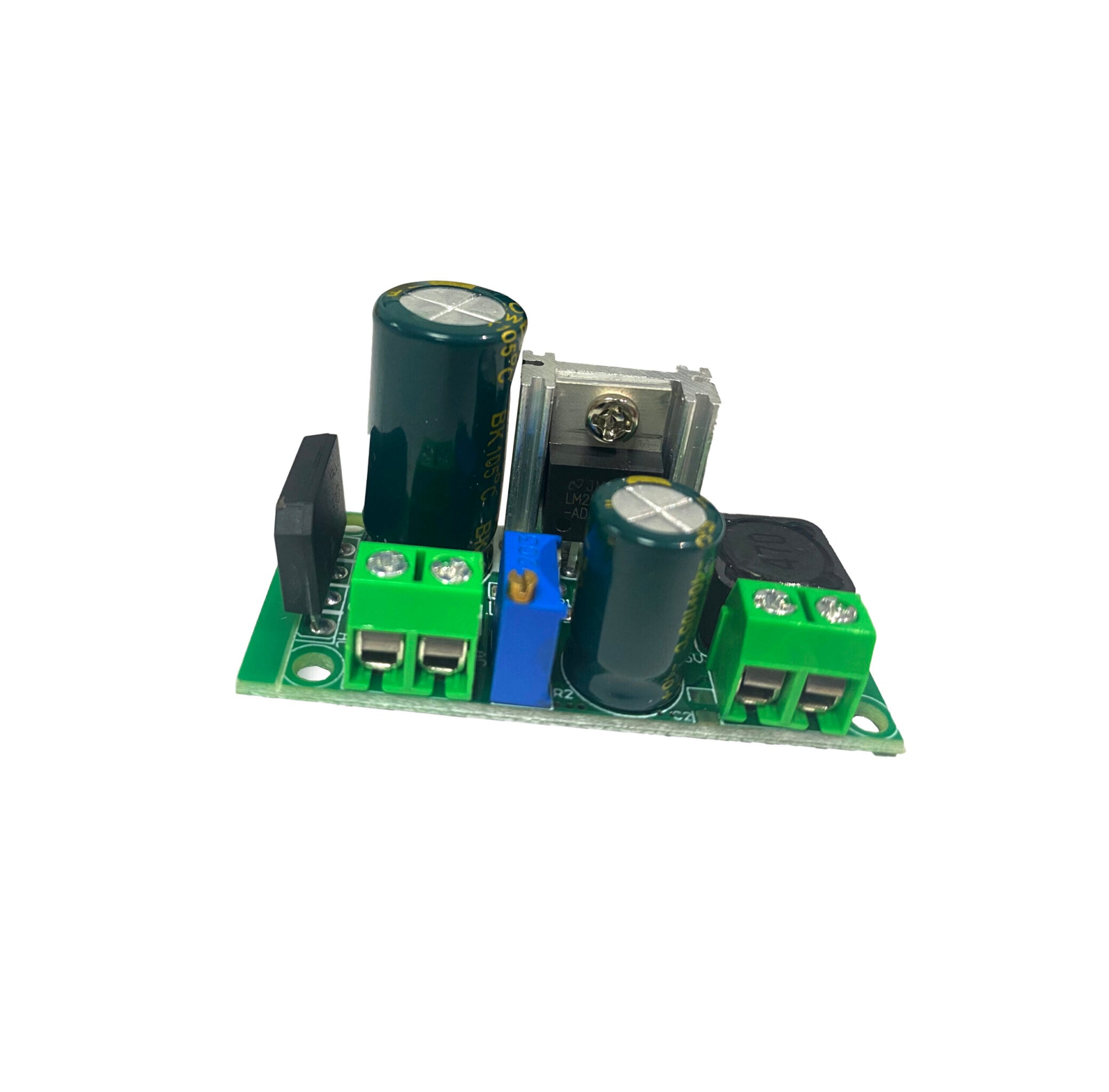
DC TO DC converter circuit(LM2596)

DC TO DC converter vs voltage regulator
| ITEM | Buck Converter | Boost Converter |
|---|---|---|
| Working mode | Voltage stabilization is achieved by adjusting the PWM duty cycle | Adjust the internal resistance to convert the excess electrical energy into heat to achieve voltage stabilization |
| Efficiency | Up to 80%-95% | 30% to 50% lower |
| The simplicity of the overall design | There are more surrounding components and it is relatively complex | Only two capacitors are needed, which is relatively simple |
| Cost | There are more components around it and it is relatively higher | It has few peripheral components and low cost |
| Heat dissipation | The heat generation is lower, so the overall heat dissipation design is more concise | More than 50% of the electrical energy is converted into heat energy, so larger heat dissipation aluminum blocks or fans are needed |
| Carrying capacity | Due to its high efficiency, it can still maintain a stable output voltage at high power | It has low efficiency and can only output a small current. A large current will lower the output voltage or cause burnout and breakdown |
| Output ripple | It is relatively high, reaching up to 30mV | Relatively low, less than 2mV |
DC-DC convert type
There are many types of DC-DC. The more common ones include boost, buck, and buck-boost conversion.
dc to dc boost converter
Voltage boosting mainly increases the output voltage, but the current will decrease. It is suitable for devices with high voltage and low current, such as electric mosquito swatters and igniters. The boost circuit also increases the output voltage by adjusting PWM (Pulse width Modulation). The overall design difficulty is relatively high, and the precision requirements for the driver chip are also relatively high. The voltage difference between the input and output can be relatively large. For example, a 5V voltage can be raised to 10,000V or even higher through the boost circuit. The electron tubes for nuclear magnetic resonance or X-rays require a voltage of about 25,000V. Then a high voltage dc converter is needed to supply power. Theoretically, it can be infinitely high. The boost circuit has modules as low as 2 milliwatts and modules as high as 10 kilowatts.
dc to dc buck convert
A step-down circuit is the opposite of a step-up circuit. It stabilizes a relatively high voltage to a relatively low one. For instance, a car charger converts the 12V in-car voltage into a 5V rechargeable voltage. Many devices are powered by the same power supply voltage, but different components inside require different voltages. Therefore, the power supply needs to be divided into different voltages. Because the application of voltage reduction are very extensive, there is a demand for voltage reduction circuits ranging from a few hundred milliwatts to tens of thousands of watts, and there are also many professional manufacturers producing them. The commonly used DC-DC converters have an output voltage of 12V, such as 48V to 12V, or an output voltage of 24V. There are also many types of DC-DC. As the application scenarios are relatively few, I will briefly introduce the types here and not delve into them in depth.
buck - boost converter
It is a DC-DC power converter that adjusts voltage levels flexibly. Unlike simple buck or boost converters, it can both reduce and increase input voltage to match the output need. It uses switches (like MOSFETs), an inductor, capacitor, and diode to store and transfer energy. When input voltage is higher than needed, it steps down; when lower, it steps up. Widely used in devices like batteries, IoT gadgets, and portable electronics for stable power supply.
In addition to what has been mentioned above, there are other types of convert
- Boost bidirectional DC-DC converter
- Step-down bidirectional DC-DC converter
- Boost – buck in-phase bidirectional DC-DC converter
- Boost – buck inverting bidirectional DC-DC converter
- SEPIC bidirectional DC-DC converter
- CUK bidirectional DC-DC converter
The parameters are quite extensive, and there are many parameters to choose from (voltage, current, power, temperature, size)
There is a high demand for DC-DC, and there are many manufacturers. The available parameters (voltage, current, power, temperature, size) are also very diverse. The output voltage ranges from tens of mv to 25KV, and the output current ranges from 5 microamperes to 500A. The size can be as small as a grain of rice, which is very beneficial for microelectronic devices. The operating temperature is currently only between -30 degrees and 85 degrees due to the temperature range of the components. This is because semiconductor devices will not function if beyond this temperature, and excessive temperature can cause the components to burn out. Modules with power ranging from 2mW to 10 kilowatts.
Application scenarios
Nowadays, many electronic devices are powered by direct current (DC), and many devices also require different DC voltages to supply power to their components internally. Therefore, the application of DC-DC are very extensive.
- Aerospace-grade applications: aircraft, aerospace
- Military-grade applications: military industry, high-speed rail, bullet trains
- Industrial-level references: electric vehicle, medical equipment
- Consumer-level applications: computer peripheral accessories, home appliances, mobile phone peripherals
Additional functions
Electrical isolation is available
In some application scenarios, it is hoped that the load will not be disturbed by external voltage fluctuations. For instance, when circuit A with A motor is working, it will generate noise. Using isolated DC-DC can prevent circuit B from being affected by the noise of circuit A.
One-to-many output
The first type is a one-to-many output of the same voltage. For this type, just connect all the different output lines to the same output terminal. The second type is one-to-many output with different voltages. This requires integrating multiple DC-DC circuits onto a single board and has multiple output terminals.
Different interfaces (DC,TYPC, terminal, XT)
Wide voltage input
Many IC manufacturers have developed wide-voltage input application circuits to ensure that a DCDC conversion circuit can meet different application scenarios and that the output voltage remains constant when the input voltage fluctuates, such as a fixed output of 12V DC-DC circuit. The DC-DC circuit has an input range that varies between 15 and 60V, while the output remains constant at 12V.
Output voltage adjustable
Long cables can also ensure stable output voltage
By adding a sampling circuit at the load end, the load voltage is transmitted to the main control chip, thereby adjusting the output voltage to achieve the function of voltage stabilization.
How to evaluate the performance of a DC-DC?
Whether the output is stable
It is required that the output voltage remain stable and even the ripple be very small when the load current changes rapidly.And the excellent power supply can maintain the output voltage value basically unchanged when heat is dropped in an environment with a large temperature difference.
Whether the user's needs are met
It is necessary to select the correct input and output voltage values, current values, output voltage error range, size, and ambient temperature matching degree.
Whether the operation is simple
Both DC-DC have been modularized. Generally, only two inputs need to be connected to the power supply and two output lines to the load. Even for adjustable power supplies, different voltage outputs can be achieved by simply rotating a knob. The overall operation is very simple.
What are the disadvantages of DC-DC converter?
Additional control chips are required and it is easily affected by temperature. If it is a high-power one, there will be the influence of EMC (a metal shell needs to be connected for shielding).
FAQS
What is a DC/DC converter in EV?
The battery of an electric vehicle can reach 800 to 1200V, but many modules inside the vehicle require different power supply voltages, such as 12V for the headlights, 5V for the audio system, and 12V for the window controller. Therefore, DC-DC of different voltages is needed for power supply.
Why is a DC/DC converter used?
Nowadays, there are many different electronic devices that require different voltages. The external power supply voltage may not be the same as the voltage needed by the electronic devices, and even certain voltage stabilization requirements may be needed. Voltage change and stabilization can be achieved through DC-DC.
Do I need a DC to DC charger for lithium batteries?
DC-DC charger for lithium batteries have now been optimized into BMS. BMS not only can charge, but also has overcharge, overcurrent and short-circuit protection functions. Some advanced BMS also have monitoring functions, allowing real-time viewing of the voltage of each battery and the status during charging and discharging.
Is a DC/DC converter a power supply?
DC/DC is not a power supply and cannot provide electrical energy independently. Essentially, it is just a voltage converter.