
Blog
DC Voltage Display Module

What is a DC Voltage Display Module?
A DC voltage display module is a compact electronic component designed to measure and digitally display the voltage of a Direct Current (DC) power source.
Core Function: Its primary function is to provide a clear, real-time numerical readout of the DC voltage it is connected to, such as from a battery, power supply, solar panel, or within an electronic circuit.
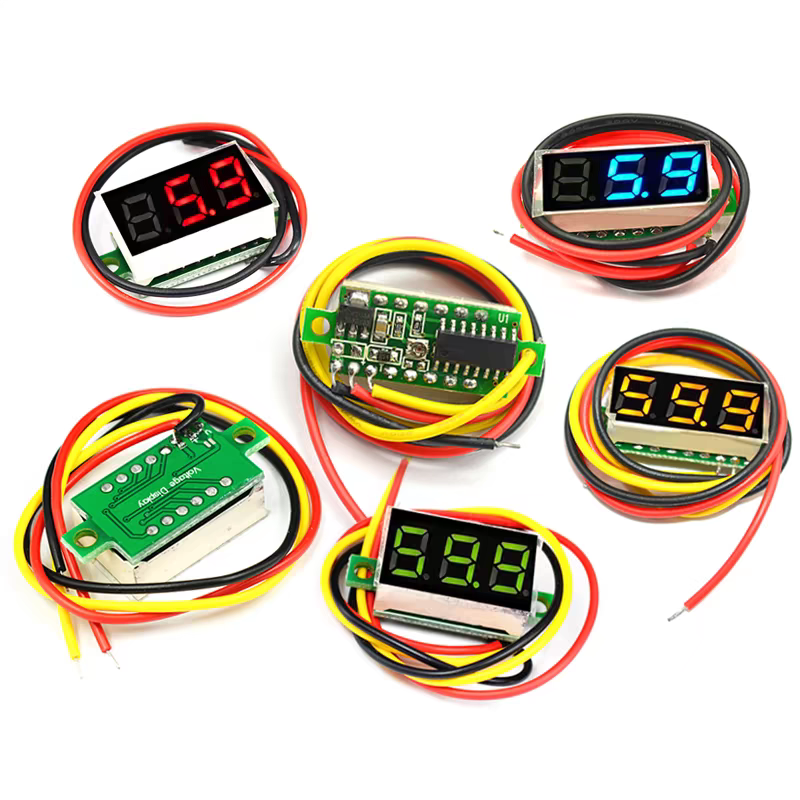
Key Characteristics: Digital Display: Typically uses LED or LCD digital tubes (e.g., 0.28", 0.36", 0.56") for easy reading.
Measurement: Precisely measures voltage within a specific range (e.g., 0V - 30V, 0V - 100V).
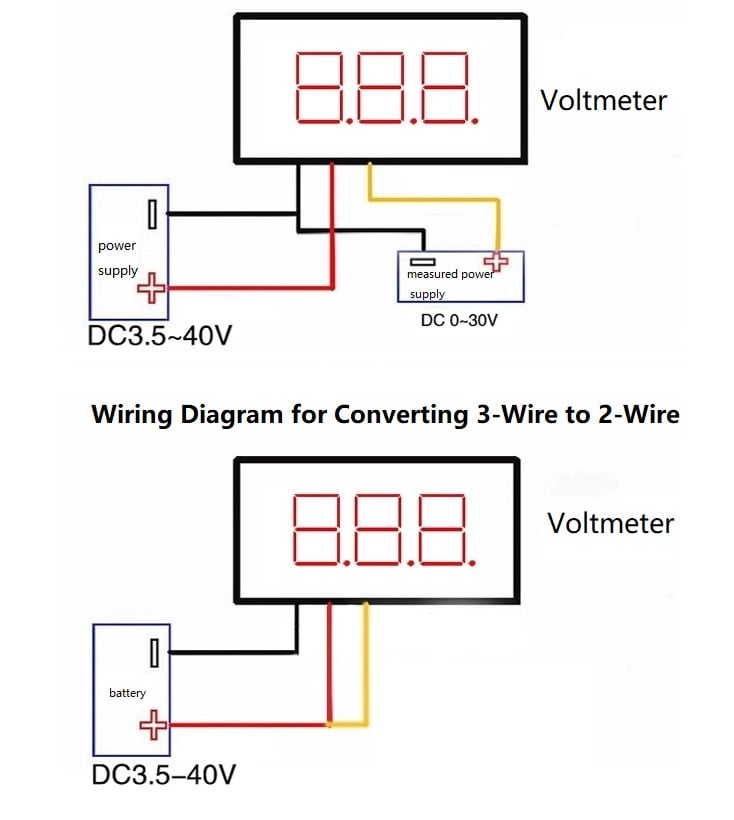
Wiring Options: Commonly comes in 2-wire or 3-wire configurations.
2-wire: The power supply for the module itself is shared with the voltage being measured. Simpler but may have a slightly higher minimum operating voltage.
3-wire: Has separate wires for power supply (Vcc), ground (GND), and the measurement signal (S/S+/IN). This often allows it to measure voltages lower than its own operating power and can provide more stable performance.
Wide Application: Used in various fields like automotive monitoring (checking car battery voltage), DIY electronics, power supply units, battery management systems, and educational experiments.
Additional Features: Many modules include protection features like reverse polarity protection (prevents damage if wires are connected backwards) and automatic precision/range switching.
How Does a DC Voltage Display Module Work?
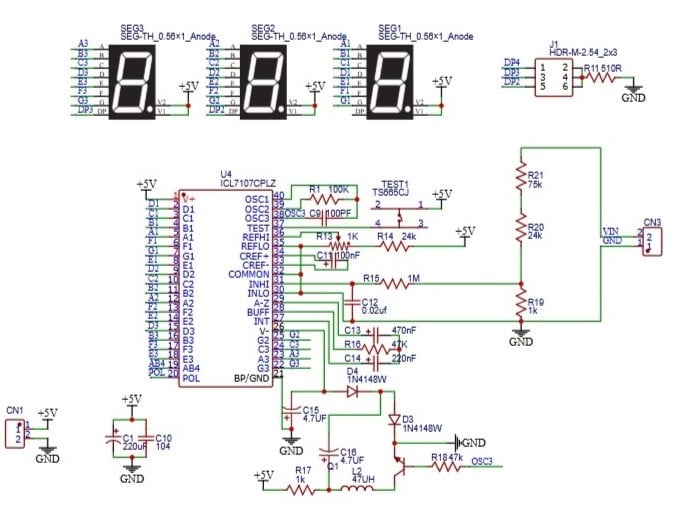
The general workflow of a digital voltmeter header is typically as shown in the following diagram:
When the digital voltmeter head works, first, the voltage to be measured is connected through the input port. If the voltage is relatively high, it will be reduced to an appropriate range in proportion through the voltage - dividing resistor network. Then, the ADC circuit samples the divided analog voltage at a fixed frequency, quantizes the sampled analog value into the corresponding digital code and encodes it into a binary digital signal. Subsequently, the encoded digital signal is transmitted to the microcontroller, processed through calibration, filtering, operation and other processes, and then converted into a signal that drives the nixie tube to display. Finally, according to the type of the nixie tube , the corresponding segments of the nixie tube are lit through appropriate level signals, and numbers from 0 to 9 are displayed by using the combination of the on and off of different segments, so as to realize voltage measurement and display.
How to Use a DC Voltage Display Module?
Digital voltmeter heads generally have differences between two-wire and three-wire systems. These two wiring methods differ, and their usage environments also vary.
| COMPARISON DIMENSION | 2-WIRE | 3-WIRE |
|---|---|---|
| Connection Modes | Only supports 2-wire connection (single connection mode) | Supports both 2-wire and 3-wire connections (dual flexible modes) |
| Electrical Performance | – Operating voltage: DC 3.50-30.0V (shares line with measurement) – Detection range: DC 3.50-30.0V | – 2-wire mode: Operating voltage DC 3.5-30V; Detection range DC 0.0-30V – 3-wire mode: Operating voltage DC 3.5-30V; Detection range DC 0.0-30V – Power supply voltage: DC 3.50-30.0V |
| Operating Current | Not specified | Clearly marked: <20mA |
| Physical & Installation Specs | – Dimensions: 33MM×15MM×9.5MM (including mounting ears) – Mounting size: 28MM (center distance of mounting ear holes) – Panel cutout size: 22.7MM×14MM – Weight: <5g per unit | – Dimensions: 33mm×15mm×9.5mm (including mounting ears) – Mounting size: 28mm (center distance of mounting ear holes) – Panel cutout size: 22.7mm×14mm – Weight: 5g per unit |
| Display Configuration | – 3-digit 0.36-inch LED digital tube – Display colors: Red/Green/Blue – Refresh rate: ~1 time/second | – 3-digit 0.36-inch LED digital tube – Display colors: Red/Blue/Green (options available) – Refresh rate: ~1 time/second |
| Protection Function | 2-wire connection with reverse connection protection (no damage if connected reversely) | Both 2-wire and 3-wire connections have reverse connection protection (comprehensive safety coverage) |
| Environmental Adaptability | Only operating temperature specified: -10°C to 65°C | More comprehensive parameters: – Operating temperature: -10°C to +65°C – Operating humidity: 10~80% (no condensation) – Operating air pressure: 80~106 kPa – Sunlight exposure: No direct exposure |
| Measurement Accuracy | 1% (±1 digit), with automatic precision adjustment (0.01V below 10V; 0.1V above 10V) | 1% (±1 digit), no automatic precision adjustment (fixed precision standard) |
| Core Advantages | 1. Automatic precision adjustment optimizes low-voltage fine measurement 2. Simple 2-wire shared-line design reduces wiring complexity | 1. Dual connection modes adapt to diverse installation scenarios 2. Comprehensive environmental adaptation parameters for complex working conditions 3. Clear operating current specification for easier system matching |
| Applicable Scenarios | Low-voltage (3.50-30.0V) scenarios requiring fine measurement (e.g., small electronic devices, low-voltage circuits) with simple wiring needs | Scenarios needing flexible connection modes (2-wire/3-wire switchable) under 0-30V, especially complex environments with humidity/pressure constraints (e.g., industrial control panels, multi-device power monitoring) |