

Blog
Dual-Channel Breadboard Module/DC Power Plug
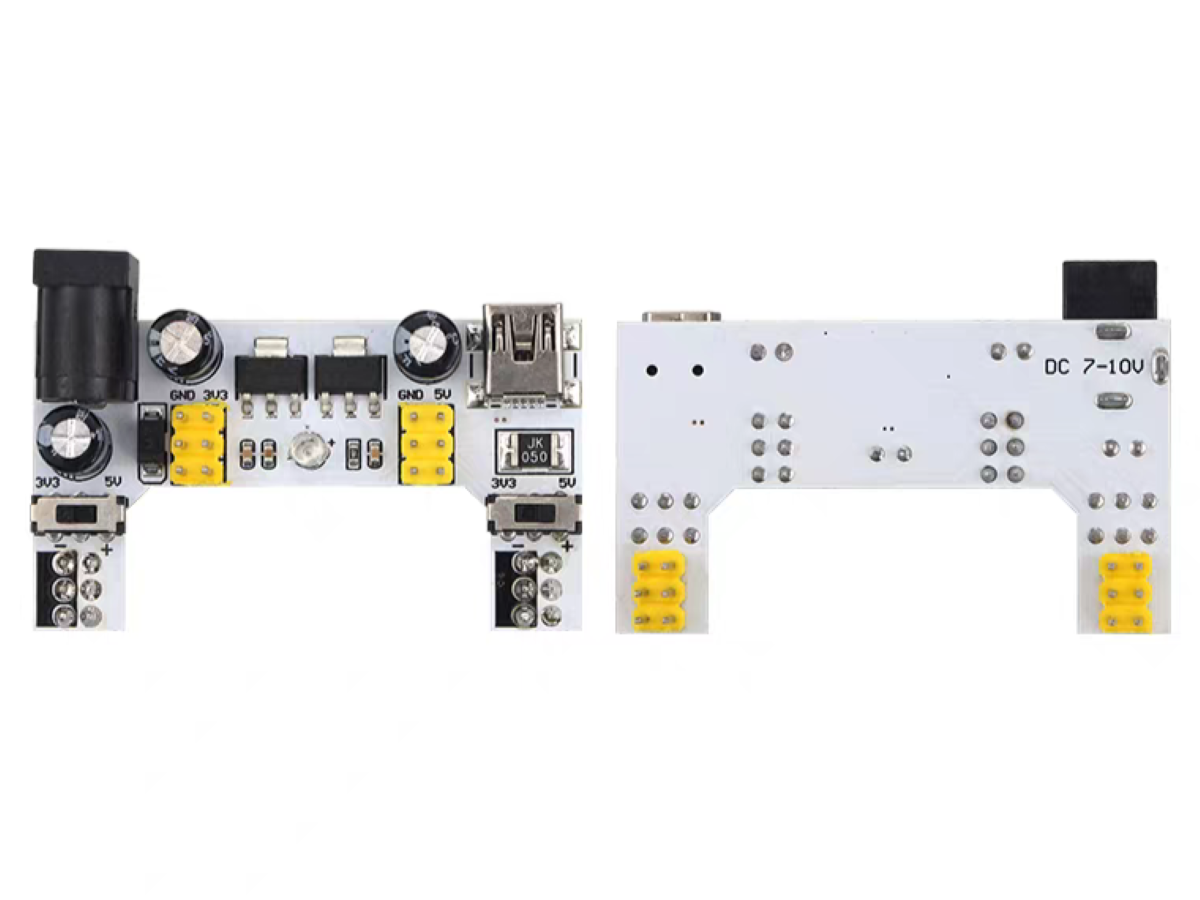
Dual-Channel Breadboard Module
A breadboard is one of the most commonly used tools in electronic prototyping and testing. It allows for quick insertion and modification of components without the need for soldering, making it ideal for circuit prototyping and experimentation. However, for circuits to function properly, a reliable power supply module is crucial, especially in more complex circuits. Different components often require different voltages and currents, so a stable and efficient power supply module can significantly improve the performance and development efficiency of the circuit.

A breadboard is a base designed for solderless electronic circuit experimentation, featuring numerous small holes. Because various electronic components can be easily inserted or removed as needed, it eliminates the need for soldering. This not only saves circuit assembly time but also allows components to be reused, making it perfect for circuit prototyping, debugging, and training.
However, since a standard breadboard has no independent power supply, we often encounter issues during circuit assembly, such as insufficient power pins on the MCU or the frequent need to switch between different voltages.
This dual-channel breadboard module is designed to solve this problem. It features two independent power supply channels, and each channel is equipped with a selection switch that allows you to freely toggle between 3.3V and 5V. This greatly reduces the burden on the MCU’s pins, leads to cleaner and more organized wiring, and improves overall efficiency.
Product Features
Recessed Design: Its low-profile design sits flush with the breadboard, ensuring it doesn’t waste any valuable space.
Dual Independent Channels: The two power channels can be isolated. Each channel has its own selection switch to freely toggle between 3.3V and 5V.
Flexible Power Options: Supports two different power supply methods for your convenience.
Components and Structure of Dual Power Supply Modules for Breadboards

The dual power supply module for breadboards is composed of several key parts:
●Power Input Port: This is the input for the external power source, which may include a USB port, battery connection port, or external power adapter port. These interfaces allow the module to receive power from an external source.
●Voltage Regulator and Stabilizer Circuit: The voltage regulator is a key component of the module. It converts the input voltage into the desired output voltage. The stabilizer circuit ensures that the output voltage remains stable, preventing fluctuations that could affect the circuit’s performance.
●Output Ports: These are the ports where the breadboard is connected. Common output voltages include 5V and 3.3V, which are suitable for powering various components with different voltage requirements.
●Protection Features: Many dual power supply modules are designed with protection features such as overload protection, overheat protection, and short-circuit protection. These features help prevent damage to the module or the circuit in the event of a malfunction or irregularity.
●Accessories and Attachments: Some modules may also come with accessories, such as jumper wires and connecting cables, to help users easily connect the module to the breadboard.
Applications of Dual Power Supply Modules for Breadboards
Dual power supply modules for breadboards have a wide range of applications in electronic development. Here are some typical use cases:
- Avoiding Power Interference: Compared to single-output modules, a dual power supply module can provide independent power channels, ensuring that circuits with different voltages do not interfere with each other. This is particularly important for circuits that require high stability.
- Complex Circuit Applications: In circuits that require multiple power inputs, a dual power supply module can effectively meet these needs, reducing the need for multiple separate power modules and simplifying the circuit design.
- Prototyping: Many electronic prototypes require multiple voltages. For example, a prototype may need 5V to power a microcontroller and 3.3V to power sensors or other low-voltage components. A dual power supply module can easily meet these needs without worrying about power interference between the components.
Common Problems and Solutions
1.Unstable Voltage or Abnormal Output
If the output voltage is unstable, it may be due to an unstable input power source or a faulty module. Check if the input power source is functioning properly and ensure the module is connected correctly. If the problem persists, the module may need to be replaced.
2.Insufficient Output Current
When the current demand exceeds the module’s maximum output capacity, it can lead to voltage drops or unstable circuits. To resolve this, you can choose a power supply module with a higher current output or use multiple modules to supply different circuits.
3.Voltage Mismatch
If some components on the breadboard require different voltages than the module’s outputs, you can use a voltage converter (such as a buck or boost converter) to adjust the voltage to match the component’s requirements.