

Blog
From Theory to Practice: A Comprehensive Technical Breakdown of the Digital Multi Servo Tester
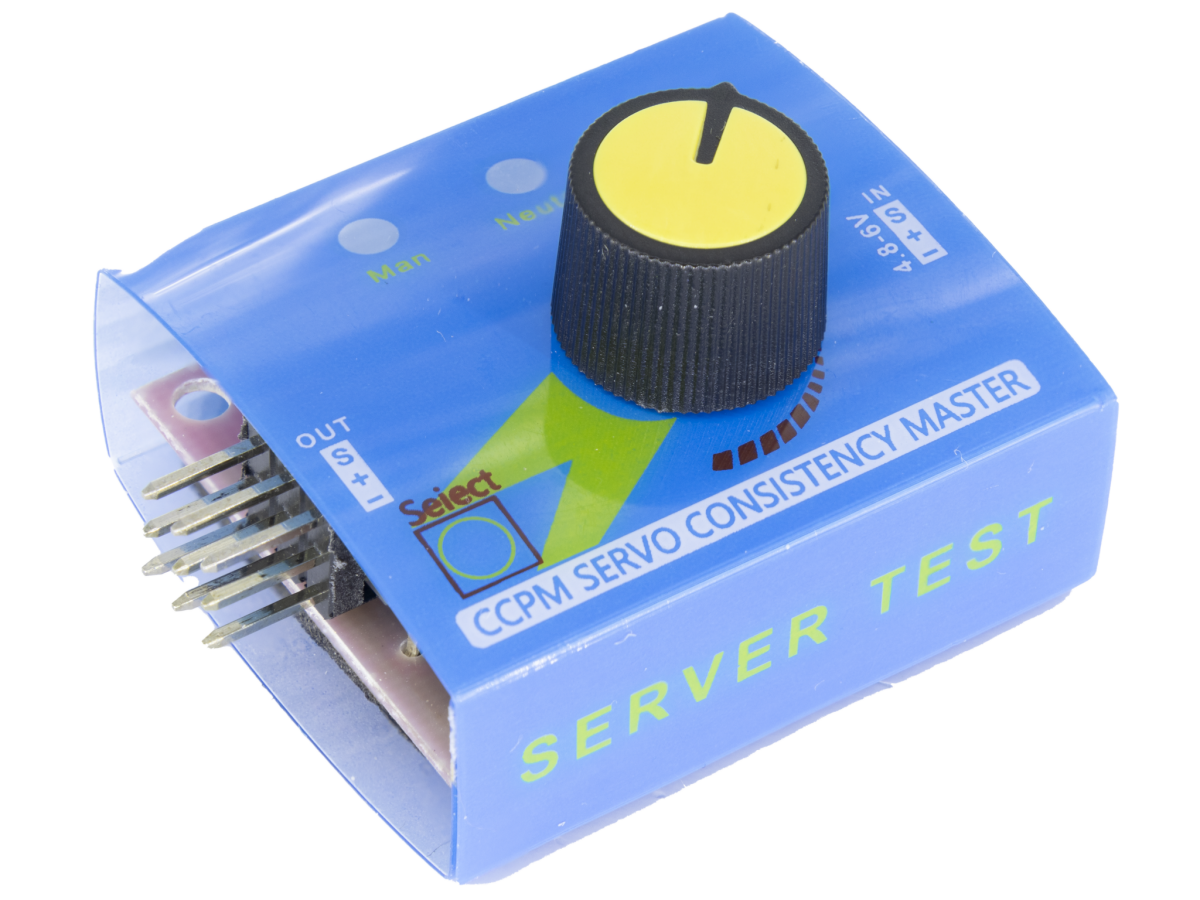
In competitive aeromodeling, multi-rotor drone tuning, and RC model building, the “consistency”of servos is crucial for performance. This is especially true for helicopters and fixed-wing models using CCPM (swashplate control), where the synchronized response and angle alignment of multiple servos directly affect flight stability. The SERVER TEST CCPM SERVO CONSISTENCY MASTER Digital Multi-Channel Servo Tester is a professional tool designed specifically for “consistency calibration,” addressing the two core needs of servo function testing and synchronous precision calibration. Today, we’ll comprehensively break down this “essential gear” for aeromodeling enthusiasts, from its principles to its applications.
What is SERVER TEST CCPM SERVO CONSISTENCY MASTER? ?—— Not just a “servo detector”
Its name reveals its core purpose: a professional multi-channel tester focused on “CCPM Servo Consistency Calibration.”
- “CCPM SERVO”refers to Cyclic Collective Pitch Mixing, the core control system for helicopter swashplates in aeromodeling, which requires 3 or 4 servos to work together.
- “CONSISTENCY”emphasizes ensuring these servos have matching angles, response speeds, and move in sync, preventing control delays or unstable flight caused by individual servo variations.
Essentially, it’s an integrated tool for “signal generation + consistency comparison.”It generates standard PWM control signals internally (no remote controller or flight controller needed), connects to multiple servos simultaneously, and allows for direct testing and calibration of their angle accuracy, center point deviation, and rotational sync. It’s particularly suited for CCPM systems in aeromodeling.
What is the working principle of SERVER TEST CCPM SERVO CONSISTENCY MASTER?
Core Principle Breakdown: How to Achieve “CCPM Servo Calibration Consistency”?
The servo’s core control signal is a 50Hz PWM pulse (1ms-2ms pulse width corresponds to 0-180 degrees). The key to this tester lies in “generating a synchronization signal + comparing execution results”, which can be broken down into three steps:
1.CCPM Signal Generation:The internal microcontroller generates multiple “synchronous PWM signals”based on the selected CCPM mode (like 3-channel swashplate). In CCPM mode, the pulse width changes for the 3 servos are mathematically related to create the desired swashplate tilt, ensuring signal-level synchronization.
2.Result Feedback:After connecting the servos, they receive the synchronous PWM signals and move. The user can then visually compare (or use an angle ruler) the actual rotation angles of all servos. If one servo’s angle is off by more than, say, 1°, it’s identified as “lacking consistency.”
3.Deviation Calibration:For servos with angle deviation, use the tester’s “fine-tuning buttons”(some models have knobs or switches) to adjust the PWM pulse width for that specific channel until all servos move to the same angle. For example, if Servo A has a 0.5°center deviation, its pulse width can be fine-tuned to 1.52ms (from the standard 1.5ms center) to achieve alignment.
In simple terms, it acts like a “calibration ruler for model servos”: it first gives a unified “command standard,” then compares the actual results to correct for individual servo differences, ensuring all servos “march in step.”
What are the advantages of SERVER TEST CCPM SERVO CONSISTENCY MASTER?
Why is this digital multi-servo tester so popular? Let’s talk about its core advantages:
- Dedicated CCPM Mode Calibration:Supports 3 or 4-channel CCPM swashplate modes (common in model helicopters). It can simulate swashplate tilting and pitch changes, calibrating the synchronous response of multiple servos. This solves the limitation of standard testers which “can only adjust angles per channel, not test coordination.”
- Intuitive Consistency Checking:By comparing the rotation angles and response speeds of multiple servos, it quickly identifies servos with excessive deviation (likeServo A turns 10°, Servo B only turns 8°). This prevents performance issues caused by mixing servos with different characteristics.
- Integrated Power & Testing:Has a built-in 4.8-6V DC power input, allowing it to power both the tester itself and the connected servos simultaneously. No need for an external power supply, simplifying field debugging.
- Optimized for Aeromodeling:Compact size (about46mm x 32mm x 17mm), lightweight, and comes with a portable case, making it easy to take to the flying field for on-site testing and adjustments.
- Wide Compatibility:Works with all standard digital and analog servos, compatible with common 9g, 12g, and 20g servo sizes used in aeromodeling. It’s plug-and-play, regardless of servo brand.
What are the typical application scenarios for the SERVER TEST CCPM SERVO CONSISTENCY MASTER?
This digital multi-servo tester’s design perfectly meets the needs of the aeromodeling world, with core applications in “CCPM System Calibration”and “Multi-Servo Model Debugging”:
1.CCPM Swashplate Calibration for Model Helicopters:Calibrates servo synchronization during swashplate tilting and pitch changes for 3/4-channel CCPM helicopters. Effectively solves issues like “body drift during take-off” and “control lag.”
2.Flap/Aileron Debugging for Fixed-Wing Models:Flaps and ailerons on fixed-wing models often need 2-3 servos to work together (e.g., flaps deploying at the same angle). The tester can calibrate angle deviations, avoiding unstable flight caused by asymmetric flaps.
3.Servo Consistency Screening:When buying new servos, use the tester to check multiple servos of the same model simultaneously. This helps you pick servos with minimal angle deviation and consistent response speed, avoiding performance loss from using mismatched servos.
4.Troubleshooting Model Repairs:When the model has abnormal operation, the tester can be used to drive the servo separately to determine whether the servo is faulty (like angle jam or jitter) or the flight control/remote control is faulty, so as to quickly locate the fault point and effectively improve the efficiency.
What are the differences between the CCPM servo consistency master controller for server testing and a standard multi-channel servo tester?
| Comparison Point | SERVER TEST CCPM SERVO CONSISTENCY MASTER | Standard Multi-Channel Servo Tester |
|---|---|---|
| Core Function | Supports CCPM mode calibration, focuses on “multi-servo consistency”, can simulate coordinated swashplate movements. | Only supports independent angle adjustment per channel (single/multi), lacks consistency calibration. |
| Primary Use Case | CCPM helicopters, RC models requiring multi-servo coordination. | Robotics, general DIY projects (no CCPM needs). |
| Signal Difference | Can generate CCPM mixed signals( multi-channel PWM). | Only generates independent PWM signals per channel, no mixing function. |
| Calibration Ability | Supports angle deviation fine-tuning, can save CCPM calibration parameters. | Can only adjust angles, no deviation calibration or parameter saving. |
| Power Supply | 4.8-6V standard aeromodeling power input, compatible with LiPo batteries. | Mostly uses 5V USB power, requires adapter for field use with model batteries. |
Product Parameter Sheet for SERVER TEST CCPM SERVO CONSISTENCY MASTER
| SERVER TEST CCPM SERVO CONSISTENCY MASTER | Specification |
|---|---|
| Output Current | <= 15mA (per channel at 5.0V) |
| Input Voltage | DC 4.2V — 6V |
| Output Signal | 1.5ms ±0.5ms (Pulse Width Range) |
| Adjustment Modes | Manual Adjustment, Auto-Sweep, Center Position Set |
| Product Dimensions | 46mm x 32mm x 17mm |
Wiring and Operation Guide
Connect the servos as shown in the diagram: The right side has three sections (top, middle, bottom) for three servos. The left side has a single row of pins for power supply. The negative terminal (marked with an S symbol) should be connected to the battery’s negative terminal—never reverse polarity, as this will burn out the IC. The S-marked pins are unused. When powered, all blue lights will illuminate simultaneously. First, the rightmost light turns on for manual potentiometer adjustment. Press the button to activate the center light for zero adjustment, then the third light illuminates for automatic testing. The test potentiometer follows the same connection as the servos, but no power supply should be connected to its input terminal. To test the motor, first connect the test potentiometer as shown in the diagram.

Connect the power supply to the single row of pins on the right side. After powering on, all three blue LEDs will light up briefly, and then only the leftmost LED will stay on. The device is now ready for operation.
Mode Selection (Use the button to cycle through modes):
- Left LED On (Manual Mode):In this mode, you can directly use the potentiometer (the adjustment knob) to control the servo’s rotation.
- Middle LED On (Center/Neutral Mode):Press the button once. In this mode, the servo moves to and holds its center (neutral) position.
- Right LED On (Auto/Sweep Mode):Press the button again. In this mode, the servo will automatically and continuously rotate back and forth.
Testing Other Components:
- Testing an ESC (Electronic Speed Controller):The wiring connection method for testing an ESC is the same as for testing a servo.
- Testing a Motor:To test a motor, you must first connect it to an ESC. The testing steps for the motor/ESC combination are then the same as those described above for the servo.
FAQS
What does “CCPM SERVO CONSISTENCY” mean on this tester?
“CCPM” refers to the cross-disk control mode in aircraftng (requiring multiple servos to cooperate). “SERVO CONSISTENCY” means ensuring these servos move in perfect sync with matching angles and speeds. Combined, it signifies the tool is “specifically for calibrating servo synchronization precision in CCPM systems,”solving problems caused by angle deviations and unsynchronized movement.
How many servos can it test simultaneously? Does it support 4-channel CCPM?
The system typically supports 3-channel (basic version) or 4-channel (advanced version) servo testing simultaneously. The 3-channel version is compatible with mainstream CCPM helicopter gyroscopes, while the 4-channel version is designed for complex servo systems in high-end multi-rotor or fixed-wing aircraft. Refer to the device interface labels (CH1-CH3 or CH1-CH4) for details.