

Blog
24V Light-Dependent Resistor Relay
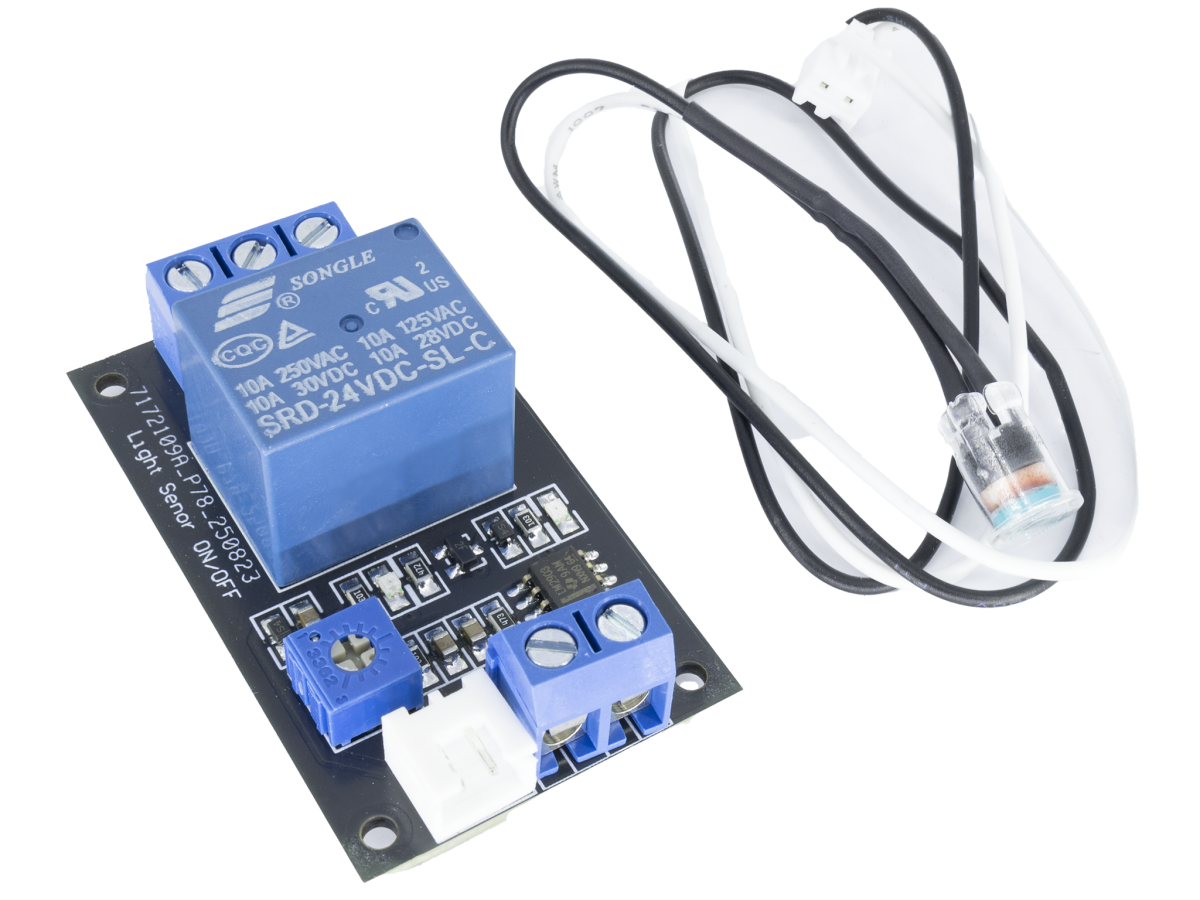
In many situations like smart homes, industrial controls, or greenhouses, we often need devices to turn on or off automatically based on light levels. Think of streetlights that switch on at dusk, screen backlights that dim in bright light, or sunshades in a greenhouse that deploy in strong sunlight. The key component enabling this “sense and act” function is often a module combining a Light-Dependent Resistor (LDR)and a Relay.
The 24V Light Sensor Relayis a popular choice for industrial equipment because it uses a stable 24V power supply and can reliably control powerful devices. Let’s break down how this “light-controlled switch” works and how to use it. We’ll also show you where to get a high-quality one at the end!
What is 24V Light-Dependent Resistor Relay?—— Not just a“Light-controlled switch”
The 24V photoresistor relay module is a modular device integrating a photoresistor (light sensor), a 24V relay (switch actuator), and control circuitry. Its core function is to automatically control the 24V relay’s engagement and disengagement based on light intensity, thereby enabling on/off control of downstream loads.
This modular design can greatly reduce the threshold of use, without the need for users to build complex detection and drive circuits, just connect 24V working power supply and controlled load, can achieve light sensing automatic control, so it is widely used in industrial equipment and automation systems that need stable voltage power supply.
What is the working principle of 24V Light-Dependent Resistor Relay?
Many people wonder: how can this small module “see” the change of light and automatically switch the circuit?Its operation involves two steps: light detection and switching execution. The core mechanism is that changes in the photoresistor’s resistance trigger the relay’s switching.
- Light Detection: The Resistance Magic of Photoresistors
The LDR is a special resistor that changes its resistance based on light.
- Bright Light(likesunny day): The LDR’s resistance becomes very low(a few thousand or even hundred ohms). The module’s circuit sees this as “enough light.”
- Dim/Dark Light(like evening, night): The LDR’s resistance becomes very high(tens of thousands or millions of ohms). The circuit sees this as “not enough light.”
- Switch operation: Relay’s “on/off”
The relay is an electromagnetic switch. Its coil needs 24V to activate.
- When the circuit decides it’s “too dark,” it sends 24V power to the relay’s coil.
- The coil creates a magnetic field, pulling the internal switch contacts closed. This completes the circuit, and your connected device (like a lamp) turns on.
- When the circuit decides it’s “bright enough,” it cuts power to the relay’s coil. The magnetic field disappears, a spring pulls the contacts apart, and your device turns off.
- Sensitivity adjustment: Customize the trigger boundary
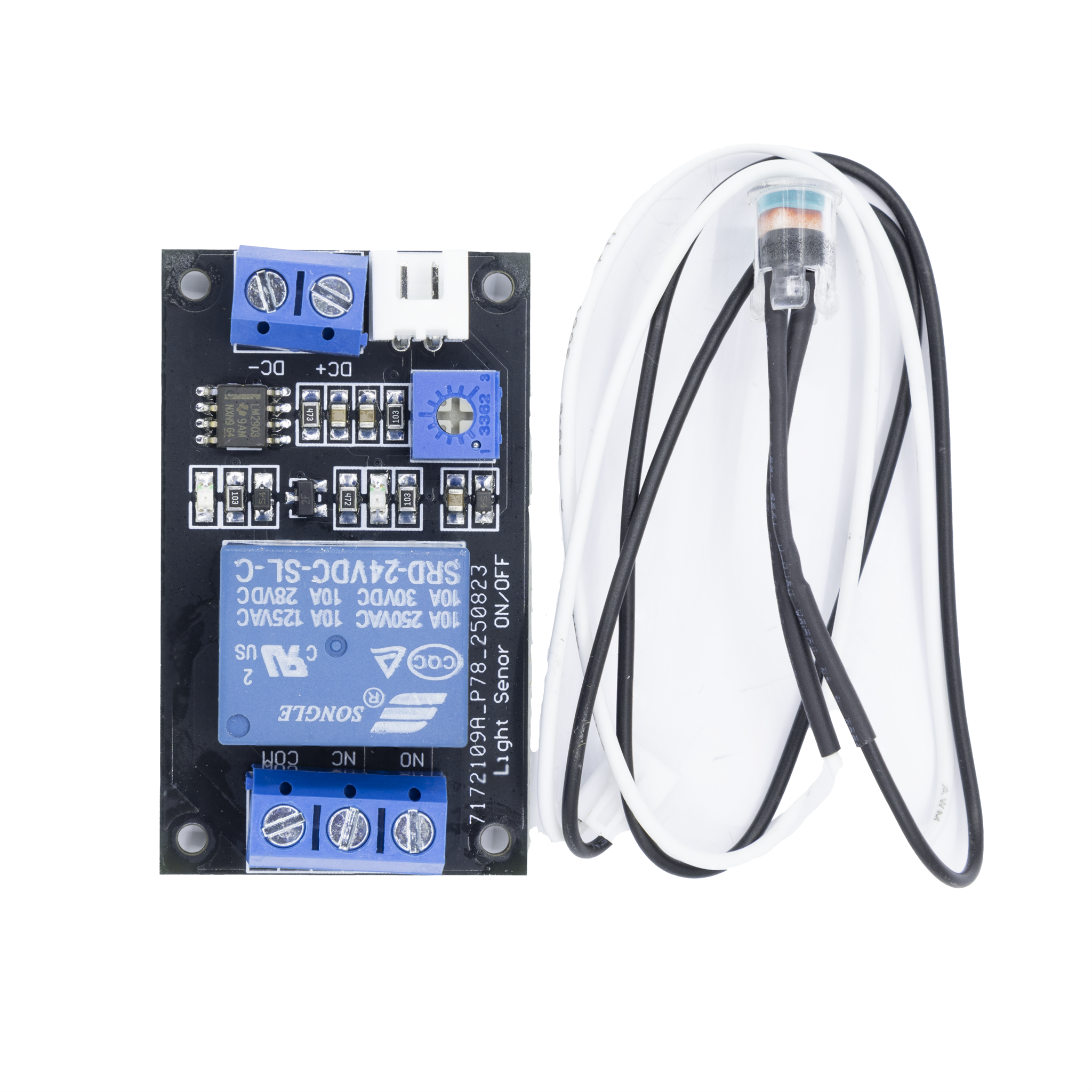
The module has a knob labeled “ADJ” (Adjust). This is a potentiometer that lets you set how darkit needs to be before the relay turns on.
- Rotate clockwise: May increase trigger sensitivity (for example, load only in darker environments).
- Counterclockwise rotation may reduce trigger sensitivity (e.g., activating the load when it’s just dark). Refer to the module labels for specific adjustment directions.
The specific adjustment direction should be combined with the module annotation. The core is to adapt to the light demand of different scenarios by changing the voltage division ratio.
What are the advantages of 24V Light-Dependent Resistor Relay?
Widely Compatible 24V Power:24V DC is a standard voltage in industrial controls, making it easy to connect to systems like PLCs. It’s more stable than lower voltage modules.
- Adjustable Sensitivity:The “ADJ” knob lets you fine-tune the trigger point for different needs.
- Strong Load Driving Ability:The built-in relay can typically handle up to 10A, allowing it to directly control high-power devices like 220V AC lamps, motors, or solenoids without extra parts.
- Good Anti-Interference:Designed for industrial use, it often includes filters and shielding to protect against electrical noise and voltage spikes in tough environments like factories.
- Suitable Response Speed:It reacts to light changes quickly (within milliseconds), but not so fast that it flickers from brief shadows or passing headlights.
What are the typical application scenarios for the 24V Light-Dependent Resistor Relay?
With industrial-grade voltage adaptability and stable reliability, 24V photoresistor relays are widely used in industrial automation, smart home, outdoor facilities and other fields:
- Industrial automation control
- Factory Lighting:Automatically turn on workshop lights when it gets dark to save energy.
- Equipment Shading:When the sun shines directly on the industrial display and precision instrument, the automatic light curtain or louver is started to avoid the strong light affecting the operation of the equipment.
- Material Detection:Use a reflector to detect whether the material is in place (when the light is blocked, it determines that the material is in place and triggers the subsequent process).
- Outdoor Facilities
- Street/Garden Lights:Automatically control 24V LED streetlights or garden lights (on at dusk, off at dawn).
- Security Lighting:When the light is insufficient, the surveillance camera automatically triggers the supplementary light to ensure the picture quality of the night surveillance.
- Greenhouse Control:The shading net and cooling fan will be automatically started according to the sunshine intensity to avoid the crops from being exposed to the sun.
- Smart Homes & Buildings
- Garage Lighting:Turn on lights when a car enters (blocking the light sensor) and off after a delay.
- Corridor Lights:When the corridor is not well lit, the lights will be automatically turned on with human sensing (some modules are integrated), which is both energy-saving and convenient.
- Automatic Curtains:The curtains open automatically at dawn and close automatically at night, without manual operation.
Of course, the application field of 24V photoresistor relay can be far more than these!
Product Parameter Sheet for 24V Light-Dependent Resistor Relay?
| Parameter | Specifications |
|---|---|
| Working Current | ≤ 90mA at 5V (≤5mA when relay is not activated) ≤ 50mA at 12V (≤5mA when relay is not activated) ≤ 30mA at 24V (≤5mA when relay is not activated) |
| Operating Temperature | -30°C – 70°C |
| Load Capacity | Normally Open (NO) Contact:DC 0-30V / 10A, AC 0-250V / 10A Normally Closed (NC) Contact:DC 0-28V / 10A, AC 0-125V / 10A |
24V Light-Dependent Resistor Relay pinout
A typical 24V photoresistor relay module has 4-6 pins, with three core types (pin labels may vary slightly by brand):
- Power pins (VCC, GND):Connect VCC to the positive terminal of a 24V DC power supply, and GND to the negative terminal (do not reverse the polarity, as this may damage the module).
- Load pins (COM, NO, NC):COM is the common terminal, NO is the normally open contact (open when powered off, closed when powered on), and NC is the normally closed contact (closed when powered off, open when powered on). The COM+NO combination is typically used to control the load’s on/off state.
24V Light-Dependent Resistor Relay Wiring Test Example
Wiring Rule:First, connect the power supply. Next, adjust the sensitivity. Finally, connect the device you want to control (the “load”). This prevents accidentally turning on the load while you are setting things up.
- Connect the Power Supply
- Connect your 24V DC power supply: the positive wire to the module’s DC+terminal and the negative wire to the DC-terminal.
- Once powered on, the module’s power indicator light (usually red) will turn on.
- Adjust the Sensitivity
- In the actual lighting conditions where you’ll use the module, use a small screwdriver to turn the “ADJ”knob.
- Example:If you want a streetlight to turn on at dusk, adjust the knob during that time. Turn it slowly until you hear the relay clickon (and the load indicator light turns on).
- Connect the Device You Want to Control (The Load)
- For an LED streetlight: Connect the positive wire of the light to the module’s NOterminal. Connect the negative wire of the light to the power supply’s GND (negative). Finally, connect the positive wire from the power supply to the module’s COMterminal. (The order can vary, as long as it creates a complete loop).
- After confrming all connections are correct, the module will automatically control the light based on the ambient light.
How to Choose a Reliable 24V Light-Dependent Resistor Relay Module?
- Check the Relay (The Switch):High-quality modules are equipped with premium relays featuring silver alloy contacts (excellent conductivity and wear resistance), whereas inferior modules predominantly use generic relays with contacts prone to oxidation and burnout.
- Check the Light Sensor (LDR):High-quality photoresistors feature clear markings (like“5528” or “3528” models) with excellent linear light response and minimal drift. In contrast, inferior ones may exhibit erratic sensitivity fluctuations and eventually fail after prolonged use.
- Look at the Circuit Board:High-quality module has obvious filter capacitors, voltage regulator chips and fuse resistors, which can protect the circuit from the influence of voltage fluctuations; the low-quality module has a simple circuit, which can only meet the basic functions and has poor stability.
The 24V photoresistor relay is the “cost-effective choice” for industrial-grade automatic light control.Its advantages (24V industrial voltage adaptation, strong load capacity, good anti-interference) make it a reliable choice in complex scenarios.