

Blog
How to Use the L293D Motor Driver Module

What is the L293D Motor Driver Module?
The L293D is a quad half-H driver primarily used for driving DC motors and stepper motors. It can drive two DC motors and features internal ESD protection, high-noise-immunity inputs, and a wide supply voltage range of 4.5V to 36V. The L293D motor driver IC is renowned for its simple circuit design, requiring only four external diodes to achieve precise control of two independent motors. Its efficient design makes it an ideal choice for numerous DC motor control applications. It also includes an overheat protection feature to effectively prevent damage to the device from excessive heat.
As a classic motor driver board, the L293D module is characterized by its abundant online learning resources, simple programming, and good stability. It is widely used by electronics enthusiasts for DIY projects such as smart cars and robots.
L293D Quad Half-H Driver Specifications
| Parameter | Specification |
|---|---|
| Output Current Capability per Driver | 600 mA |
| Pulsed Output Current | 1.2 A per driver |
| Output Clamp Diodes | For inductive transient suppression |
| Supply Voltage Range | 9 V to 24 V |
| Input Logic Supply | Separate input-logic supply |
| Protection Feature | Thermal shutdown |
| ESD Protection | Internal ESD protection |
| Input Characteristics | High-noise-immunity inputs |
| Compatibility | Functional replacement for SGS L293D |
L293D Quad Half-H Driver: Input and Output Schematics
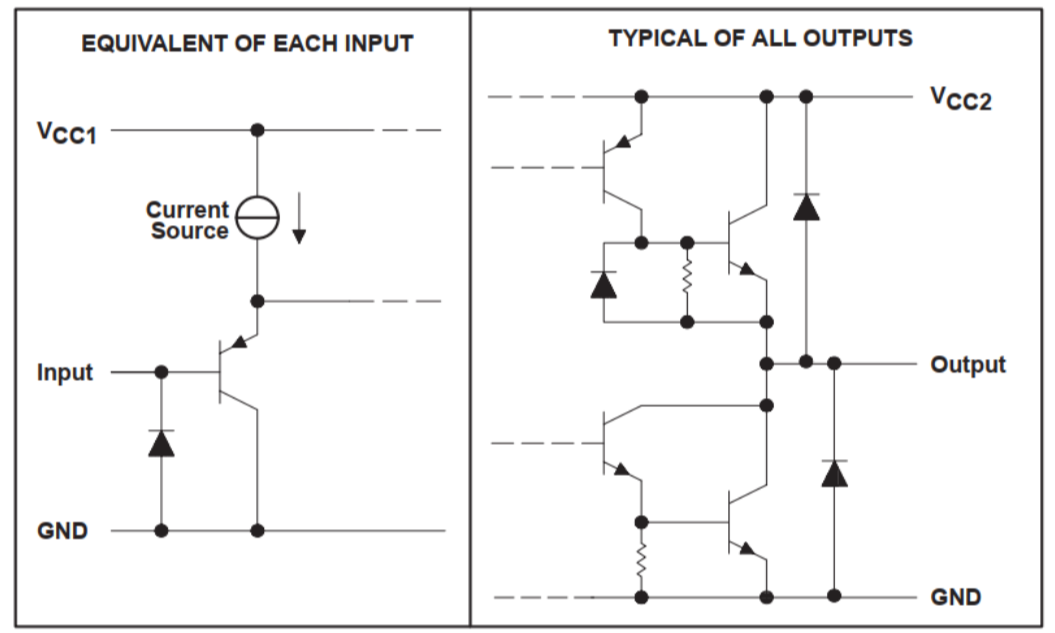
L293D IC Pinout

Power Pins
| Pin | Name | Description |
|---|---|---|
| Pin 16 | Vcc1 | Logic supply voltage (typically 5V) for internal logic |
| Pin 8 | Vcc2 | Motor supply voltage (4.5V – 36V) |
| Pin 4, 5, 12, 13 | GND | Ground pins (must be connected to system ground) |
All grounds must be common with the microcontroller ground.
Enable Pins (Speed Control)
| Pin | Name | Description |
|---|---|---|
| Pin 1 | Enable 1,2 | Enables Motor A (Output 1 & 2). HIGH = enabled |
| Pin 9 | Enable 3,4 | Enables Motor B (Output 3 & 4). HIGH = enabled |
- These pins can be connected to PWM signals for speed control.
- If LOW, the corresponding motor is disabled.
Input Pins (Direction Control)
| Pin | Name | Description |
|---|---|---|
| Pin 2 | Input 1 | Control input for Motor A |
| Pin 7 | Input 2 | Control input for Motor A |
| Pin 10 | Input 3 | Control input for Motor B |
| Pin 15 | Input 4 | Control input for Motor B |
These pins are connected to microcontroller GPIOs and define the motor direction.
Output Pins (Motor Connections)
| Pin | Name | Description |
|---|---|---|
| Pin 3 | Output 1 | Motor A terminal |
| Pin 6 | Output 2 | Motor A terminal |
| Pin 11 | Output 3 | Motor B terminal |
| Pin 14 | Output 4 | Motor B terminal |
Connect each motor directly across its corresponding output pins.
Motor Direction Logic (Example: Motor A)
Lorem ipsum dolor sit amet, consectetur adipiscing elit. Ut elit tellus, luctus nec ullamcorper mattis, pulvinar dapibus leo.
Add Your Heading Text Here
| Enable | Input 1 | Input 2 | Motor State |
|---|---|---|---|
| HIGH | HIGH | LOW | Rotate forward |
| HIGH | LOW | HIGH | Rotate reverse |
| HIGH | LOW | LOW | Brake / stop |
| HIGH | HIGH | HIGH | Brake |
| LOW | X | X | Motor OFF |
L293D Mini Motor Driver Module: Working Principle
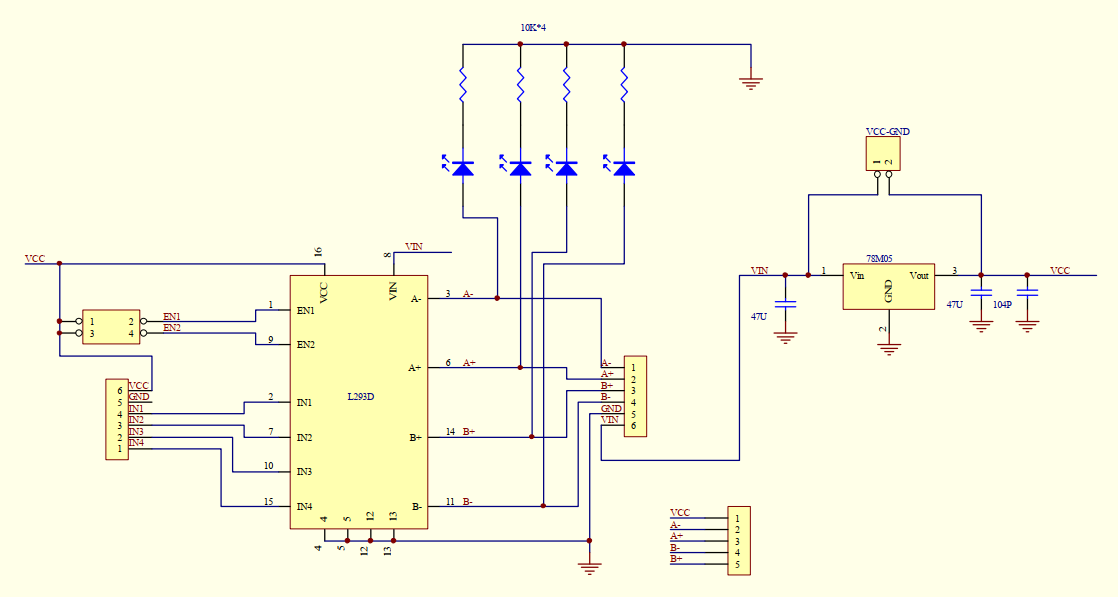
The L293D mini motor driver module is based on the L293D dual H-bridge IC, which amplifies low-current control signals from a microcontroller to drive DC or stepper motors. By controlling the IN pins, the module changes the polarity of the voltage across the motor to achieve forward rotation, reverse rotation, braking, or stop, while motor speed is typically controlled by applying a PWM signal to the EN pins. It uses separate supplies for logic and motor power and includes built-in flyback diodes to protect the circuit from back EMF, making it suitable for low-power motor control applications.
L293D Mini Motor Driver Module: Hardware Introduction
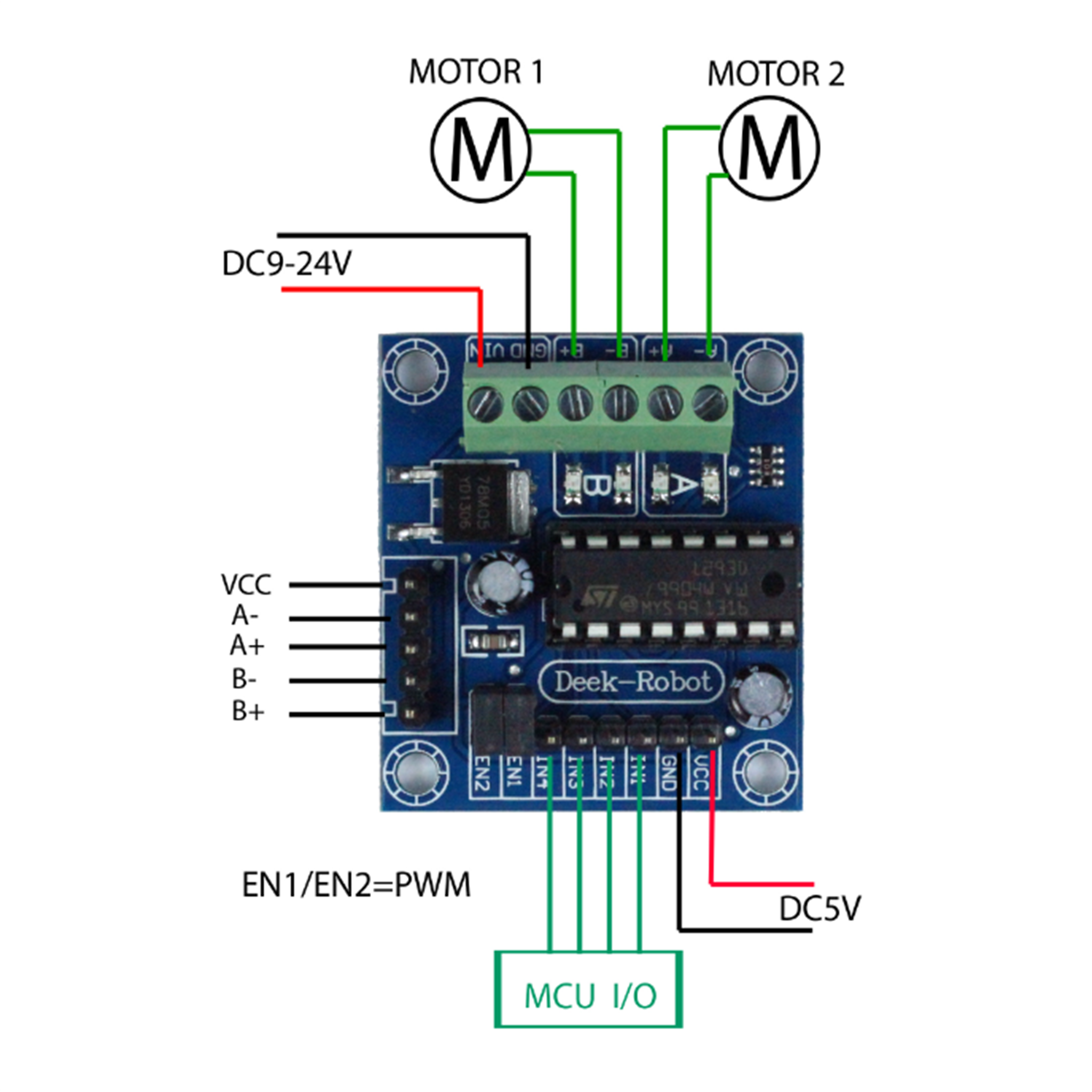
| L293D Pin | Description |
|---|---|
| ENA | Motor A enable (PWM speed control) |
| IN1 | Motor A control pin 1 |
| IN2 | Motor A control pin 2 |
| IN3 | Motor B control pin 1 |
| IN4 | Motor B control pin 2 |
| ENB | Motor B enable (PWM speed control) |
| OUT1 / OUT2 | Motor A output |
| OUT3 / OUT4 | Motor B output |
| VCC | Motor power supply |
| GND | Ground |
| 5V | Logic power (from Arduino if supported) |
Controlling the L293D Mini Motor Driver Module with Arduino
Project Introduction
This project uses an Arduino Uno as the main microcontroller (MCU). By interfacing with the L293D motor driver module via its digital output pins, it achieves precise directional control of two independent DC motors. This allows each motor to rotate forward or backward, either individually or simultaneously.
Arduino Uno to L293D Wiring Table (Control Pins)
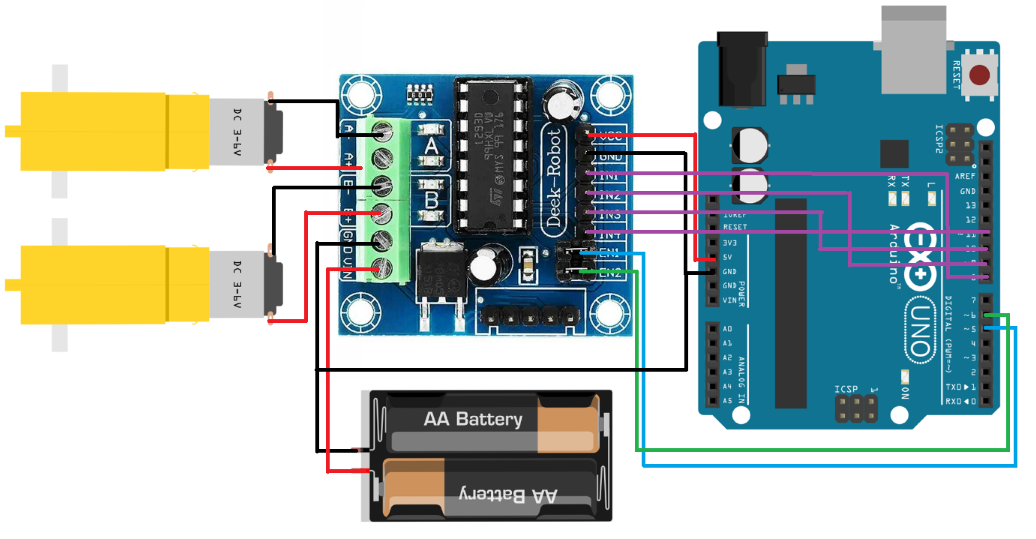
| Arduino Uno Pin | L293D Pin | Description |
|---|---|---|
| D5 (PWM) | ENA | Motor A speed control |
| D8 | IN1 | Motor A direction control |
| D9 | IN2 | Motor A direction control |
| D10 | IN3 | Motor B direction control |
| D11 | IN4 | Motor B direction control |
| D6 (PWM) | ENB | Motor B speed control |
Motor Connection Table
| Motor | L293D Output Pins |
|---|---|
| Motor A | OUT1, OUT2 |
| Motor B | OUT3, OUT4 |
Power Connection Table (Important)
| Power Source | Connection |
|---|---|
| Arduino GND | L293D GND |
| Motor Power + | L293D VCC |
| Arduino 5V | L293D 5V (if module supports onboard logic power) |
⚠ Important Notes:
- Arduino GND and motor power GND must be connected together.
- Do NOT power motors directly from Arduino 5V.
- Use an external power supply suitable for your motors.
Arduino code
					// L293D Dual DC Motor Control Example
// Board: Arduino Uno

// Motor A pins
const int ENA = 5;   // PWM pin for Motor A speed
const int IN1 = 8;
const int IN2 = 9;

// Motor B pins
const int ENB = 6;   // PWM pin for Motor B speed
const int IN3 = 10;
const int IN4 = 11;

void setup() {
  // Set all control pins as output
  pinMode(ENA, OUTPUT);
  pinMode(IN1, OUTPUT);
  pinMode(IN2, OUTPUT);

  pinMode(ENB, OUTPUT);
  pinMode(IN3, OUTPUT);
  pinMode(IN4, OUTPUT);

  // Set initial motor speed (0–255)
  analogWrite(ENA, 200);
  analogWrite(ENB, 200);
}

void loop() {

  // Motor A forward, Motor B forward
  motorA_forward();
  motorB_forward();
  delay(2000);

  // Stop both motors
  motor_stop();
  delay(1000);

  // Motor A backward, Motor B backward
  motorA_backward();
  motorB_backward();
  delay(2000);

  // Stop again
  motor_stop();
  delay(2000);
}

// ---------- Motor control functions ----------

void motorA_forward() {
  digitalWrite(IN1, HIGH);
  digitalWrite(IN2, LOW);
}

void motorA_backward() {
  digitalWrite(IN1, LOW);
  digitalWrite(IN2, HIGH);
}

void motorB_forward() {
  digitalWrite(IN3, HIGH);
  digitalWrite(IN4, LOW);
}

void motorB_backward() {
  digitalWrite(IN3, LOW);
  digitalWrite(IN4, HIGH);
}

void motor_stop() {
  digitalWrite(IN1, LOW);
  digitalWrite(IN2, LOW);
  digitalWrite(IN3, LOW);
  digitalWrite(IN4, LOW);
}
Motor Direction Logic Table
| IN1 | IN2 | State |
|---|---|---|
| HIGH | LOW | Forward |
| LOW | HIGH | Backward |
| LOW | LOW | Stop |
| IN3 | IN4 | State |
|---|---|---|
| HIGH | LOW | Forward |
| LOW | HIGH | Backward |
| LOW | LOW | Stop |
Related Materials
FAQ
L293D vs L298N: An In-Depth Comparison
| Feature | L293D | L298N |
|---|---|---|
| Manufacturer | STMicroelectronics / TI | STMicroelectronics |
| Driver type | Dual H-Bridge | Dual H-Bridge |
| Supported motors | 2 DC motors / 1 stepper | 2 DC motors / 1 stepper |
| Maximum motor voltage (Vcc2) | 36 V | 46 V |
| Logic voltage (Vcc1) | 5 V | 5 V |
| Max current per channel | 600 mA (1.2 A peak) | 2 A (3 A peak) |
| Output device type | Bipolar transistors | Bipolar transistors |
| Voltage drop | ~1.8–2.5 V | ~2–4 V |
| Internal flyback diodes | Yes | No (external required) |
| PWM speed control | Yes (via Enable pin) | Yes (via Enable pin) |
| Enable pins | Enable 1,2 & Enable 3,4 | ENA & ENB |
| Number of control pins | 6 | 6 |
| Thermal protection | No | Yes |
| Current sensing | No | Yes (Sense A, Sense B) |
| Package | 16-pin DIP IC | Multiwatt-15 (large) |
| Typical form factor | Bare IC | Module with heatsink |
| Heatsink required | No | Yes |
| Efficiency | Low | Very low |
| Power dissipation | Low–medium | High |
| Board size | Very small | Large |
| Cost | Low | Medium |
| Ease of use | Beginner friendly | Moderate |
| Typical applications | Small robots, toys, education | Robot cars, CNC, higher-power motors |
What is the L293D component?
The L293D is a 16 pin IC, with eight pins, on each side, dedicated to the controlling of a motor. There are 2 INPUT pins, 2 OUTPUT pins and 1 ENABLE pin for each motor. L293D consist of two H-bridge. H-bridge is the simplest circuit for controlling a low current rated motor.
What is L293D used for?
The L293D is designed to provide bidirectional drive currents of up to 600-mA at voltages from 4.5 V to 36 V. Both devices are designed to drive inductive loads such as relays, solenoids, DC and bipolar stepping motors, as well as other high-current/high-voltage loads in positive-supply applications.
How many motors can the L293D drive?
The l293d can control up to 4 DC motors, but it can’t power them. So what you want to do is give it a separate power source for the motors, fed directly into the motor shield rather than to the Arduino.
What is L293D motor shield?
The L293D Motor Driver/Servo Shield for Arduino is probably one of the most versatile on the market and features 2 servo and 4 motor connectors for DC or stepper motors. That makes it a great shield for any robotic project.
Can L293D drive a stepper motor?
The L293D is a dual H-bridge driver IC, capable of driving two DC motors or one bipolar stepper motor.
What's better than L298N?
The TB6612FNG is smaller than the L298N, and doesn’t require a heat sink. It also features a much higher efficiency at over 90% versus 40-70% for the L298N, and a low-current standby mode that the L’ lacks.