

Blog
MB102 (AMS 1117) Breadboard Power Supply Module Introduction
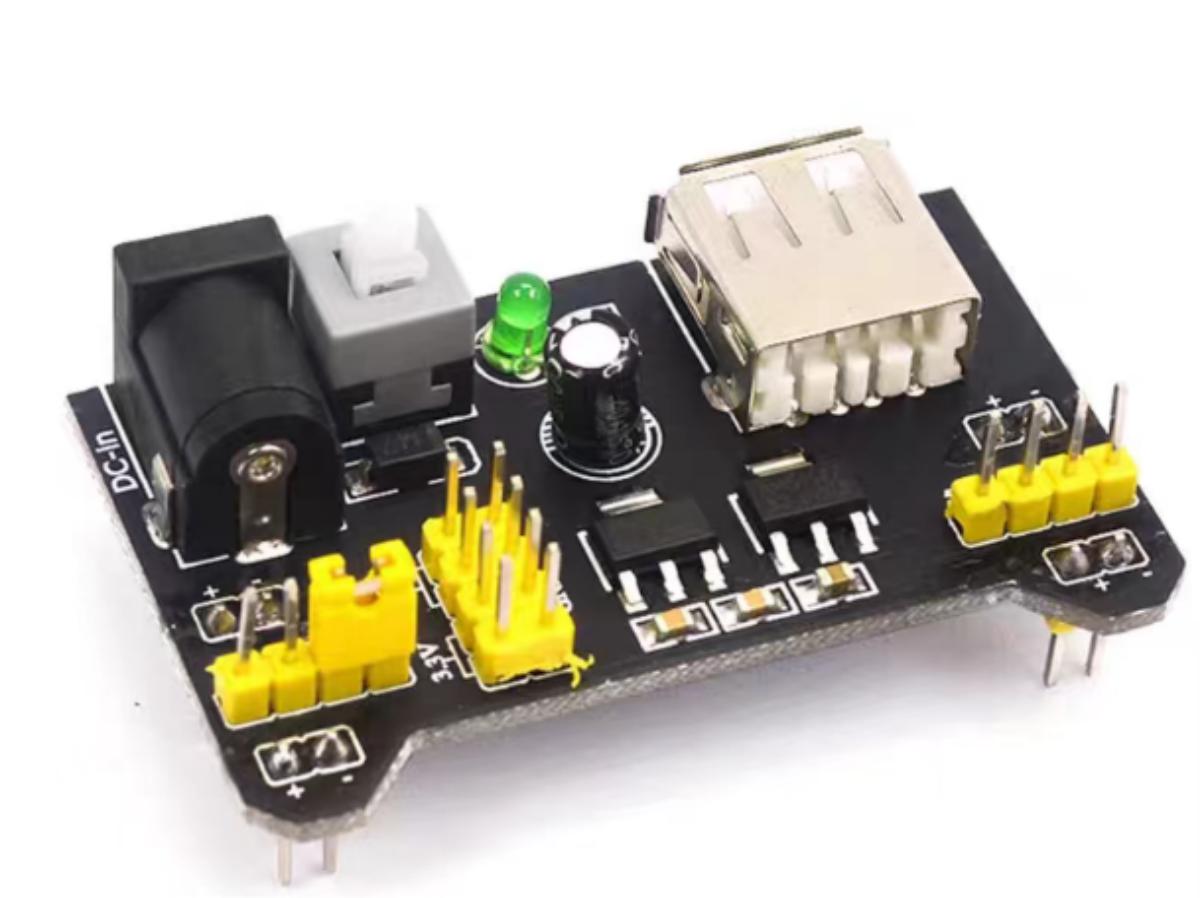
What is mb102?
The MB102 Breadboard Power Supply Module is a dedicated power accessory designed specifically for breadboards. It delivers two stable DC voltage outputs—3.3V and 5V—and you can switch between the two using a jumper cap as needed. This module draws power via either a DC power adapter or a USB interface. Whether you’re an electronics enthusiast, student, or engineer, and whether you’re designing prototype circuits or testing them, this module will make your work far more convenient and hassle-free.
What are the advantages of mb102?
First, it can be plugged directly into a breadboard for use—eliminating the need for tedious extra soldering. Additionally, its output is highly flexible, supporting dual-channel voltage outputs (3.3V and 5V) that can meet the power supply requirements of most electronic components such as microcontrollers and sensors. It also boasts excellent compatibility: its input interface supports multiple power supply types, making it adaptable to different power scenarios.
Inside the module, a built-in voltage regulator ensures stable voltage output, preventing component damage caused by voltage fluctuations. Beyond that, it features an on-board capacitor and a manual switch: the capacitor suppresses and filters out noise in the power supply, making the output smoother and more stable; the switch and jumper cap further enhance the module’s ease of use. With its low cost, simple operation, and ability to simplify complex wiring (reducing wire tangles and clutter), the MB102 is sure to become your go-to tool.
MB102 Technical Parameters and Circuit Principles
Technical Specifications
- Operating Input Voltage: 6.5V – 12V (USB: 5V)
- Output Voltage: 3.3V or 5V
- Maximum Output Current: < 700mA
- Module Dimensions: 5.3cm x 3.5cm
Among the parameters of the MB102 breadboard power supply module, we must focus on what the input voltage of the MB102 is and what the maximum current of the MB102 is; otherwise, your circuit is very likely to be burned out. Regardless of which devices you intend to connect, you must be extra cautious with these parameters!

Now, let’s briefly get to know the MB102 breadboard power supply module:
- Left/Right Rail Jumper: Voltage selection (5V or 3.3V)
- Output Terminals: 2x 3.3V outputs, 2x 5V outputs, 4x GND outputs
- DC Input Jack: 6.5V – 12V input port (USB input jack: 5V)
- AMS1117: Voltage Regulator IC (we will explain this in more detail later)
Circuit Schematic


- Input Interfaces: The DC Interface (3-Pin) supports 6.5V~12V DC input, while the USB Interface supports 5V DC input.
- Reverse Polarity Protection (D1: IN5807 Schottky Diode): Prevents circuit burnout caused by reverse connection of power supply polarity. Its working principle is that D1 conducts in the forward direction and cuts off in the reverse direction; when the polarity is reversed, D1 is reverse-biased, and there is no current in the circuit. The Schottky Diode has a low forward voltage drop (≈0.3V), which can reduce power loss when high-voltage input is applied.
- Voltage Regulator Circuit: The circuit adopts two AMS1117 linear voltage regulators to achieve stable 5V and 3.3V output respectively. The 5V voltage regulator (U1: AMS1117-5.0) outputs stable 5V, which is supplied to the load and the 3.3V voltage regulator after being filtered by a capacitor. In USB mode, 5V is directly connected to the Vin pin of U1; at this time, the input of U1 is approximately equal to its output, and the AMS1117 works as a voltage follower with extremely low loss. For the 3.3V voltage regulator (U2: AMS1117-3.3), the 5V output from U1 is converted by U2 into stable 3.3V output. Whether in DC or USB mode, 5V is a prerequisite for U2’s operation, because the AMS1117 requires a voltage difference of “input ≥ output + 1V” to work stably.
- Filter Capacitors: C1 (on the input side) filters out low-frequency ripples from the DC input and stabilizes the input voltage of U1. C2 (on the output side) filters out high-frequency noise from the output of U1, improving the purity of the 5V power supply.
- Power Indicator Circuit (D2: LED, R1: Current-Limiting Resistor): Intuitively indicates whether the 5V power supply outputs normally. The 5V voltage drives D2 to emit light through R1 (which limits current to prevent LED burnout due to overcurrent); if the LED goes out, it indicates that the 5V power supply is abnormal.
- Output Interfaces: Through interfaces such as J1, J2, J7, and J8, the module distributes 3.3V, 5V, and GND to the breadboard, meeting the power supply requirements of different circuits. The power rails (long copper strips on the left and right sides) of the breadboard can be directly connected to 3.3V or 5V via the interfaces, which facilitates rapid circuit construction.
How to use mb102?
Using the MB102 breadboard power supply module is actually pretty straightforward. There are two ways to power it: one is the DC jack, which can be connected to a 6.5V–12V power adapter or battery. The other is the USB port—you can just plug in a 5V cable like the one used for phone chargers, and USB is really convenient for small experiments.
There’s a small switch on the module; just press it. If the light turns on, that means it’s powered on properly. If it doesn’t light up, first check if the cable is plugged in tightly—if that doesn’t work, try a different power source.
There are also two small jumper caps on the pin header, one set on each side (left and right). If you want one side of the breadboard to output 3.3V, snap the jumper cap onto the 3.3V pin; for 5V, put it on the 5V pin. If you don’t attach the jumper cap, that side won’t have any voltage—only the ground (GND) will be connected. For example, if you need to power a 3.3V board like the Raspberry Pi Pico on one side and a 5V device like an Arduino on the other, just adjust the jumpers accordingly.
Installing it on the breadboard is easy too: just plug it into the edge. Its 3.3V, 5V, and GND pins will align with the long power rails (the rows of holes) on both sides of the breadboard. When building your circuit, you can draw power directly from these rails. For instance, if you’re connecting an LED: for a 3.3V LED, add a 220-ohm resistor in series, then plug one end into the 3.3V rail and the other into the GND rail. Powering sensors works the same way—plug into the 5V rail if it needs 5V, and always connect GND to GND.
However, there are a few things to note: Don’t connect devices that draw too much power—the module can only handle around 700mA total. Connecting multiple motors will easily make it get hot. Never plug a power source over 12V into the DC jack, and the USB port can only take 5V; otherwise, the module might get damaged. It’s best to turn off the switch before changing the jumpers to avoid accidental short circuits.
If you find the light isn’t turning on or the voltage is incorrect, first check if the jumpers are on the right pins and if the power source is working. If it’s overloaded, turn off the switch, unplug some devices, and then turn it back on.

What is the function of AMS1117?
We already got a brief overview of the AMS1117 voltage regulator IC in the voltage regulator circuit section earlier—now let’s dive into more details. A similar component from other manufacturers is the LM1117. Their operating principle is straightforward:
When the input voltage to the module fluctuates (for example, the 6.5V–12V input from the DC jack may be unstable, or the 5V input from the USB port may have slight fluctuations), these ICs adjust it via their internal circuitry to flatten it into a precise 5V or 3.3V output. Even if the load of the external circuit changes (such as suddenly adding an extra sensor), the output voltage remains largely unchanged. This ensures that the “sensitive” components on the breadboard—like microcontrollers and sensors—won’t be damaged or malfunction due to voltage spikes or drops.
A key characteristic of these ICs is that they require the input voltage to be slightly higher than the output voltage (typically by at least 1V) to operate stably. For instance, the 3.3V version of the IC needs an input voltage of at least 4.3V. That’s why, in the MB102 module, the 3.3V IC is connected after the 5V output: the 5V version of the IC first stabilizes the voltage, then supplies power to the 3.3V version—guaranteeing a stable 3.3V output.
While their efficiency isn’t particularly high (excess voltage is dissipated as heat), they excel in simple circuitry and low cost. For small-scale experiments on a breadboard, they provide more than enough stable and reliable power—which is exactly why entry-level modules like the MB102 often use them.
AMS1117 Technical Principles
The AMS1117 stabilizes its output voltage through an internal feedback mechanism consisting of an “error amplifier + power adjustment transistor”:
When the input voltage fluctuates (e.g., rises from 6V to 12V) or the load changes (e.g., multiple sensors are suddenly connected), tiny deviations occur in the output voltage. The error amplifier inside the IC detects these deviations and then adjusts the conduction level of the power transistor — when the input voltage is too high, the power transistor “reduces its conduction level” to decrease output; when the voltage drops due to increased load, the power transistor “increases its conduction level” to supplement current. Ultimately, this keeps the output voltage stabilized at the set value (e.g., 3.3V or 5V).
Parameters
- Maximum Input Voltage: Fixed-output versions (e.g., AMS1117-3.3, AMS1117-5.0) typically support up to 15V; exceeding this value may burn out the chip. The adjustable version (AMS1117-ADJ) also has a maximum input voltage of 15V. In practical applications, the input voltage must be at least 1V higher than the output voltage (referred to as “voltage dropout”); otherwise, stable output cannot be achieved (for example, the 3.3V version requires an input voltage of at least 4.3V).
- Output Voltage: Common fixed-output voltages include 3.3V, 5.0V, and 1.8V (the number in the model name indicates the output voltage—e.g., the AMS1117-3.3 outputs 3.3V). The adjustable version (ADJ) allows setting the output voltage between 1.25V and 13.8V via external resistors.
- Maximum Output Current: It can reach up to 1A under ideal conditions, but is actually limited by heat dissipation. If the voltage dropout (difference between input and output voltages) is large (e.g., converting 12V to 3.3V), the chip will generate significant heat, and the maximum current may drop below 700mA—which is why the MB102 module is labeled “recommended not to exceed 700mA”.
- Voltage Dropout: The minimum voltage difference between input and output required to maintain stable output, with a typical value of 1.2V. For example, the 5V version needs an input voltage of at least 6.2V to stably output 5V; however, when powered via USB (5V input), the voltage dropout of the 5V version is close to 0, allowing normal operation.
- Line Regulation / Load Regulation: These are metrics for measuring voltage stability—the smaller the value, the better. For instance, line regulation is typically < 0.2% (meaning minimal output fluctuation when input voltage changes), and load regulation is < 0.4% (ensuring stable output when load current varies).
1117 pinout
The AMS1117 is most commonly available in the 3-pin SOT-223 package, with pin functions as follows:
Pin 1 (Vout): Output pin, connected to the load and filter capacitor;
Pin 2 (GND): Ground pin, which must be connected to the input power supply ground;
Pin 3 (Vin): Input pin, connected to the unregulated DC power supply.
The adjustable version (ADJ) has an additional “Adjust” pin (typically Pin 2 is reconfigured as the ADJ pin). The output voltage is set by means of voltage division using two external resistors, following the formula:
Vout = 1.25V × (1 + R2/R1)
(Note: R1 and R2 refer to the two external resistors used for voltage division.)

FAQ
What does the power supply module do?
A power module converts unstable external power sources (such as mains electricity, batteries, USB port output, etc.) into stable DC voltage and current required by electronic devices or circuits. Simply put, it acts like a combination of a “power converter + voltage regulator”.Additionally, a high-quality power module will also filter out noise in the power supply, preventing sudden voltage fluctuations from damaging the equipment. Some modules even come with overload protection—for example, they will automatically cut off power when the load current is too high, ensuring the safety of the circuit.
What is compatible with AMS1117?
Its input voltage range is 1.1V to 15V (depending on the specific model), and the maximum output load current can reach 1A (proper heat dissipation is required). It is compatible with standard passive components, such as the 10-microfarad (µF) electrolytic capacitors commonly used at the input/output terminals, as well as the resistors required for the adjustable version (ADJ type).
The component seamlessly works with low-power devices, including microcontrollers (e.g., Arduino, Raspberry Pi Pico), various sensors, and USB-powered modules. To ensure stable operation, note that the input voltage must be at least 1V higher than the output voltage, and capacitors must be used as required for filtering and noise reduction.
What is the use of AMS1117 IC?
The AMS1117 chip is a low-dropout linear regulator (LDO). Its function is to take an unstable input DC voltage and precisely regulate it to a fixed output voltage. Because of its low cost, simple circuitry, and stable output voltage, it is widely used in various scenarios that require low-voltage power supply.
What difference of ams1117 and Lm7805?
The LM7805 is a traditional linear voltage regulator with a large voltage dropout (requiring an input voltage 2–3V higher than the output; for example, a 5V output needs an input of at least 7V). It provides a fixed 5V output only, typically comes in a TO-220 package, and generates significant heat when the voltage dropout is large. It is suitable for scenarios with high input voltage and fixed 5V output.
By contrast, the AMS1117 is a low-dropout (LDO) voltage regulator with a voltage dropout of only about 1V. It offers multiple fixed voltage options (3.3V, 5V, etc.) as well as an adjustable version (1.25V–13.8V). With a smaller package (e.g., SOT-223), it boasts higher efficiency and less heat generation. It is better suited for low-voltage input, space-constrained low-power devices (such as breadboard modules and small sensors).