

Blog
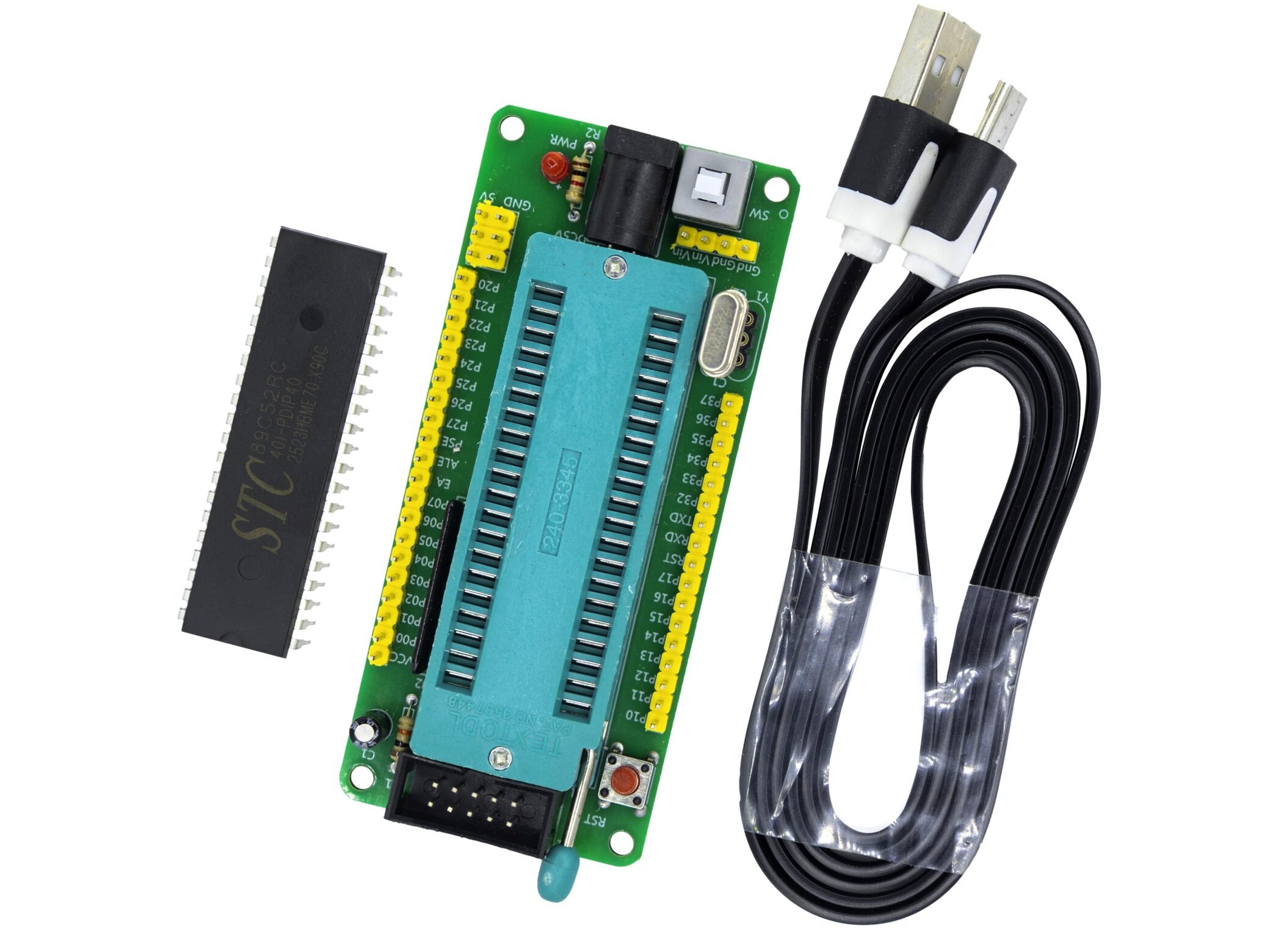
One article takes you through 51 MCU+stc89c52
Introduction
In the realm of microcontrollers, the 51 single chip microcomputer family holds a significant place, especially for beginners and professionals delving into embedded systems. Among the variants, the Stc89c52rc microcontroller stands out as a popular choice, often used with a 51 mcu development board. In this blog, we’ll explore what a 51 MCU is, dive deep into the Stc89c52rc, compare it with similar models like Stc89c51 and even touch upon its relation to advanced controllers like Stm32, understand its parameters via the Stc89c52rc datasheet and Stc89c52rc pinout, learn how to use it with code examples, and identify its application scenarios.
What is a 51 MCU?
A 51 MCU (short for 51 microcontroller unit) refers to a family of microcontrollers that are based on the Intel 8051 architecture. These microcontrollers are widely used due to their simplicity, cost – effectiveness, and ease of programming. They typically include features like on – chip memory, timers, interrupts, and input/output ports, making them suitable for a wide range of embedded applications. The 51 single chip microcomputer is a core component in many electronic projects, from simple LED blinkers to more complex automation systems.

MCU structure
- Microprocessor (CPU):Used for data processing and bit operations (bit testing, setting, and resetting).
- RAM:512 bytes, similar to a computer’s “memory”: used to store working variables and data during program operation.
- ROM:8K (Flash), similar to a computer’s “hard disk”, used to store programs and permanently save application programs.
- Parallel input/output port (I/O):Used for system buses, external memory expansion, and I/O interface chips.
- Serial input/output port (UART):Used for serial communication and I/O interface chip expansion.
- Timer/counter:Works independently of the CPU. When the counter overflows, it sends an interrupt request to the CPU.
- Clock circuit:Divided into internal oscillator and external oscillator, used for the “regular” operation of the CPU.
Classification of 51 single-chip microcomputers
The core of the 51 single – chip microcomputer is its chip. There are many chip manufacturers and various chip types. Here are some mainstream manufacturers and their single – chip microcomputer models.
- STC Series: The STC series is a type of 51 single-chip microcomputers produced by China’s Hongjing Technology. Hongjing Technology is quite well-known in China, and its product quality is good. The STC series offers a wide range of models, covering from low-performance 51 series to high-performance ARM series. Common models like STC89C51 and STC89C52 are widely used in different fields.
- Atmel Series: Atmel Corporation is a manufacturer specializing in microcontrollers, memory, and semiconductor solutions. Its 51 single-chip microcomputer products have a good reputation in the market. The Atmel series is widely recognized for its low power consumption and reliability. Models such as AT89C51 and AT89C52 are extensively used in consumer electronics, smart homes, and other fields.
- Silicon Labs Series: Silicon Labs is a semiconductor company headquartered in the United States. Its single-chip microcomputer products have high performance and integration. The Silicon Labs series is widely used in wireless communication, industrial control, and other fields. Common models like C8051F120 and C8051F340 have high computing speeds and rich peripheral interfaces.
- Renesas Series: Renesas Electronics Corporation is a Japanese semiconductor manufacturer. Its 51 single-chip microcomputer products have high reliability and stability. The Renesas series is widely used in automotive electronics, industrial control, and other fields. Common models such as R5F21276 and R5F100GJ have high computing speeds and rich peripheral interfaces.
There are many types of single – chip microcomputer chips, such as:
- ROMless type: 8031, 80C31, 8032, 80C32
- MaskROM type: 8051, 80C51, 8052, 80C52
- EPROM type: 8751, 87C51, 8752
- E²PROM type: 8951, 89C51, 8952, 89C52
Among them, 89C51 and 89C52 are quite well-known and widely used.
MCS-51 Series Single-Chip Microcomputer Classification
| Series | Model | On-chip Memory ROM | On-chip Memory RAM | External Memory RAM | External Memory ROM | I/O Ports Parallel (Bit) | I/O Ports Serial | Number of Interrupt Sources | Number of Timer/Counters (Bit) |
|---|---|---|---|---|---|---|---|---|---|
| 51 Subseries | 8031, 80C31 | None | None | 256B | None | 4×8 | 1 | 5 | 2×16 |
| 8051, 80C51 | 4KB ROM | 4KB RAM | 256B | None | 4×8 | 1 | 5 | 2×16 | |
| 8751, 87C51 | 4KB EPROM | 4KB RAM | 256B | None | 4×8 | 1 | 5 | 2×16 | |
| 8951, 89C51 | 4KB EEPROM | 4KB RAM | 64KB | 64KB | 4×8 | 1 | 5 | 2×16 | |
| 89S51 | 4KB Flash | 4KB RAM | 64KB | 64KB | 4×8 | 1 | 5 | 2×16 | |
| 52 Subseries | 8032, 80C32 | None | None | 512B | None | 4×8 | 1 | 6 | 3×16 |
| 8052, 80C52 | 8KB ROM | 8KB RAM | 512B | None | 4×8 | 1 | 6 | 3×16 | |
| 8752, 87C52 | 8KB EPROM | 8KB RAM | 512B | None | 4×8 | 1 | 6 | 3×16 | |
| 8952, 89C52 | 8KB EEPROM | 8KB RAM | 64KB | 64KB | 4×8 | 1 | 6 | 3×16 |
Product Specific Introduction: Stc89c52rc Microcontroller
The Stc89c52rc microcontroller is a member of the Stc 51 series, which is an enhanced version of the traditional 8051 architecture. Let’s look at its key parameters from the Stc89c52rc datasheet:

| PARAMETER | VALUE |
|---|---|
| CPU | 8051 – compatible core |
| Flash Memory | 8KB |
| RAM | 512 bytes |
| EEPROM | 2KB |
| Number of I/O Ports | 32 |
| Timers/Counters | 3 (16 – bit) |
| UART Channels | 1 |
| Operating Voltage | 3.3V – 5.5V |
| Operating Frequency | Up to 35MHz |
Stc89c52rc Pinout Overview
The Stc89c52rc pinout consists of various ports serving different functions:
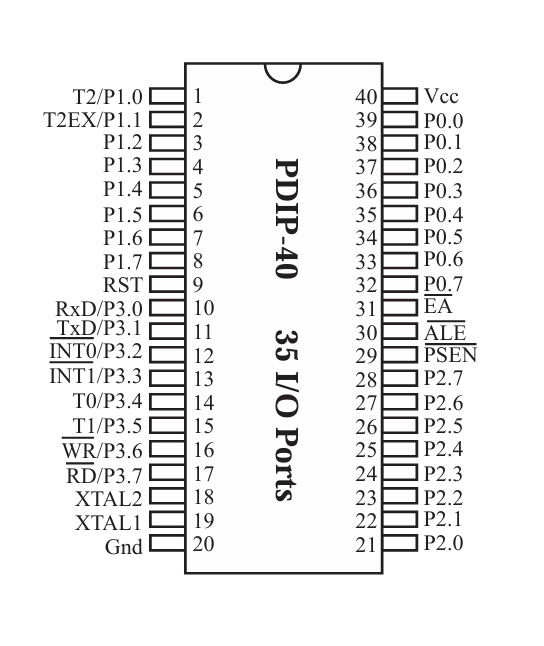
You can refer to the datasheet for the specific functions of the pins.
Comparison with Similar Models
Here’s a comparison table between Stc89c52rc, Stc89c51, and for reference, a basic Stm32 (STM32F103C8T6) to show the evolution:

| Feature | STC89C51 | STC89C52RC | STM32F103C8T6 |
|---|---|---|---|
| Flash Memory | 4KB | 8KB | 64KB |
| RAM | 128 bytes | 512 bytes | 20KB |
| CPU Architecture | 8051 | 8051 (enhanced) | ARM Cortex-M3 |
| Operating Frequency | Up to 24MHz | Up to 35MHz | Up to 72MHz |
| Peripherals (e.g., ADC, PWM) | Limited | More than STC89C51 | Rich (multiple ADCs, PWM channels, I2C, SPI, etc.) |
| Application Complexity | Simple | Moderate | Complex, high-performance |
How to Use Stc89c52rc (With Code Example)
Prerequisites
- STC89C52RC microcontroller
- Keil uVision 4/5 IDE
- STC-ISP programming software
- LED circuit (8 LEDs with current-limiting resistors)
- USB-to-serial converter (for programming)
- Power supply (5V)
Step 1: Create a New Project in Keil
- Open Keil uVision and click Project > New μVision Project
- Choose a location and name your project (e.g., “RunningLight”)
- Select the microcontroller: Atmel > AT89C52 (compatible with STC89C52RC)
- Click “OK” and select “Yes” to copy the startup code
Step 2: Write the Running Light Code
Create a new C file and add the following code:
					#include <reg52.h>

// Define LED port (connect LEDs to P1)
#define LED_PORT P1

// Delay function (approximately 500ms at 11.0592MHz)
void delay_ms(unsigned int ms) {
    unsigned int i, j;
    for(i = 0; i < ms; i++)
        for(j = 0; j < 112; j++);
}

void main() {
    unsigned char led_state = 0x01;  // Initial state: first LED on

    while(1) {
        LED_PORT = ~led_state;       // Output inverted state (active low)

        // Shift to next LED
        if(led_state == 0x80)
            led_state = 0x01;        // Reset to first LED
        else
            led_state <<= 1;         // Shift left

        delay_ms(500);               // Delay 500ms
    }
}
Add the file to your project and compile (press F7) to generate a .hex file.
Step 3: Hardware Connections
Connect the components as follows:
- Connect 8 LEDs’ anode to P1.0-P1.7 through 220Ω resistors
- Connect all LEDs’ cathode to GND
- Connect STC89C52RC VCC to 5V, GND to GND
- Connect USB-to-serial TX to STC89C52RC RXD (P3.0)
- Connect USB-to-serial RX to STC89C52RC TXD (P3.1)
- Add a 10μF capacitor between VCC and GND (for stability)
Step 4: Program the Microcontroller
- Open STC-ISP software
- Select the correct microcontroller model: STC89C52RC
- Click “Open Program File” and select your .hex file
- Choose the correct COM port (from Device Manager)
- Set baud rate to 115200
- Power off the STC89C52RC circuit
- Click “Download/Program” in STC-ISP
- Power on the circuit – programming will start automatically
Use Scenarios
The Stc89c52rc microcontroller and 51 MCU – based systems find applications in various fields:
- Education: Widely used in universities and training institutes for teaching embedded system fundamentals, as the 51 single chip microcomputer is easy to understand for beginners.
- Home Automation: Controlling simple devices like lights, fans, and small robotic systems. For example, a 51 mcu development board with Stc89c52rc can be used to build a system that turns on lights at a specific time.
- Industrial Control: Basic monitoring and control tasks where high – end controllers like Stm32 are not necessary, such as simple sensor data logging (temperature, humidity sensors connected via I/O ports).
- Hobbyist Projects: Enthusiasts use 51 MCU and Stc89c52rc for building robots, remote – controlled cars, and DIY electronic gadgets.
Conclusion
The 51 MCU family, with the Stc89c52rc microcontroller as a prominent member, remains a vital part of the embedded systems world. Whether you’re starting with a 51 mcu development board to learn the ropes or using the Stc89c52rc for a practical project, understanding its Stc89c52rc datasheet, Stc89c52rc pinout, and how to program it is essential. While advanced controllers like Stm32 offer more power, the 51 single chip microcomputer and Stc 51 series like Stc89c52rc and Stc89c51 provide an accessible entry point and effective solution for many applications.
FAQS
What is the difference between Stc89c52rc and Stc89c51?
The main differences lie in memory and some features. As seen in the comparison table, Stc89c52rc has 8KB Flash Memory and 512 bytes of RAM, while Stc89c51 has 4KB Flash Memory and 128 bytes of RAM. Stc89c52rc also typically offers slightly better performance with a higher maximum operating frequency (up to 35MHz compared to Stc89c51’s up to 24MHz).
Can I program Stc89c52rc with Arduino IDE?
While the Arduino IDE is mainly designed for Arduino boards, it’s possible to program Stc89c52rc with it, but you’ll need to install additional hardware support packages or use third – party tools to add compatibility. However, traditional tools like Keil uVision or dedicated STC programmers and their associated software are more commonly used for programming Stc89c52rc and other 51 MCU variants.
Is Stc89c52rc suitable for beginners in embedded systems?
Absolutely. The 51 single chip microcomputer architecture, which Stc89c52rc is based on, is known for its simplicity and ease of understanding. Using a 51 mcu development board with Stc89c52rc allows beginners to learn fundamental concepts of microcontrollers, such as I/O operations, timing, and interrupts, without being overwhelmed by complex architectures like those in Stm32 initially.
How does Stc89c52rc compare to Stm32 in terms of performance?
Stm32 microcontrollers, which are based on ARM Cortex – M cores, offer significantly higher performance than Stc89c52rc and other 51 MCU devices. They have more advanced peripherals, higher clock speeds, larger memory capacities, and support more complex operations. Stc89c52rc is better suited for simple, low – to – medium complexity tasks, while Stm32 is ideal for high – performance applications like motor control, advanced sensor fusion, and IoT projects.
Where can I find the latest Stc89c52rc datasheet?
You can find the Stc89c52rc datasheet on the official website of STC Microelectronics. Additionally, many electronics component distributors and technical forums also host datasheets for popular microcontrollers like Stc89c52rc. It’s important to refer to the latest datasheet for the most accurate and up – to – date information on parameters, Stc89c52rc pinout, and features.