

Blog
Simple Step-Up Converter Chip-SD6303
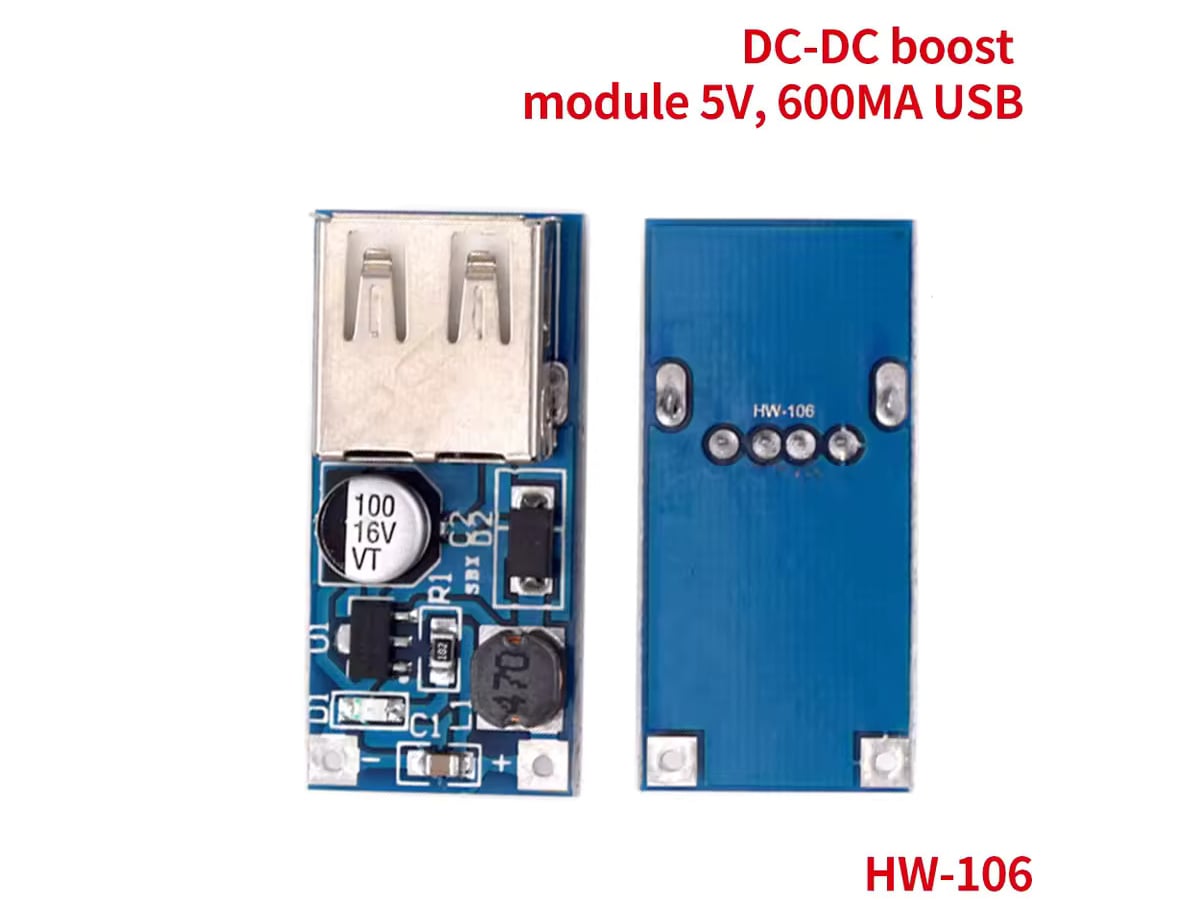
Simple Step-Up Converter Chip
What is a BOOST boost circuit?
Traditional boosting methods rely on transformers, but this approach has two major drawbacks:
1.Transformer size is hard to control. Higher power output requires thicker copper wires and insulation layers, which is unfavorable for device miniaturization and significantly increases production costs.
2.Poor compatibility with direct current (DC). Except for long-distance power transmission and motor driving, alternating current (AC) has limited applications—most modern devices run on DC. Using traditional boosting means converting DC to AC, boosting the voltage, then rectifying it back to DC. This process drastically reduces overall power efficiency and complicates the circuit.
Thus, the BOOST converter circuit, specifically designed for DC voltage boosting, came into being.A BOOST converter is a DC-specific boosting circuit popularized this century. It leverages the properties of inductors to generate an additional voltage, which superimposes with the original power supply voltage to deliver a higher output voltage.
Why is a voltage booster circuit required?
In many scenarios, there’s a gap between the input voltage and the actual required voltage. For example, battery-powered devices often use a single battery to minimize cost and size. However, lithium-ion batteries discharge between 2.7V and 4.2V—even chips like the STM32 require a minimum of 3.3V, meaning the 2.7V-3.3V range would go unused. To fully utilize the battery’s capacity, a boost converter is essential.
How Does a BOOST Converter Work?
Simply saying, a BOOST converter uses the principle that an inductor’s current cannot change instantaneously. When the inductor is charged and the input current is suddenly reduced, the inductor generates a voltage in the same direction as the original to maintain the current flow. The magnitude of this voltage depends on the current and time:
U=L*di/dt
By superimposing this induced voltage with the power supply voltage, a higher output voltage is achieved.
Here’s the basic working logic:
1.When charging the inductor, disconnect other loads to let the inductor current reach its maximum safe value.
2.During discharge, connect the inductor in series with the power supply. The load causes the inductor current to tend to decrease, so the inductor inevitably produces an induced voltage in the same direction as the charging voltage. Since the currents in a series circuit are equal but voltages add up, the output voltage equals the sum of the power supply voltage and the inductor’s induced voltage.
Congratulations—you’ve just grasped the core of a BOOST converter!
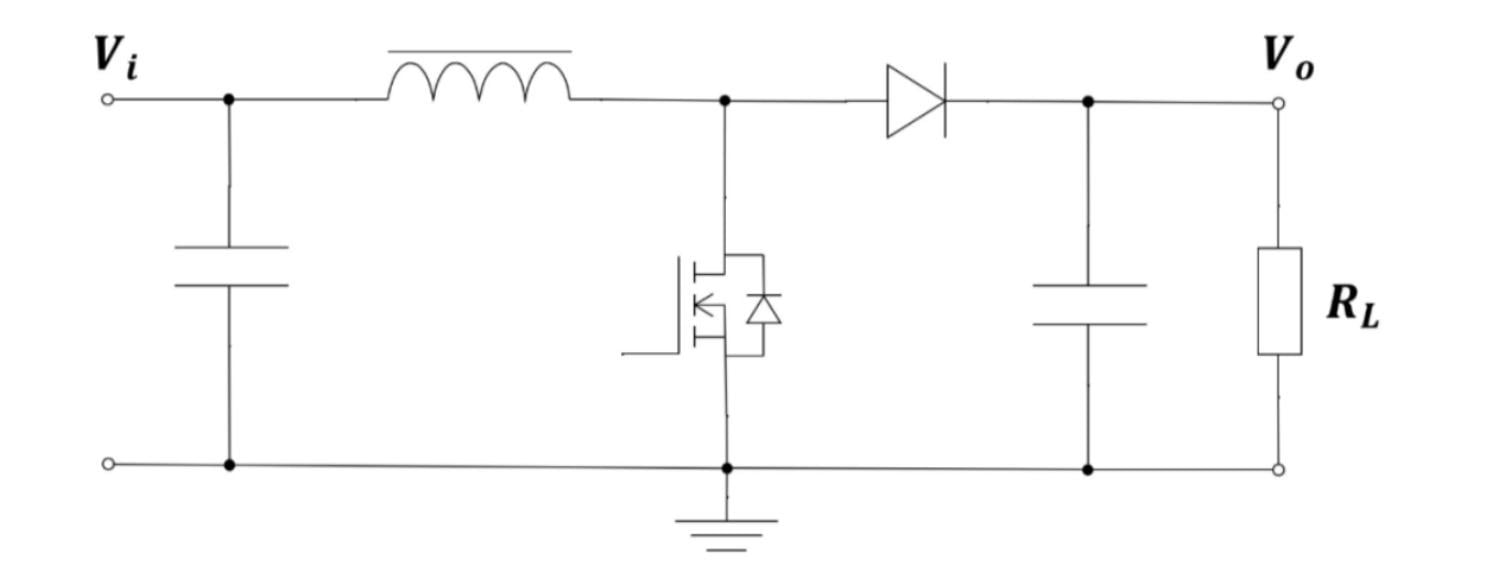
During charging, the inductor induces a voltage with the left positive and right negative, opposing the power supply voltage. The voltage from the inductor is very low, while the output capacitor’s voltage doesn’t drop immediately. A diode is needed to prevent current backflow, ensuring the MOSFET only receives current from the inductor. At this stage, the load is powered by the capacitor on the right. Note: The MOSFET should not stay closed for too long—once the inductor current saturates, it can no longer prevent rapid current growth, which may burn the circuit.
In the discharge phase, the MOSFET closes. According to the inductor’s properties, the power supply voltage (Vi) and the inductor voltage (VL) superimpose to power the load (RL) and charge the capacitor.
This is the basic operating principle of a BOOST converter. Theoretically, a higher switching frequency allows for a smaller inductor. Since MOSFETs can switch at very high frequencies, modern BOOST converters can be made extremely compact.
This is just the most basic BOOST converter—more complex DC boost circuits exist but are not covered here. Additionally, with advances in integrated electronics, many components can be integrated into a single chip. A simple BOOST circuit can now be built with just an inductor and a few capacitors, such as the SD6303 chip.
What is SD6303?
The SD6303 series is a high-efficiency, low-ripple BOOST converter chip with an extremely high operating frequency. Its core is a Pulse Frequency Modulation (PFM) control circuit. Unlike Pulse Width Modulation (PWM), which adjusts pulse width while keeping the interval constant, PFM uses fixed pulse widths and varies the interval to control the MOSFET’s switching time.
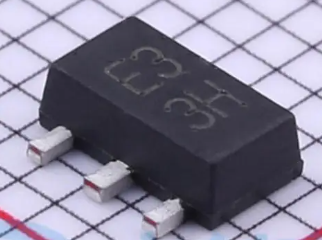
The circuit requires only a minimum of one inductor, one diode, and two capacitors to operate. It comes in compact packages like SOT23, further reducing circuit size. With a minimum startup voltage of 0.7V, it can handle power sources with large voltage fluctuations, such as solar panels. The chip integrates an output voltage feedback and correction network, startup circuit, oscillation circuit, reference voltage circuit, PFM control circuit, overcurrent protection circuit, and a MOSFET. The oscillation circuit provides a reference frequency and fixed pulse width, while the reference voltage circuit delivers a stable reference level. Thanks to internal correction technology, the output voltage accuracy is ±2.5%. The reference voltage also features temperature compensation, ensuring the chip’s output voltage temperature coefficient is less than 100ppm. A high-gain error amplifier maintains stable output voltage across different input voltages and load currents.
Key Parameter Information of SD6303
| Maximum Operating Frequency | 300kHz | Minimum Startup Voltage | 0.8V (1mA) |
| Output Accuracy | ±2.5% | Input Voltage Range | 0.8V – VOUT |
| Maximum Efficiency | 89% | Built-in MOSFET Max Current | 1000mA |
| EN Pin Threshold Voltage | 0.4 × VOUT | Maximum Output Current | 800mA |
| Maximum Duty Cycle | 83% | No-Load Current | 10µA |
What Scenarios is the SD6303 Suitable For?
Designed for low-power, compact devices, the SD6303 has a rated power of 250mW but can handle up to 600mA—more than enough for small devices. Its wide input voltage range (0.8V to VOUT) makes it versatile. It’s ideal for battery-powered devices like remote controls, or any low-power device requiring a voltage higher than the battery’s output. You can even use 2 AA batteries to charge a smartphone with it!
SD6303 Application Circuit
The SD6303 comes in versions with built-in or external MOSFETs, each with pros and cons: the built-in version offers simpler design and lower cost, while the external version allows for higher-quality MOSFETs, delivering better efficiency and power.
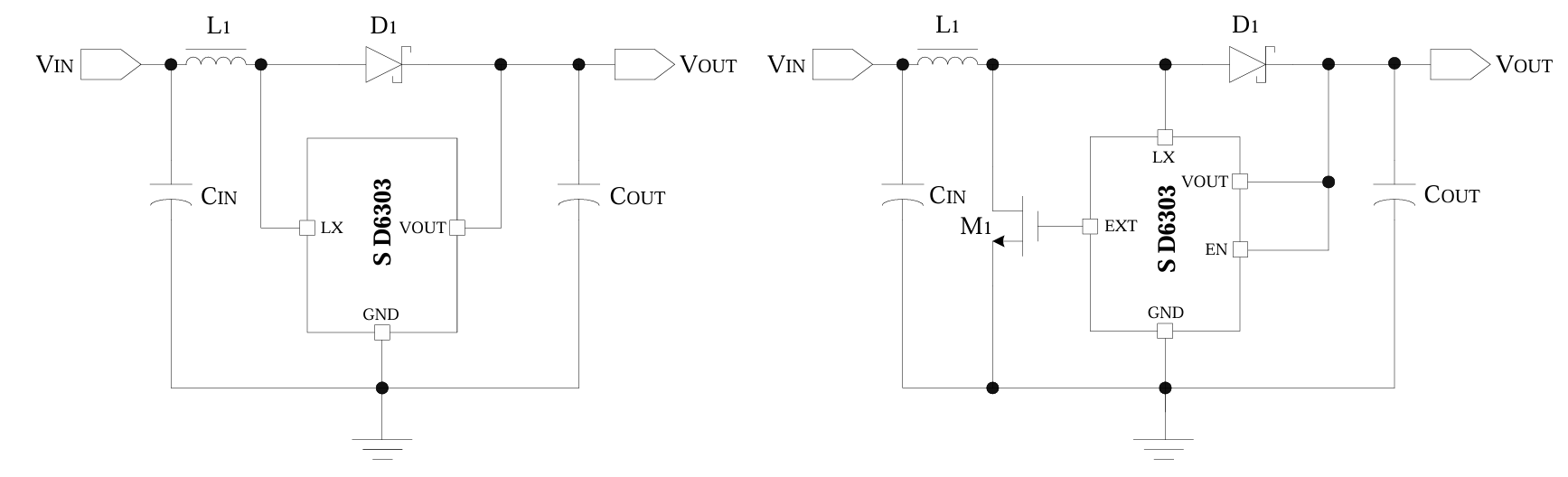
Component selection requires attention:
- Inductor: Avoid overly small or large inductors. A too-small inductor easily saturates, causing excessive output ripple and damaging other components due to overcurrent. A too-large inductor reduces output current under the same load and increases cost/size. The datasheet recommends 47μH; increase the value slightly for higher current needs.
- Diode: Schottky diodes with low voltage drop are ideal, but the commonly used 1N58 series balances performance and cost.
- External MOSFET (if applicable): Choose one with low on-resistance. While no specific voltage rating is given, experience suggests it should not exceed VOUT.
- Capacitors: Use a 22μF output capacitor (larger with lower ESR for heavy loads). For the input capacitor, a larger value is better—mount it close to the chip on the PCB for optimal performance.
Since the SD6303 has a 5V output version, you can add a USB port to power other low-power devices, turning it into an SD6303 module.