

Blog
High-Precision Microvolt/Millivolt Voltage Amplifier Module
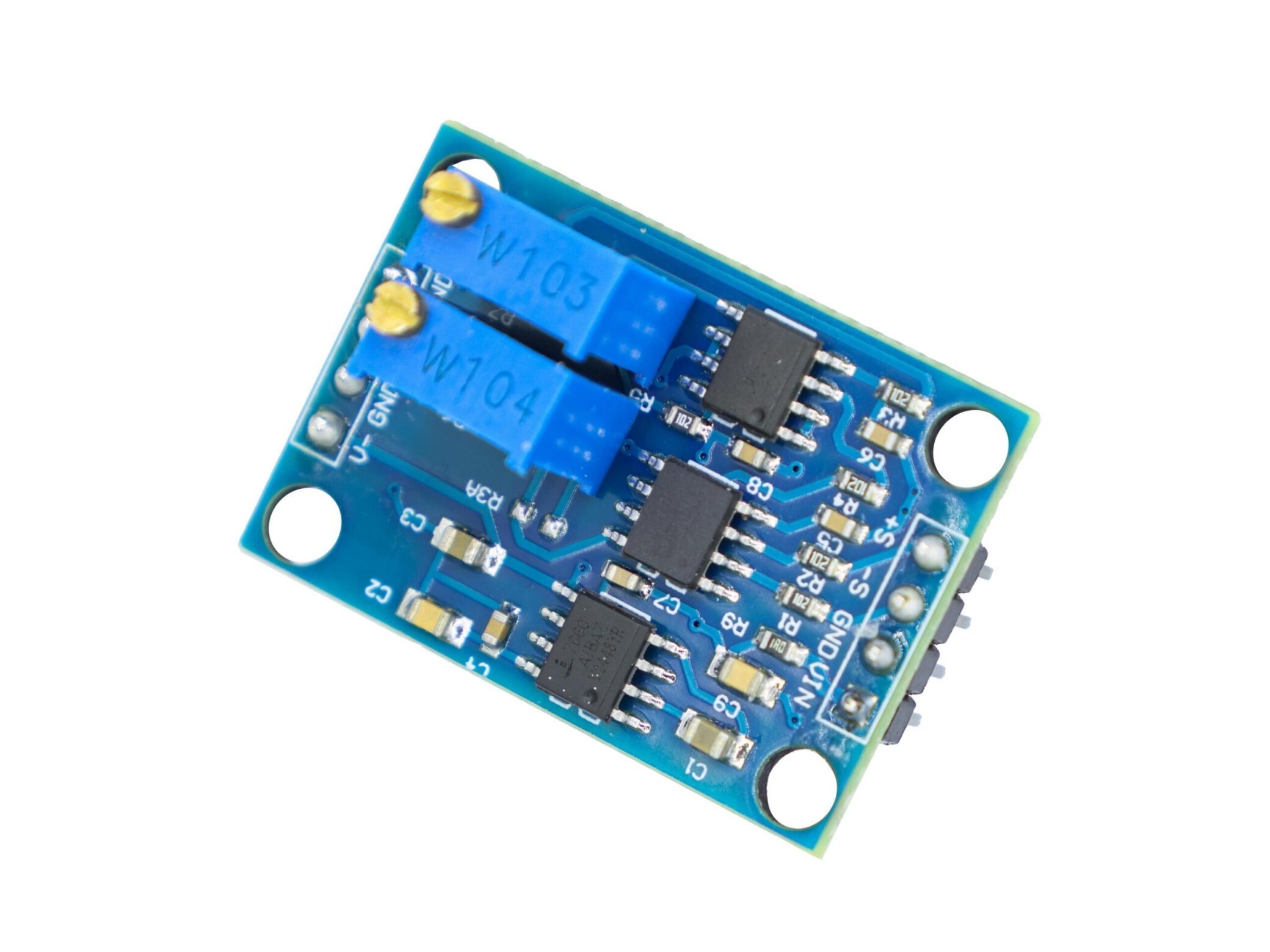
What is the voltage amplifier?
The voltage amplifier constitutes one of the signal amplification units in electronic circuits. Its core functionality involves amplifying weak input voltage signals by a fixed proportional ratio to achieve the required voltage magnitude while minimizing signal distortion issues, thereby facilitating subsequent processing or utilization. This component is primarily employed to interface weak input voltage signals with control units.
Working Principle of Voltage Amplifier
The operational principle of a voltage amplifier relies on the nonlinear characteristics of active devices (transistors/field-effect transistors) that are properly DC-biased to operate in their linear amplification region. This enables a weak input voltage signal to control the energy from an external DC power supply, ultimately converting it into an output voltage signal across a load resistor that maintains an identical waveform but with significantly amplified magnitude.
Achieving this “small-controlling-large” energy conversion necessitates the use of active devices. The most classic and commonly employed active devices for voltage amplification are bipolar junction transistors (BJTs) and field-effect transistors (FETs).
Working Principle of a Transistor (using an NPN BJT as an example):
The transistor has three terminals: emitter (E), base (B), and collector (C). Biasing: A suitable DC bias voltage is established through external resistors to set the operating point in the amplification region. This is fundamental for proper amplifier operation.
Control Process:
a. The weak AC input voltage signal (Vin) is superimposed onto the DC bias voltage at the base terminal.
b. Minute variations in the base voltage induce corresponding small changes in the base current (Ib).
c. Due to the transistor’s current amplification effect (β = Ic/Ib), these minor base current variations result in substantial changes in the collector current (Ic).
d. This significantly varying Ic flows through a collector resistor (Rc). According to Ohm’s Law (V = I×R), it generates a proportionally large voltage drop across the resistor.
e. The final output voltage (Vout) is extracted between the collector terminal and ground. This voltage exhibits a variation magnitude substantially greater than that of the input voltage, thereby achieving voltage amplification.
Working Principle of a Field-Effect Transistor (MOSFET):
The input voltage (Vin) is applied between the gate (G) and source (S) terminals.
Minimal variations in the gate voltage modulate the channel width through field effect, consequently controlling substantial changes in the drain-to-source current (Id).
Id similarly flows through a drain resistor (Rd), producing an amplified output voltage (Vout).
What is the ideal voltage amplifier?
An ideal voltage amplifier should have infinite input impedance (drawing no current from the preceding stage), zero output impedance (output voltage completely unaffected by the load), infinite open-loop gain and bandwidth (amplifying signals of any frequency without distortion), while being entirely free of noise and distortion, possessing infinite common-mode rejection ratio (CMRR) and power supply rejection ratio (PSRR), and exhibiting no performance variation with temperature. The performance parameters pursued for voltage amplifiers continuously improve toward these goals, yet they can never fully achieve equivalence to an ideal voltage amplifier.
Applications of Voltage Amplifiers
The purpose of a voltage amplifier is to amplify weak voltage signals to the required amplitude while preserving their original characteristics (such as waveform and frequency) as much as possible. It is commonly used in electronic systems to interface weak signal sources with signal processing modules.
For example, when various types of sensors are in use, they convert physical quantities (such as temperature, pressure, light intensity, etc.) into electrical signals. However, the output electrical signals are too weak to be recognized and processed by ADCs, MCUs, and other components. Therefore, a voltage amplifier is required to amplify the output electrical signals to bring them within the normal voltage range.
There are many other examples, such as the raw signals from microphone outputs, low-frequency and intermediate-frequency signals at the receiving end in communication systems, as well as weak voltage processing in commonly used oscilloscopes and multimeters—all serving the same purpose.
Voltage Amplifier Based on AD620

Electrical Parameters of Voltage Amplifier
| Parameter Name | Parameter Value |
|---|---|
| Operating Voltage | DC 4.5-20V |
| Quiescent Current | <50µA |
| Output Level | High 3.3V / Low 0V |
| Trigger Mode | Non-repeatable trigger / Repeat trigger (default) |
| Lockout Time | 2.5s (default), adjustable range from fractions of a second to tens of seconds |
| Operating Temperature | -15°C to 70°C |
Application Scenarios of Voltage Amplifiers
Voltage amplifiers have extensive application scenarios. This product can be used for signal amplification of various sensors, such as weak signals output from strain gauges, thermocouples, accelerometers, pressure transducers, etc. The amplified signals are then processed to enable precise control by controllers. Alternatively, it can isolate and amplify signals from field sensors (e.g., 4-20mA) before transmitting them to PLC or DCS control systems, thereby improving anti-interference capability and safety. In summary, this voltage amplifier can be employed in most scenarios requiring voltage boosting and filtering.
How can I amplify voltage?
This product features eight ports, primarily divided into input and output ports.
The side with Vin, +S, -S, and GND constitutes the signal input ports.
The side with V-, GND, Vout, and GND serves as the signal output ports.
During use, the signal input, signal output, and power input must share a common ground.
+S is the signal input positive terminal, and -S is the signal input negative terminal (which can be grounded).
V- can output the Vin voltage (can supply power to sensors).
Below is the port diagram of the voltage amplifier:

Zero Adjustment Wiring Diagram: Before use, wire according to the diagram for zero adjustment. Short-circuit +S and -S, then adjust the trimming potentiometer until the output Vout reads 0V.

2.Single-Ended Input Wiring Diagram: This wiring diagram is suitable for single-ended output signals from sensors, silicon photocells, etc.

3.Differential Input Wiring Diagram: This wiring diagram is suitable for sensors with differential outputs, such as pressure transducers and bridge circuits.

FAQ
What is the difference between a current amplifier and a voltage amplifier?
Current amplifiers focus on amplifying current, featuring low input and high output impedance, making them suitable for driving low-impedance loads (e.g., coils, LEDs). Voltage amplifiers focus on amplifying voltage, featuring high input and low output impedance, making them suitable for signal conditioning and driving high-impedance loads (e.g., sensors, audio preamplifiers). The fundamental distinction lies in their requirements for impedance matching and output capability.
Is bjt a voltage amplifier?
A BJT (Bipolar Junction Transistor) is inherently not a voltage amplifier but a current-controlled device. However, through circuit design (such as common-emitter configuration), it can be configured as a voltage amplifier. Yet, it requires external circuitry to achieve voltage amplification functionality. Its performance (gain, bandwidth, etc.) is influenced by factors like bias circuits and load resistors, making it non-ideal as a voltage amplifier.
What is another name for a voltage amplifier?
The most accurate and widely used alternative name is:Operational Amplifier (Op-Amp).This is the most common synonym in modern electronics.
What is the difference between a power amplifier and a voltage amplifier?
The core functionalities of power amplifiers and voltage amplifiers differ significantly. Power amplifiers primarily amplify power, capable of delivering both higher output voltage and substantial output current, making them suitable for directly driving low-impedance loads. In contrast, voltage amplifiers only provide higher output voltage with limited current output capability, making them ideal for driving high-impedance loads. Furthermore, power amplifiers place greater emphasis on output power, efficiency, thermal management, and distortion issues. Specific differences are summarized in the table below:
| Characteristic | Voltage Amplifier | Power Amplifier |
|---|---|---|
| Core Objective | Amplify voltage | Amplify power (voltage + current) |
| Output Capability | High voltage, low current | High voltage, high current |
| Efficiency | Not important (typically low) | Critical metric (requires high efficiency) |
| Heat Dissipation Needs | Basically no heat dissipation required | Heat sink must be equipped |
| Load Impedance | High impedance (e.g., >1kΩ) | Low impedance (e.g., 4-8Ω speaker) |