

Blog
An Article to Understand Portable Power Station: Unlocking New Ways of Outdoor Electricity Usage

During weekends and holidays, traveling by RV, camping in the wild, fishing, etc. have become a fashionable way of life. Before going on a trip to the outdoors, one must fully prepare for the tasks at hand, so as to fully enjoy the pleasures of camping. How can outdoor life be made more refined? The first step is to solve the most basic electricity problem. Otherwise, various electronic devices such as refrigerators, water boilers, cameras, drones, movies, etc. will not be able to perform their functions properly.
What is a portable power station?

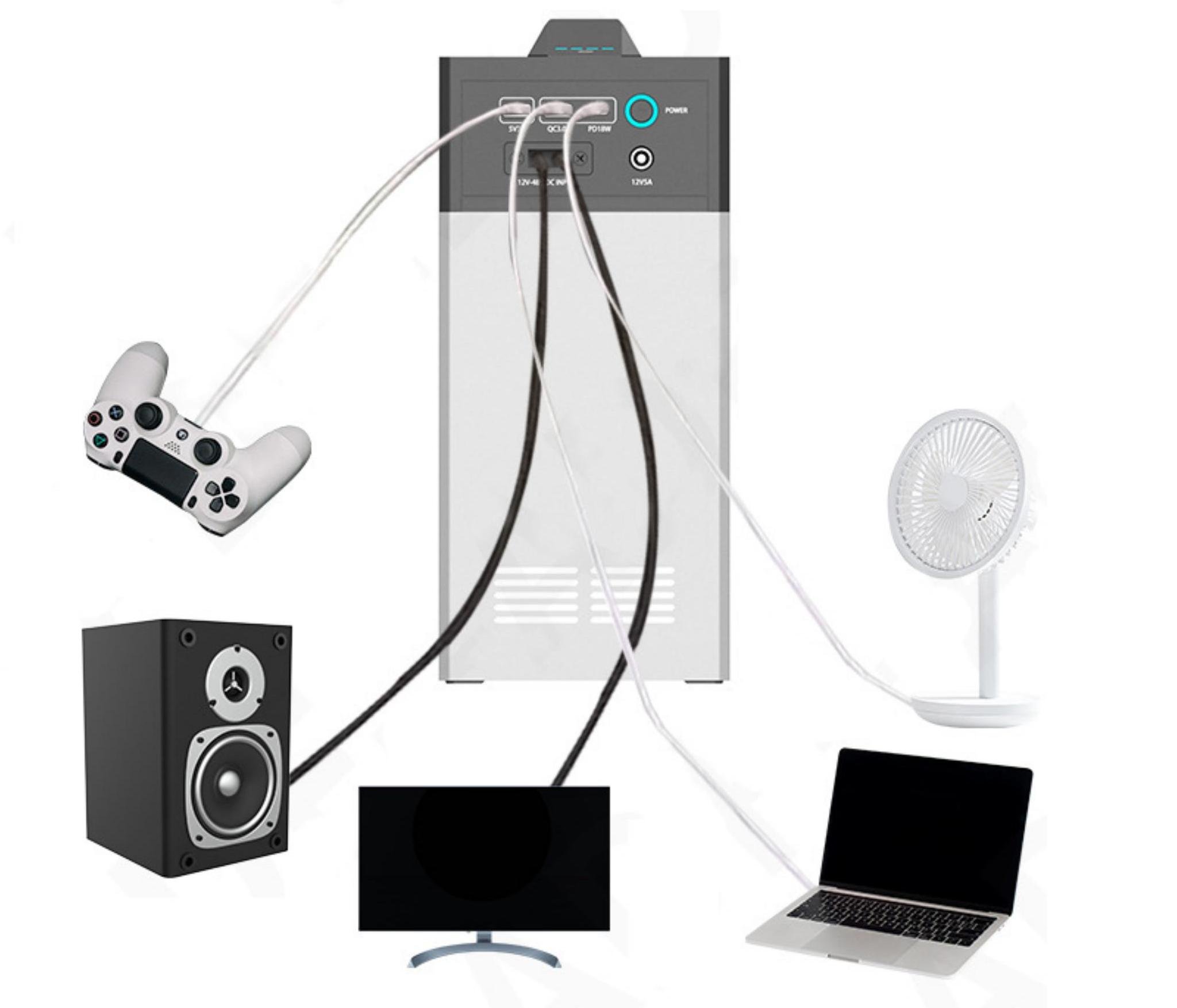
When it comes to outdoor power usage, many people might first think of “rumbling diesel generators” or “portable power bank with a battery life of 30 minutes”, but portable power station has already transcended these limitations. It is a portable power equipment that integrates “energy storage, power supply, and safety protection”. Its core consists of lithium battery, various types of interfaces, and an intelligent protection system. The size is usually that of a suitcase, and the weight is typically between 5-15KG, which even women can carry easily.
Take a common 1000wh portable power station as an example. Its capacity is equivalent to the total of 90 2942mAh mobile phone batteries, but it weighs only 8.9KG. The size is approximately 322mm*220.55*141mm, and it can fit easily in the trunk of a car or a camping backpack. Compared to traditional outdoor power supplies, its greatest advantage is “clean and noise-free”. Pressing the switch provides quiet power supply, and the output is a pure sine wave current, exactly the same as the current of household sockets. Charging precision equipment such as portable power station for laptop and cameras will not damage the batteries, solving the pain points of traditional power supplies such as “damaging equipment and loud noise”, making it the first choice for best portable power source.
Core Components of Portable Power Station
A reliable portable power station mainly relies on three key components: “battery, inverter, and protection system”. These three elements jointly determine the capacity, power supply stability and safety of the device, and are also the key factor that distinguishes the best portable power stations from ordinary products.
The battery (the foundation of capacity and safety)
Most mainstream portable power stations adopt 3.2V LiFePO4 battery cells, which can be combined in series/parallel to form different capacities (such as 100Ah, 280Ah, 314Ah), corresponding to total capacity specifications like 320Wh, 896Wh, 1004.8Wh, etc. It is like “matching fuel tanks of different sizes” for the power station, meeting diverse needs from short-distance camping (100Wh-500Wh portable power station) to home emergency power supply (portable power stations with 1000Wh and above).
The advantage of LiFePO4 batteries lies in their stable chemical properties, with a cycle charge-discharge count of over 2000 times. Calculate based on one use per week, their service life can exceed 5 years, far longer than the 500-cycle life of ordinary portable power banks, and they are the core guarantee for rechargeable portable power stations.
The inverter (the key component for converting direct current to alternating current)
The battery stores direct current (the same as that in mobile phone batteries), while appliances such as portable power station for tv and small refrigerators require alternating current. The inverter is a “current converter” that can convert direct current into alternating current, and the output waveform is a pure sine wave. This waveform is consistent with the household power grid and will not cause devices to freeze or crash like “modified waves”. Even current-sensitive devices such as projectors and low-power portable power stations for medical devices can be driven stably, meeting the requirements of AC power station.
The protection system (BMS intelligently safeguards electrical safety)
A BMS (Battery Management System) is hidden inside the device, serving as a “24-hour online security guard” that can real-time monitor the battery’s voltage, temperature, and current status. When hazardous conditions such as excessive temperature (over-temperature protection), current exceeding the standard (over-current protection), abnormal voltage (over-charging/over-discharging protection), and line short circuit (short-circuit protection) are detected, the BMS will cut off the power instantly to avoid safety accidents like battery swelling and fire. For example, when the battery voltage exceeds 3.65-3.7V (over-charging threshold) or drops below 2.65-2.7V (over-discharging threshold), the system will immediately stop charging and discharging, providing all-round protection for the electrical safety of the portable power station. This is also the core configuration of a safe portable power station.
Core Parameters of Portable Power Stations
Many people find parameters like “1000Wh” and “300W” complicated, but in fact, these numbers are intuitive reflections of the “power usage experience”. They become clear at a glance when broken down, and are even the key basis for selecting the best portable power station:
Capacity (Wh)
1000Wh does not mean “1000 watts of power”, but “total energy storage capacity”, with the calculation formula being “Power (W) × Time (h)”. For example, a 1000Wh portable power station can power a 20W camping light for 50 hours, a 60W laptop for 16 hours, a 100W small TV for 10 hours, and a 6W car refrigerator for 166 hours, which can fully meet the power needs of weekend camping or short-term power outages. When purchasing, you can estimate based on the power of commonly used devices: if you mainly power mobile phones (5V3A) and laptops (60W), a 500Wh-800Wh portable power station is sufficient. If you need to power a small refrigerator or projector, it is recommended to choose a portable power station with 1000Wh or more, such as a 1500 watt power station.
Output Power (W)
Parameters are usually marked with “rated power” and “peak power”. The former is the power that the device can stably output, while the latter is the power used to cope with the instantaneous high power consumption when the device starts. Taking a portable power station with a rated power of 300W and a peak power of 500W as an example, the rated power can stably drive low-power devices such as 30W fans, 100W small TVs, and 60W projectors. The peak power can handle the instantaneous high power consumption of 200W hair dryers and 300W electric cookers when they start, preventing the device from tripping as soon as it is turned on.
It should be noted that during long-term use, the total power of the connected devices must not exceed the rated power. Otherwise, overload protection will be triggered. For example, a 2000W portable power station cannot drive devices with power exceeding 2000W for a long time.
Charging Parameters
Portable power stations support multiple charging methods, no need to rely on fixed sockets, and are suitable for different scenarios, which is the core advantage of rechargeable portable power station:
① AC charging: Charging via household/hotel sockets, which can be charged from 0 to 100% in 80 minutes and 0 to 80% in 50 minutes. It is suitable for home energy replenishment and adapts to indoor power station scenarios.
② Solar charging: Paired with a solar panel for portable power station with 12-48V and within 200W, it can be fully charged in about 3 hours. It is suitable for outdoor portable power station scenarios without power grids, such as solar portable power station.
③ Car charging: It takes 5-7 hours to fully charge via a 12V car charging port and 3-4 hours via a 24V car charging port. It enables “on-the-road energy replenishment” during long-distance self-driving and adapts to portable power station for car.
④ Generator charging: It can be quickly fully charged in 1.2 hours, meeting the emergency energy replenishment needs in extreme weather (such as heavy rain, cloudy days) and adapting to generator portable power station.
Portable Power Station vs Traditional Power Source
Compared with fuel generators and portable power bank, portable power station has obvious advantages. Precisely because of this, they have gradually become the mainstream choice for outdoor portable power source and home backup power station.
Comparison Dimensions | Fuel generator | Ordinary portable power bank | |
Noise | No noise (<30 decibels), suitable for the requirements of quiet portable power stations. | High noise level (60-80 decibels) | No noise |
Environmental Friendliness | Zero emission and zero pollution, belonging to eco-friendly portable power station | Emit exhaust gases (including CO, PM2.5) | Zero emission |
Battery Life | Long (500Wh – 2000Wh), such as a 1000Wh portable power station | Dependent on oil volume (require frequent refueling) | Short (10Wh – 100Wh) |
Power Supply Stability | Pure sine wave (stable), suitable for portable power station for small appliances. | Modified sine wave (prone to damaging equipment) | Only DC (suitable for few devices) |
Portability | Medium (5-15KG, portable by hand), such as a small portable power station. | Poor (over 20KG, requiring a cart) | Good (<1KG, portable to carry with you) |
Applicable Scenarios | Camping (camping power station)、emergency (power stations for power outages)、outdoor work | Large-scale construction sites, long-duration power outages | Daily charging for mobile phones and tablets |
As can be seen from the comparison, the portable power station balances “battery life, stability, portability and environmental protection”. It can not only meet the sophisticated power demand of the portable camping power station, but also cope with the scenario of the portable power station for home backup, filling the gap of traditional power supplies and becoming the first choice for the best portable power supply.
FAQ
How long will a portable power station run?
The operating duration of a mobile power station is significantly affected by factors such as energy storage capacity, load power, and power supply mode, leading to large variations. Portable models can generally run for several hours to more than ten hours. Home emergency models can operate for several hours to about a day. Industrial-grade mobile power stations or those equipped with continuous energy supply (such as fuel oil, solar energy) can run continuously for more than ten hours or even longer, and some emergency power supply vehicles can provide power for a long time when fuel is sufficient.
How does a portable power station work?
① Charging the Battery:
AC Wall Outlet: Plug the power station into a standard household socket.
Solar Panel: Connect a compatible solar panel to utilize solar energy.
Car Charger: Use the car’s 12V DC socket for charging during travel.
② Energy Storage: After charging, the battery stores electrical energy in the form of direct current (DC).
③ Power Conversion: When you connect a device to the power station, the inverter converts the stored DC power into alternating current (AC) as needed. For devices requiring DC power (e.g., USB-powered gadgets), power is supplied directly.
④ Powering Devices: You can connect multiple devices to different output ports. The power station manages the energy flow to ensure each connected device receives the appropriate amount of electricity.

