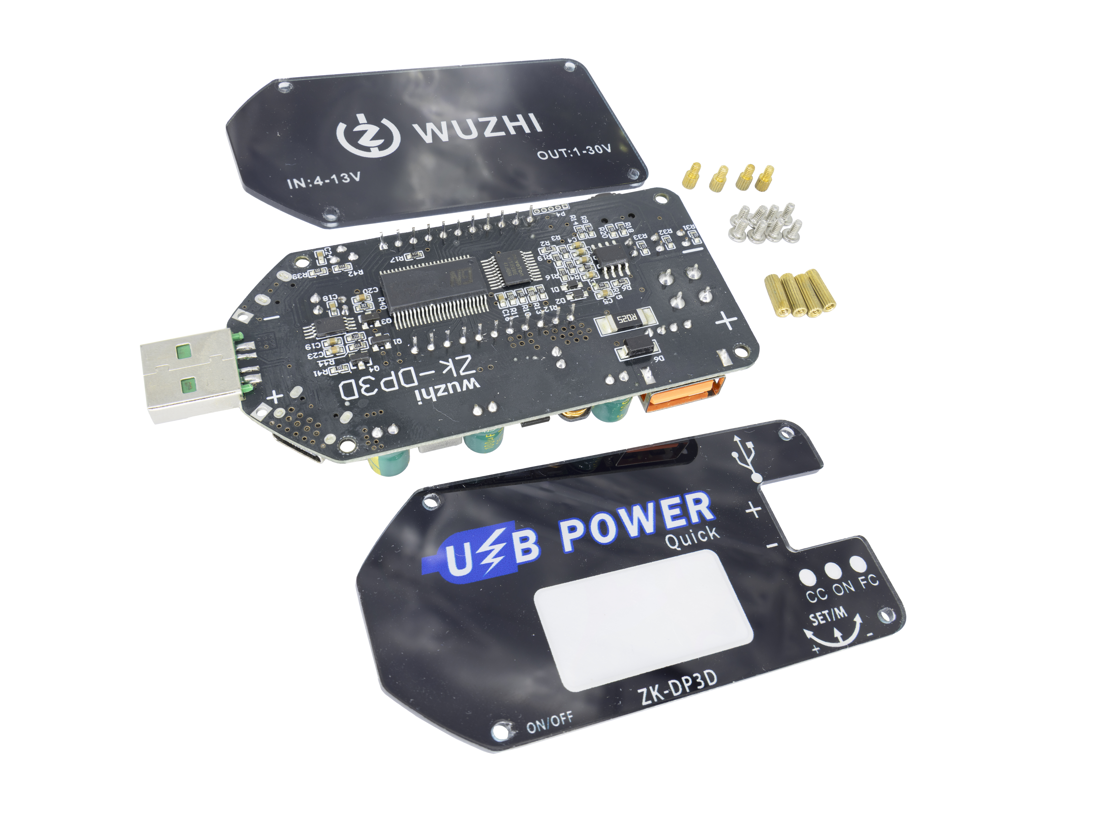
What is an adjustable buck-boost module?
An adjustable buck-boost converter is a DC current conversion component. It can adjust to a specified output voltage according to changes in the input voltage and maintain a stable output. It is capable of both stable voltage boosting and stable voltage bucking, making it suitable for scenarios with variable voltages or where components require testing of various voltage requirements.
Working principle of buck-boost converter
Most adjustable buck-boost modules adopt the Buck-Boost topology. The core components include switching elements (controlling energy transmission), inductors (storing and discharging energy), diodes or synchronous rectifiers (providing current paths when switches are turned off), capacitors (stabilizing voltage), and control circuits (adjusting switch duty cycle to stabilize voltage).
- BUCK (step-down): The output voltage is determined by the duty cycle: Vout = D * Vin (where D is the proportion of on-time).
- BOOST (step-up): The inductor voltage is superimposed with the input voltage (VL + Vin), and power is supplied to the load and capacitor through the diode.
The output voltage Vout = Vin / (1 – D).
By combining these two circuits, buck-boost functionality can be achieved.
What does a buck-boost converter do?
With its excellent output voltage range and convenient usage, the adjustable buck-boost module plays a role in multiple fields. Battery-powered devices: boosting voltage for 3.7V lithium batteries, stepping down voltage for 12V lead-acid batteries, and stabilizing the output voltage of mobile batteries. DIY electronic projects: adapting to low-power components, such as connecting a high-power power supply to a buck-boost module to output voltage to a single-chip microcomputer; some sensors that require specific voltages can also be adjusted to the corresponding voltage through the module. LED driving: the brightness of LED lights can be changed by adjusting the output voltage. Consumer electronic products: wireless chargers, where the buck-boost circuit adjusts the coil driving voltage. The above are all typical application scenarios of buck-boost modules.
DC-DC USB Adjustable Buck-Boost Voltage Regulator Power Board Desktop Power Module
This adjustable buck-boost module is relatively compact and portable, with a wide output voltage range, making it suitable for general low-power electrical appliances. When in use, simply plug it into a USB or MicroUSB port. Then, you can adjust the output voltage by rotating the adjustable potentiometer—the faster the rotation, the greater the adjustment range. The output voltage can be viewed on the nixie tube, facilitating easy adjustment. With its ability to output multiple voltages, it is sufficient for daily use and electronic DIY scenarios.
A short press of the button can cut off the output voltage, and a long press can turn off the nixie tube display. In application, it can convert an input voltage of 5V to common output voltages such as 3.3V, 5V,9V, 12V, and 24V.
Comparison with other adjustable buck-boost converters
Compared with other adjustable buck-boost modules, its biggest advantage is that it can be powered via USB and MicroUSB, which makes it highly convenient for daily use. Secondly, it has a relatively wide voltage range, supporting output of common voltages such as 3.3V, 9V, 12V, and 24V, thus being applicable to a wide range of scenarios. Meanwhile, the mature production process ensures that this adjustable buck-boost module has a high cost performance and a low price, making it suitable for ordinary people to keep at home as a backup, as well as for electronic engineers and enthusiasts to carry and use at any time. However, due to its size limitation, it cannot be used for high-power electronic devices.
Technical Parameters Description
Input voltage range: 3.5V-12V
Output voltage range: 1.2V-24V
Output power: The applicable power threshold varies depending on the output voltage.
- When the output voltage is 1.2V-2V, it should be used within 2W.
- When the output voltage is 2V-20V, it should be used within 3W.
- When the output voltage is 20V-24V, it should be used within 2.5W.
In case of excessive current, it will automatically cut off the circuit to protect the safety of the circuit.
Introduction to Application Scenarios
The application scenarios of adjustable buck-boost modules are very extensive, covering almost all low-power electronic devices that require flexible voltage conversion. Here are some common scenarios:
Power supply for mobile devices: For example, common electronic devices such as mobile phones, tablets, and Bluetooth headsets need their power sources to be converted to the common voltage (5V) for normal charging.
Testing electronic devices: When testing various low-power electronic devices, such as handheld fans, you can connect the positive and negative poles to the adjustable buck-boost module to test whether they work normally.
Precautions
When in use, pay attention to the input and output voltage levels of the application; they must not be lower than or exceed the voltage range.
If the current exceeds the applicable range, it will trigger a circuit break to protect the circuit. However, attention should also be paid to the issue of the power used.
FAQ
What is the difference between boost and buck-boost converter?
A boost converter can only increase the input voltage and cannot reduce it. A buck-boost converter, on the other hand, can both increase and decrease the input voltage. Moreover, their working principles are different: a boost converter achieves voltage boosting through inductor energy storage and capacitor discharge, with the input and output voltages being in phase. However, the topology of a buck-boost converter is more complex, and its input and output voltages are out of phase.
Why is it called buck-boost?
This name is derived from the combination of the two, and its usage purpose is reflected in its name. It can both step down and step up the voltage.