

Blog
Comprehensive Overview of the XY‑2.5AD 2.5A Dual‑Way Motor Drive Module
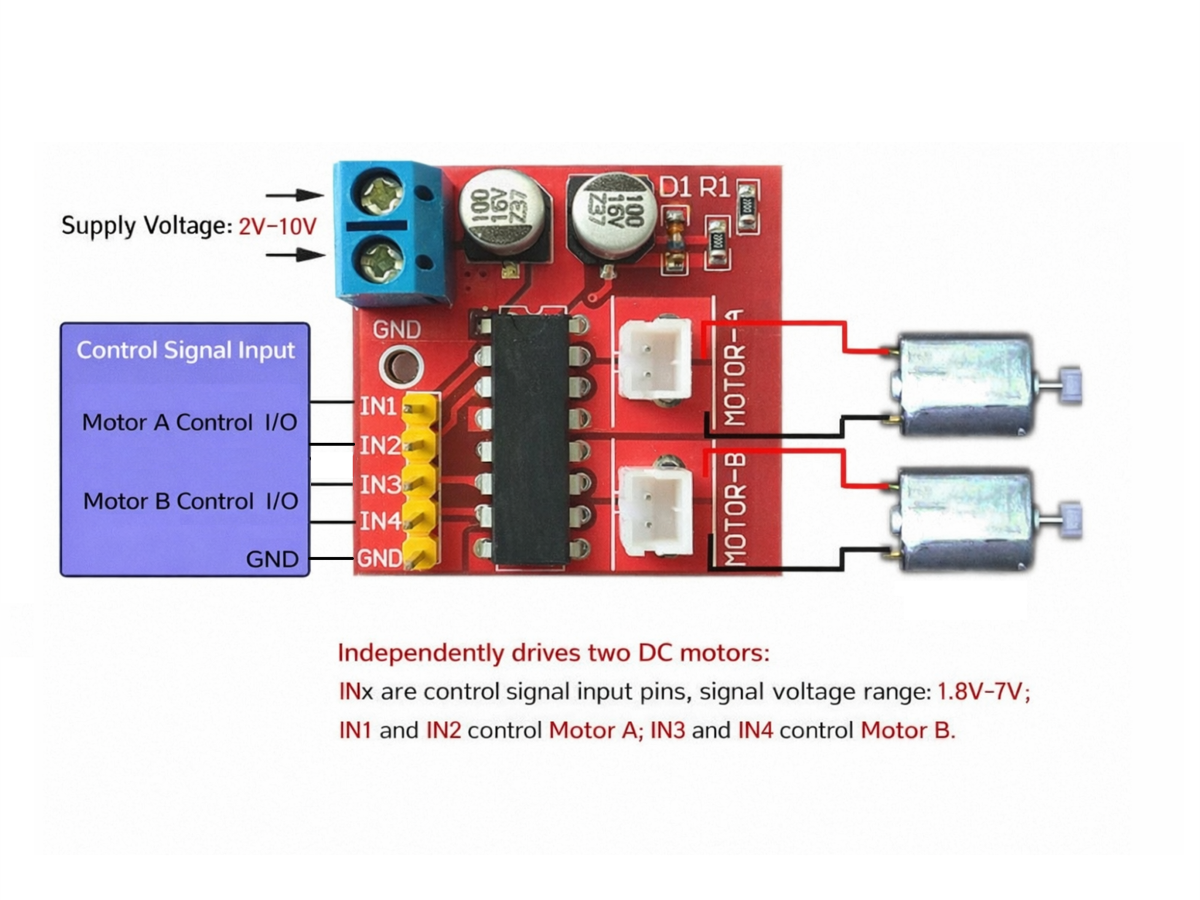
What is XY-2.5AD 2.5A dual-way motor drive module?
The XY‑2.5AD 2.5A dual‑way motor drive module is a practical and cost‑effective solution for controlling low‑to‑medium power brushed DC and stepper motors in a range of electronics and robotics projects. Its compact size, dual‑motor capability, built‑in protection mechanisms, and compatibility with common microcontrollers make it popular among beginners and hobbyists alike. Whether used for mobile robots, automated systems, or educational experiments, this module balances performance with simplicity, offering a flexible platform for motor control.
Key Features & Specifications of XY-2.5AD
Dual H‑Bridge Architecture
The core of the XY‑2.5AD module is its dual H‑bridge motor driver configuration. Each H‑bridge can independently drive a DC motor, which allows for two motors to be controlled simultaneously — or one 4‑wire stepper motor via coordinated control of both bridges. This setup supports forward and reverse rotation of motors.
Electrical Characteristics
- Supply Voltage Range: Approximately 2V – 10V DC, which covers most small motors in hobby electronics.
- Signal Input Voltage: Designed to accept control logic levels from about 8V to 7V, making it compatible with both 3.3V and 5V microcontrollers.
- Maximum Current: Each channel can handle up to 5A continuous current, suitable for many DC motors used in robots and small vehicles.
- Low Standby Current: The design draws very little power when not actively driving motors, enhancing battery efficiency.
Protection Circuits
To improve reliability, the module incorporates:
- Over‑heat Protection: Thermal shutdown prevents damage from excessive current draw or stalled motors.
- Anti‑common state conduction: Prevents erratic behavior when input pins are left floating.
Physical Attributes
The module is small, lightweight, and easily mountable, typically with 2 mm mounting holes, allowing easy integration into compact project enclosures.
Functional Capabilities
Direction and Speed Control
The XY‑2.5AD allows precise control over both the direction and speed of motors. Using PWM signals on the input pins, users can achieve:
- Forward and reverse rotation
- Variable speed control
- Independent control of two motor channels
Stepper Motor Support
By coordinating outputs of the dual H‑bridge circuits, the module can also drive a 4‑wire two‑phase stepper motor, expanding its utility beyond simple DC motor applications.
Typical Use Cases of XY-2.5AD
The XY‑2.5AD is widely used in applications such as:
- Small robotics — drive wheels or actuators in lightweight robots.
- DIY projects & prototyping — educational projects controlling motors with Arduino or ESP32.
- Smart vehicles — miniature car platforms and robotic chasses.
- Home automation components — controlling motion in small devices.
Design Considerations & Best Practices
When using the XY‑2.5AD module:
- Power supply requirements: Ensure the power supply can deliver stable current up to 2.5A for each motor channel.
- Heat management: Although thermal protection is built‑in, proper ventilation and heat dissipation practices increase reliability.
- Signal grounding: Common ground between the controller (e.g., microcontroller) and the motor driver is critical for consistent PWM control.
- Protect against miswiring: Correct polarity and connections help avoid damage due to reverse voltage or short circuits.
Advantages and Limitations
Advantages
- Compact yet powerful driver for dual motors.
- Bidirectional control with versatile PWM speed regulation.
- Integrated safety features for thermal and signal handling.
Limitations
- Current limit of 2.5A per channel restricts use to small and medium motors; larger motors require beefier drivers.
- No advanced feedback mechanisms (such as current sensing or encoder interfaces) built into the module.
Pin Description of the XY-2.5AD Module
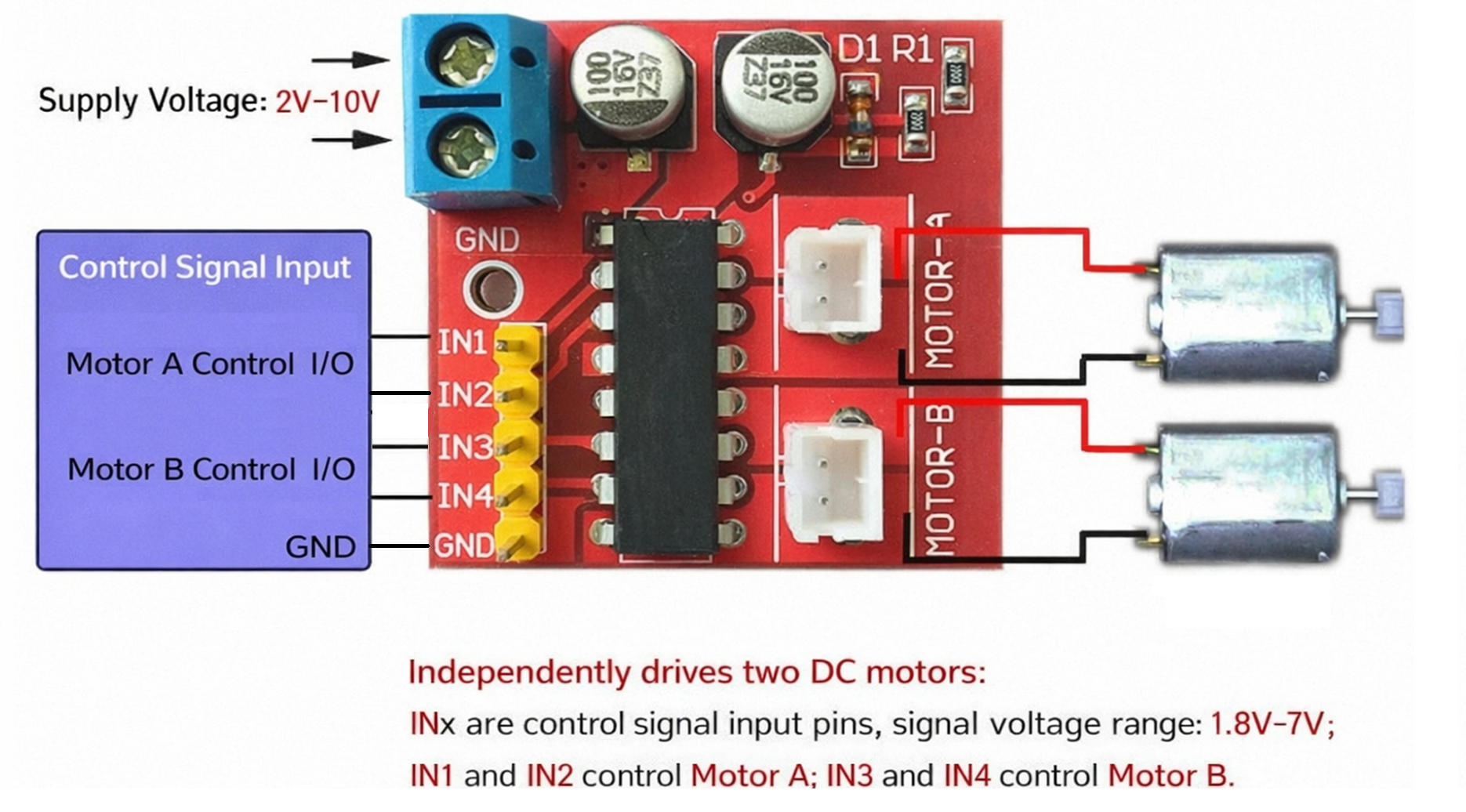
Although different manufacturers may label the pins slightly differently, the typical XY-2.5AD dual-way motor driver module includes the following pins:
Power Pins
- VM / V+ – Motor power supply (2V–10V DC, according to motor rating)
- GND – Ground (must be common with MCU ground)
Motor Output Pins
- OUT1 / OUT2 – Motor A terminals
- OUT3 / OUT4 – Motor B terminals
Control Input Pins
- IN1 / IN2 – Direction and PWM control for Motor A
- IN3 / IN4 – Direction and PWM control for Motor B
Basic Wiring Diagram (Arduino + Two DC Motors)
Below is a typical wiring configuration using an Arduino UNO and two brushed DC motors.
Power Connections
- Arduino GND → XY-2.5AD GND
- External motor power supply + → VM / V+
- External motor power supply – → GND
It is not recommended to power motors directly from the Arduino 5V pin.
Control Signal Connections
| Arduino Pin | XY-2.5AD Pin | Function |
|---|---|---|
| D5 (PWM) | IN1 | Motor A speed |
| D4 | IN2 | Motor A direction |
| D6 (PWM) | IN3 | Motor B speed |
| D7 | IN4 | Motor B direction |
Motor Connections
- Motor A → OUT1 & OUT2
- Motor B → OUT3 & OUT4
Working Principle (DC Motor Control)
| DC Motor | Rotation Mode | IN1 | IN2 | IN3 | IN4 |
|---|---|---|---|---|---|
| Motor A | Forward (speed) | 1 / PWM | 0 | — | — |
| Reverse (speed) | 0 | 1 / PWM | — | — | |
| Standby | 0 | 0 | — | — | |
| Brake | 1 | 1 | — | — | |
| Motor B | Forward (speed) | — | — | 1 / PWM | 0 |
| Reverse (speed) | — | — | 0 | 1 / PWM | |
| Stop | — | — | 0 | 0 | |
| Brake | — | — | 1 | 1 |
Each motor is controlled using one PWM pin and one direction pin:
| Direction Pin | PWM Pin | Motor State |
|---|---|---|
| HIGH | PWM | Forward rotation |
| LOW | PWM | Reverse rotation |
| LOW | LOW | Brake / Stop |
PWM duty cycle (0–255) determines the motor speed.
Arduino Example Code (Two DC Motors)
Below is a simple and clear Arduino sketch suitable for beginners and demonstrations.
					// XY-2.5AD Motor Driver Example
// Two DC Motors Control with Arduino

// Motor A pins
const int IN1 = 5;   // PWM
const int IN2 = 4;   // Direction

// Motor B pins
const int IN3 = 6;   // PWM
const int IN4 = 7;   // Direction

void setup() {
  pinMode(IN1, OUTPUT);
  pinMode(IN2, OUTPUT);
  pinMode(IN3, OUTPUT);
  pinMode(IN4, OUTPUT);
}

void loop() {
  // Motor A forward
  digitalWrite(IN2, HIGH);
  analogWrite(IN1, 180);  // Speed (0–255)

  // Motor B forward
  digitalWrite(IN4, HIGH);
  analogWrite(IN3, 180);

  delay(3000);

  // Stop both motors
  analogWrite(IN1, 0);
  analogWrite(IN3, 0);
  delay(1000);

  // Motor A reverse
  digitalWrite(IN2, LOW);
  analogWrite(IN1, 150);

  // Motor B reverse
  digitalWrite(IN4, LOW);
  analogWrite(IN3, 150);

  delay(3000);

  // Stop again
  analogWrite(IN1, 0);
  analogWrite(IN3, 0);
  delay(2000);
}
Stepper Motor Control
The XY-2.5AD can also drive a 4-wire bipolar stepper motor:
- One H-bridge controls Coil A
- The other H-bridge controls Coil B
- Direction and stepping are achieved by energizing coils in sequence
This module does not generate step pulses internally, so stepping logic must be implemented in software.
Practical Tips and Safety Notes
- Always use an external power supply for motors
- Ensure common ground between Arduino and driver
- Avoid exceeding 5A continuous current
- Provide airflow or heatsinking for long-term high-load operation
- Never hot-plug motors while powered
FAQ
What types of motors can the XY-2.5AD module drive?
The XY-2.5AD 2.5A Dual-Way Motor Drive Module is designed primarily for driving two DC motors independently. It can also be used to drive a single stepper motor by utilizing both channels together. The module supports bidirectional motor control (forward and reverse) and is suitable for small to medium power motors within its voltage and current ratings.
What is the maximum current and voltage supported by the XY-2.5AD?
Each channel of the XY-2.5AD can provide a continuous current of up to 2.5A (with proper heat dissipation). The supported motor supply voltage typically ranges from low-voltage DC up to the module’s rated maximum (please refer to the official specifications for exact limits). Exceeding the rated voltage or current may cause overheating or permanent damage to the module.
How is motor speed and direction controlled on the XY-2.5AD module?
Motor direction is controlled by digital logic signals applied to the input control pins, which determine forward or reverse rotation. Motor speed is controlled using a PWM (Pulse Width Modulation) signal on the enable or speed control pins. By adjusting the PWM duty cycle, users can precisely regulate motor speed while maintaining efficient power usage.