

Blog
GP2Y1014AUOF PM2.5 Optical Dust Sensor Module
GP2Y1014AUOF PM2.5 Optical Dust Sensor Module Introduction
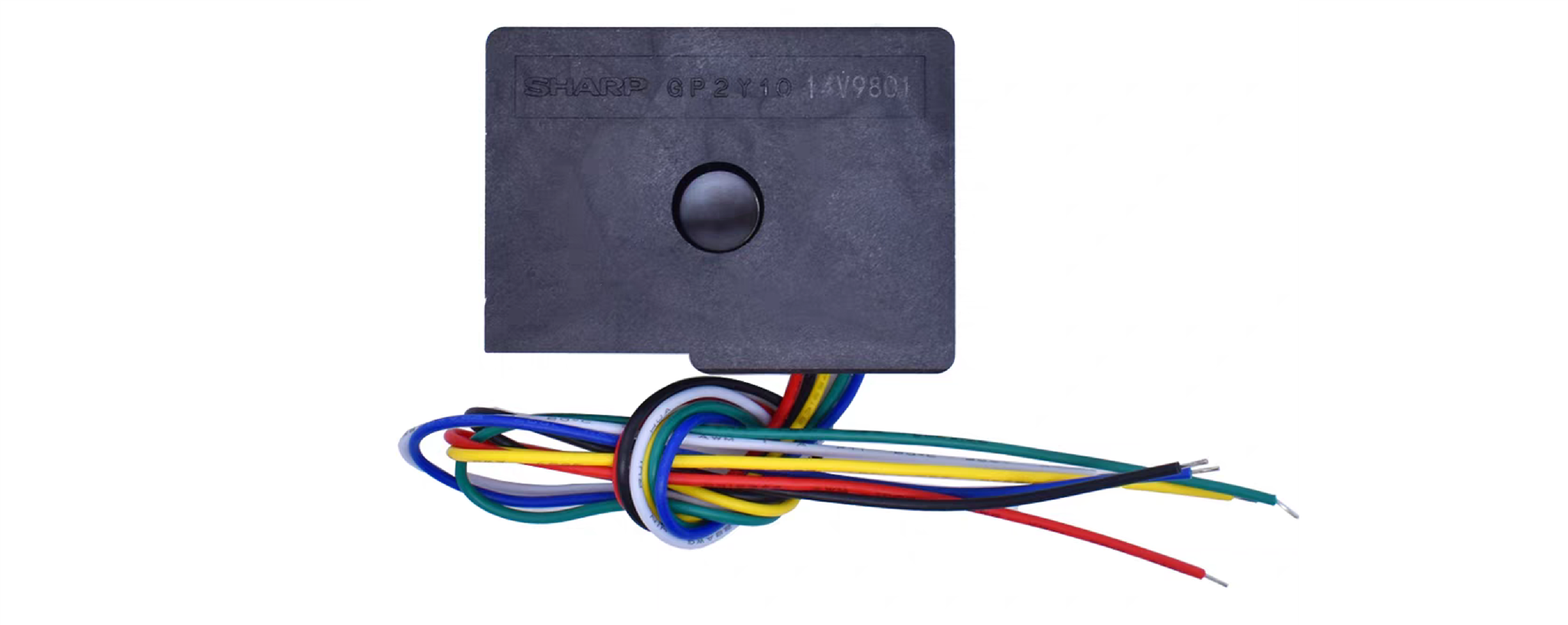
The GP2Y1014AUOF is an optical dust sensor developed by Sharp, designed for detecting airborne particulate matter such as dust, pollen, smoke, and fine particles (PM2.5). It is widely used in air purifiers, air quality monitoring systems, HVAC equipment, and environmental monitoring projects.
Dust Sensor GP2Y1010AU0F Key Features
High sensitivity to fine particles such as cigarette smoke and PM2.5.
Low current consumption (approx. 20 mA average).
Compact design (46.0 × 30.0 × 17.6 mm) for easy integration.
Analog voltage output proportional to dust density.
Fast response time for real-time monitoring.
GP2Y1014AU0F Dust Sensor Pinout
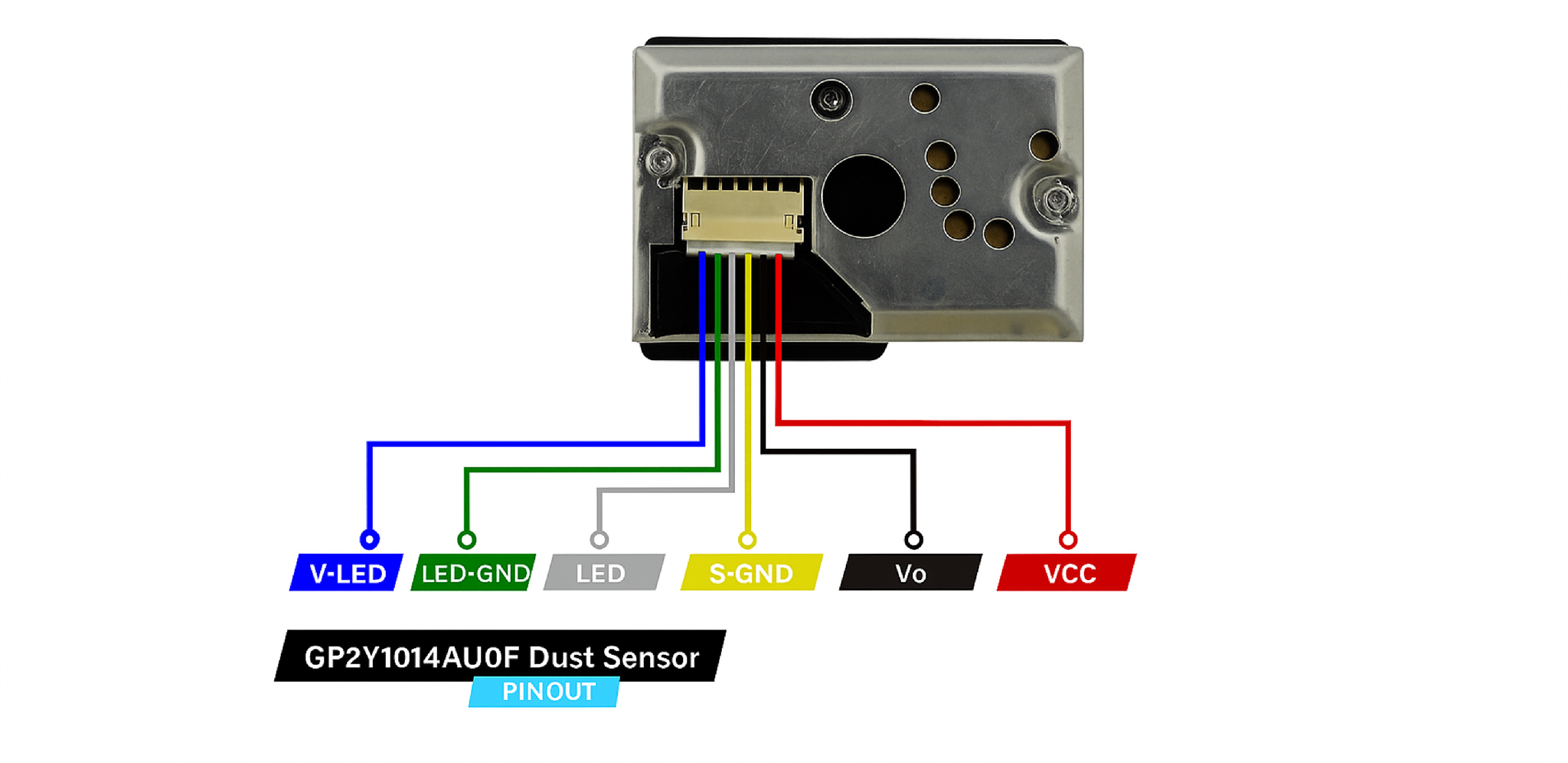
| PIN NAME | DESCRIPTION | CONNECTION INSTRUCTION |
|---|---|---|
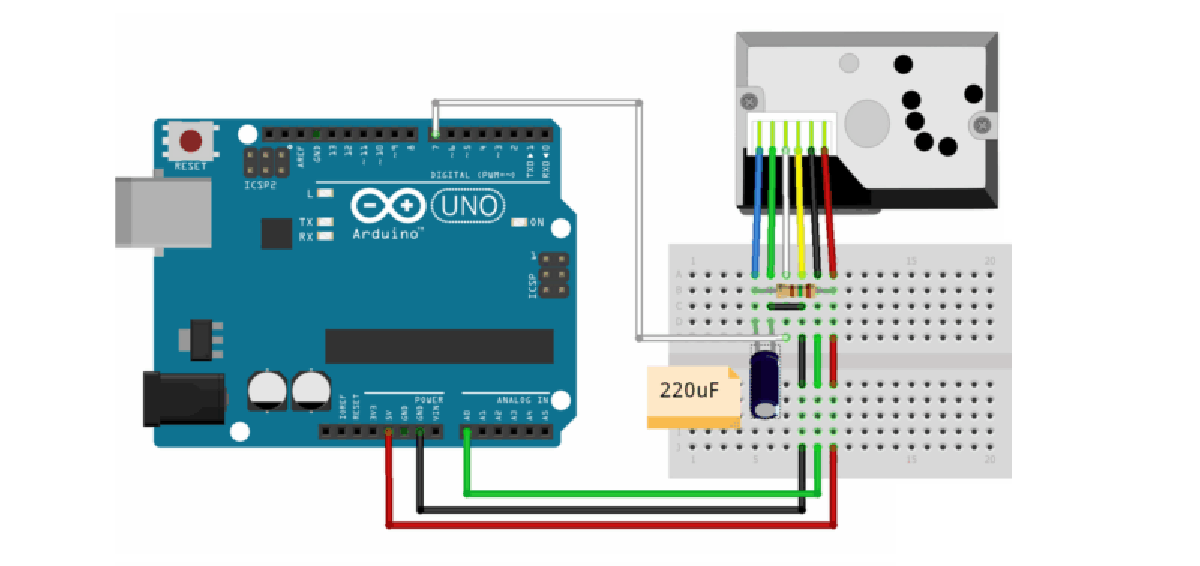
| V-LED | The VCC pin of the LED | Connect to the 5V pin of the Arduino with a 150Ω Current Limiting Resistor |
| LED-GND | The Ground Pin of the LED | Connect to the Ground pin of the Arduino |
| LED | Pin for toggling the LED On/Off | Connect to any digital pin of Arduino |
| S-GND | Ground pin of the pulse Dust Sensor module | Connect to the ground pin of the Arduino |
| Vout | Output of the Dust Sensor Module | Connect to any analog pins of the Arduino |
| VCC | Power Pin of the Dust Sensor Module | Connect to the 5V or 3.3V pin of the Arduino |
Technical Specifications of Dust Sensor GP2Y1010AU0F
| PARAMETER | VALUE |
|---|---|
| Power Supply Voltage | 5 – 7V |
| Operating Temperature | -10 – 65 °C |
| Current Consumption | Max 20 mA |
| Small Particle Detection Value | 0.8 μm |
| Zero Sensitivity | 0.5 V (0.1 mg/m³) |
| Voltage in Air | Typical 0.9 V |
| Storage Temperature | -20 – 80 °C |
| Dimension | 46 × 30 × 17.6 mm |
| Approximate Weight | 15 g |
How Does a GP2Y1014AU0F Dust Sensor Module Work?
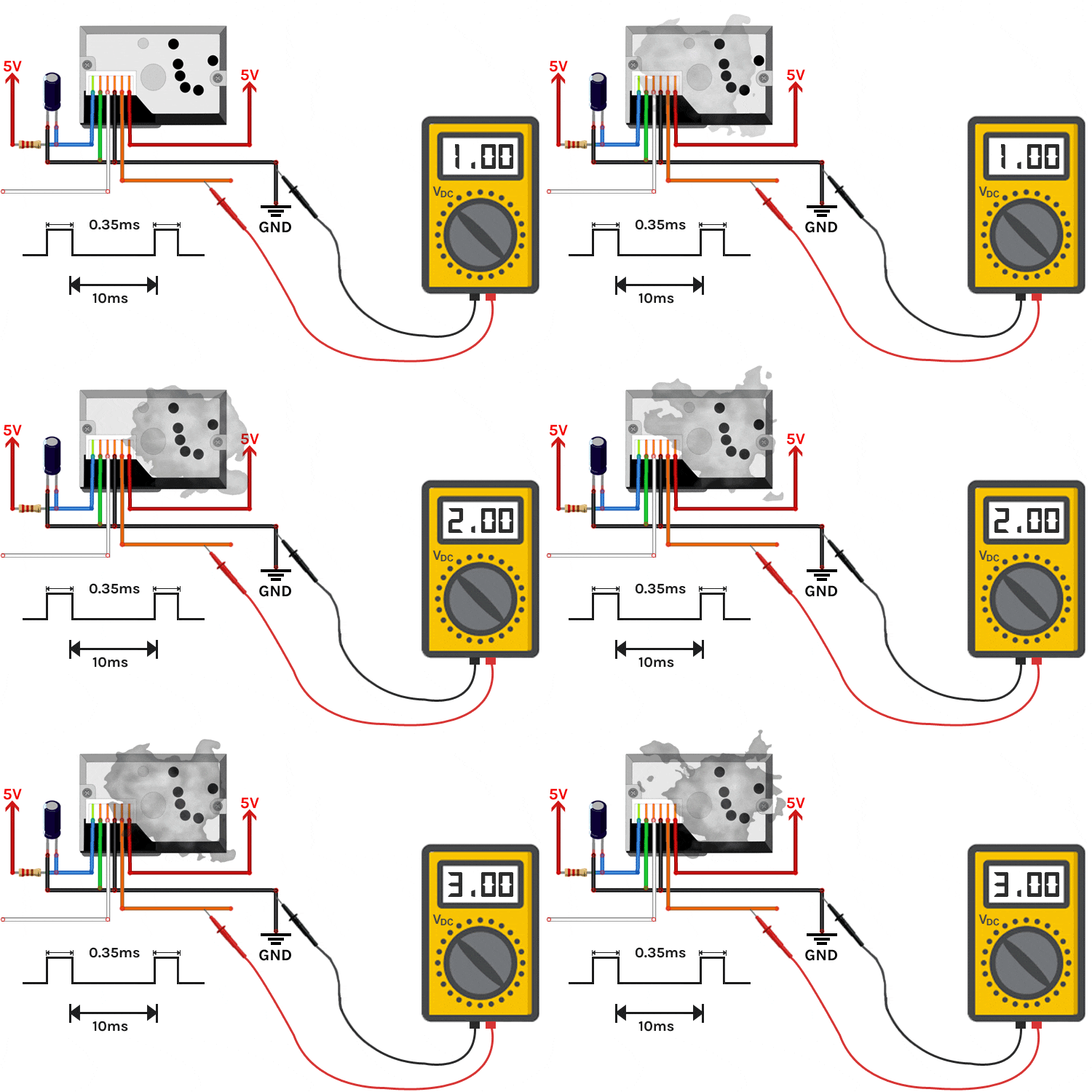
The sensor operates based on the principle of optical scattering. Inside the module, an infrared LED and a phototransistor are placed diagonally. When the LED emits light, airborne particles inside the sensor chamber scatter the beam. The scattered light is detected by the phototransistor, and the resulting analog signal corresponds to the dust concentration in the air.
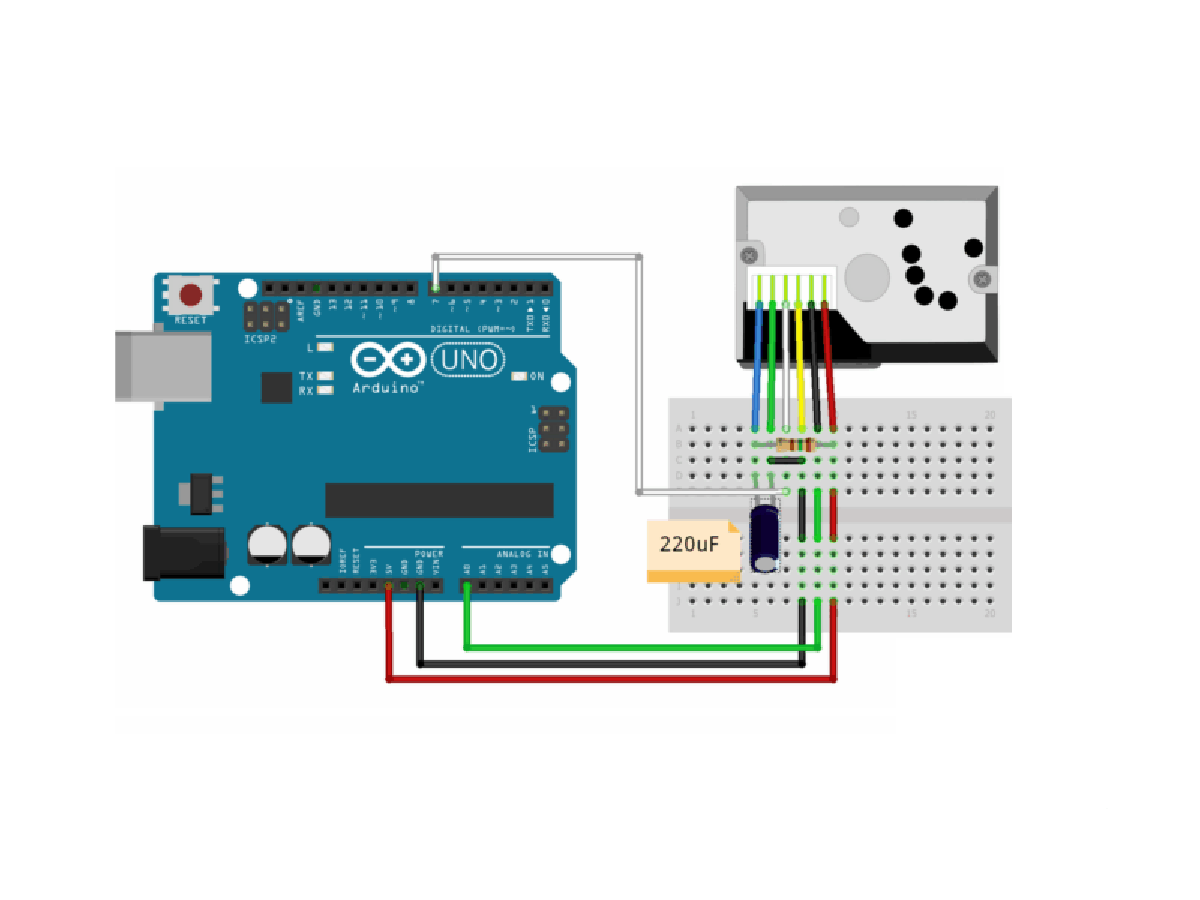
Arduino GP2Y1014AU0F Dust Sensor Circuit Connection Diagram
Code
					#include <Wire.h>
#include <Adafruit_GFX.h>
#include <Adafruit_SSD1306.h>

#define SCREEN_WIDTH 128 // OLED display width
#define SCREEN_HEIGHT 64 // OLED display height
Adafruit_SSD1306 display(SCREEN_WIDTH, SCREEN_HEIGHT, &Wire, -1);

const int ledPin = 2;   // Controls the sensor's LED
const int measurePin = A0; // Analog output pin

float dustDensity = 0;

void setup() {
  Serial.begin(9600);
  pinMode(ledPin, OUTPUT);
  digitalWrite(ledPin, HIGH);

  // Initialize OLED display
  if(!display.begin(SSD1306_SWITCHCAPVCC, 0x3C)) {
    Serial.println(F("SSD1306 allocation failed"));
    for(;;); // Don't proceed, loop forever
  }
  display.clearDisplay();
  display.setTextSize(1);
  display.setTextColor(SSD1306_WHITE);
  display.setCursor(0,0);
  display.println("GP2Y1014AUOF Demo");
  display.display();
  delay(2000);
}

void loop() {
  int voMeasured = 0;
  float calcVoltage = 0;

  // Activate LED for one measurement cycle
  digitalWrite(ledPin, LOW);
  delayMicroseconds(280);
  voMeasured = analogRead(measurePin);
  delayMicroseconds(40);
  digitalWrite(ledPin, HIGH);
  delayMicroseconds(9680);

  // Convert to voltage
  calcVoltage = voMeasured * (5.0 / 1024.0);

  // Calculate dust density (simple approximation formula, mg/m3)
  dustDensity = 0.17 * calcVoltage - 0.1;

  if(dustDensity < 0) dustDensity = 0;

  // Serial output
  Serial.print("Vo: ");
  Serial.print(calcVoltage);
  Serial.print(" V   Dust Density: ");
  Serial.print(dustDensity);
  Serial.println(" mg/m3");

  // OLED display
  display.clearDisplay();
  display.setTextSize(1);
  display.setCursor(0,0);
  display.println("GP2Y1014AUOF");
  display.setTextSize(2);
  display.setCursor(0,20);
  display.print(dustDensity,2);
  display.println(" mg/m3");
  display.display();

  delay(1000);
}
The demonstration effect is as follows

Relevant Materials Download
FAQ
What is the difference between a dust sensor and a PM2.5 sensor?
PM2.5 specifically refers to particulate matter with a diameter of 2.5 microns or smaller. A PM2.5 sensor adopts the laser scattering principle: it emits laser light to irradiate suspended particles in the air, then collects the scattered light generated by the particles, and obtains the time-varying curve of the scattered light to calculate the concentration of PM2.5. In contrast, a general dust sensor typically uses a photodiode as the core detection component to sense the presence and approximate concentration of dust, with a broader detection range for particulate matter (not limited to PM2.5) and relatively simpler detection logic.
What is the difference between an optical dust sensor and a laser dust sensor?
A laser dust sensor is a type of high-precision dust-measuring sensor that relies on laser technology. Its core components include a fan (for guiding air flow into the detection chamber), a laser diode (for emitting a stable laser beam), a receiver (for capturing scattered light from particles), and a dedicated measuring circuit (for processing light signals into concentration data). On the other hand, an optical dust sensor (often referred to as an infrared optical dust sensor) uses a different structural design: an infrared emitting diode and a phototransistor are arranged diagonally (not directly opposite) in the sensor. When dust particles pass through the detection area, they reflect the infrared light emitted by the diode, and the phototransistor detects this reflected light to determine the presence and approximate concentration of dust. Compared with laser dust sensors, optical dust sensors have lower precision but simpler structures and lower costs.
How do you test a dust sensor?
To test a dust sensor, follow these key steps: First, according to the technical datasheet provided by the sensor manufacturer, configure a suitable pulse driver circuit—this circuit is essential to ensure the sensor works in its rated working state and outputs stable signals. Then, connect the sensor to a microprocessor or microcontroller (such as Arduino, STM32). Next, use the microprocessor/microcontroller to sample the output signal of the sensor (which may be an analog signal or a digital signal, depending on the sensor type). Finally, perform data calculation and analysis based on the sensor’s signal conversion formula (provided in the datasheet) to verify whether the sensor’s output data is consistent with the actual dust concentration in the test environment, thereby completing the performance test.
Can I wire multiple GP2Y1014AU0F sensors to one Arduino?
you can connect multiple GP2Y1014AU0F sensors to a single Arduino, but you need to pay attention to the following points: First, each sensor must be wired to an independent analog pin of the Arduino (since the GP2Y1014AU0F outputs analog signals) and an independent LED control pin (to control the sensor’s internal infrared LED). Second, to avoid mutual interference between multiple sensors (e.g., the infrared light of one sensor affecting the detection of another), you need to implement a time-division multiplexing control logic—this means only activating one sensor for detection at a specific time, and switching to the next sensor after the detection is completed. Additionally, if you plan to connect more than 2-3 GP2Y1014AU0F sensors, it is recommended to use an Arduino Mega instead of a basic Arduino (such as Arduino Uno), because the Arduino Mega has more analog pins and digital pins, which can meet the wiring needs of multiple sensors.
What is the difference between GP2Y1014AU0F and PM2.5 sensors?
PM2.5 sensors are professional-grade sensors designed for specific particulate matter detection. They use laser scattering technology, which can accurately identify and measure particles with a diameter of ≤2.5 microns, and have high detection precision and strong specificity. In contrast, the GP2Y1014AU0F is a general-purpose dust-sensing component. It uses infrared LED detection technology: its infrared emitting diode and phototransistor work together to sense the presence of dust, but it cannot specifically distinguish PM2.5 particles (it detects a broader range of dust particles). As a result, the GP2Y1014AU0F has a much lower detection accuracy (only providing approximate concentration trends) but a significant advantage in cost. Therefore, it is suitable for basic air quality monitoring projects (such as educational experiments, home simple air quality observation) but not for scenarios requiring precise PM2.5 data.
What is the accuracy of the sensor compared to a professional air quality monitor?
The GP2Y1014AU0F has an accuracy of ±15% under ideal test conditions (e.g., stable temperature, no interference from other light sources, uniform dust distribution). This level of accuracy is sufficient for monitoring relative changes in dust concentration (e.g., observing whether the dust level increases or decreases over time) but cannot provide precise absolute concentration values. In contrast, professional air quality monitors typically have an accuracy of ±5%. They use calibrated reference standards (e.g., standard particulate matter samples) in their detection systems and undergo strict pre-use calibration, enabling them to output accurate absolute readings of air quality indicators (such as PM2.5, PM10 concentration). Therefore, if your application involves scientific research, environmental monitoring, or other scenarios requiring rigorous data accuracy, you should use certified professional air quality monitors; the GP2Y1014AU0F is more suitable for educational demonstrations, hobbyist projects, or basic air quality trend monitoring.