Blog
HG7881 Four-Channel Motor Driver in Action

Smart cars are very common in our daily experiments. When you want a smart car to achieve flexible steering, a robotic arm to perform precise movements, or multiple devices to operate collaboratively and efficiently, you need a “commander” that can “drive multiple motors simultaneously” — the HG7881 Four-Channel DC Motor Driver Module.
Today, we will disassemble this module, covering pins, principles, and practical operations, to help you easily master the “multi-motor linkage” technology.
What is HG7881 Four-Channel DC Motor Driver
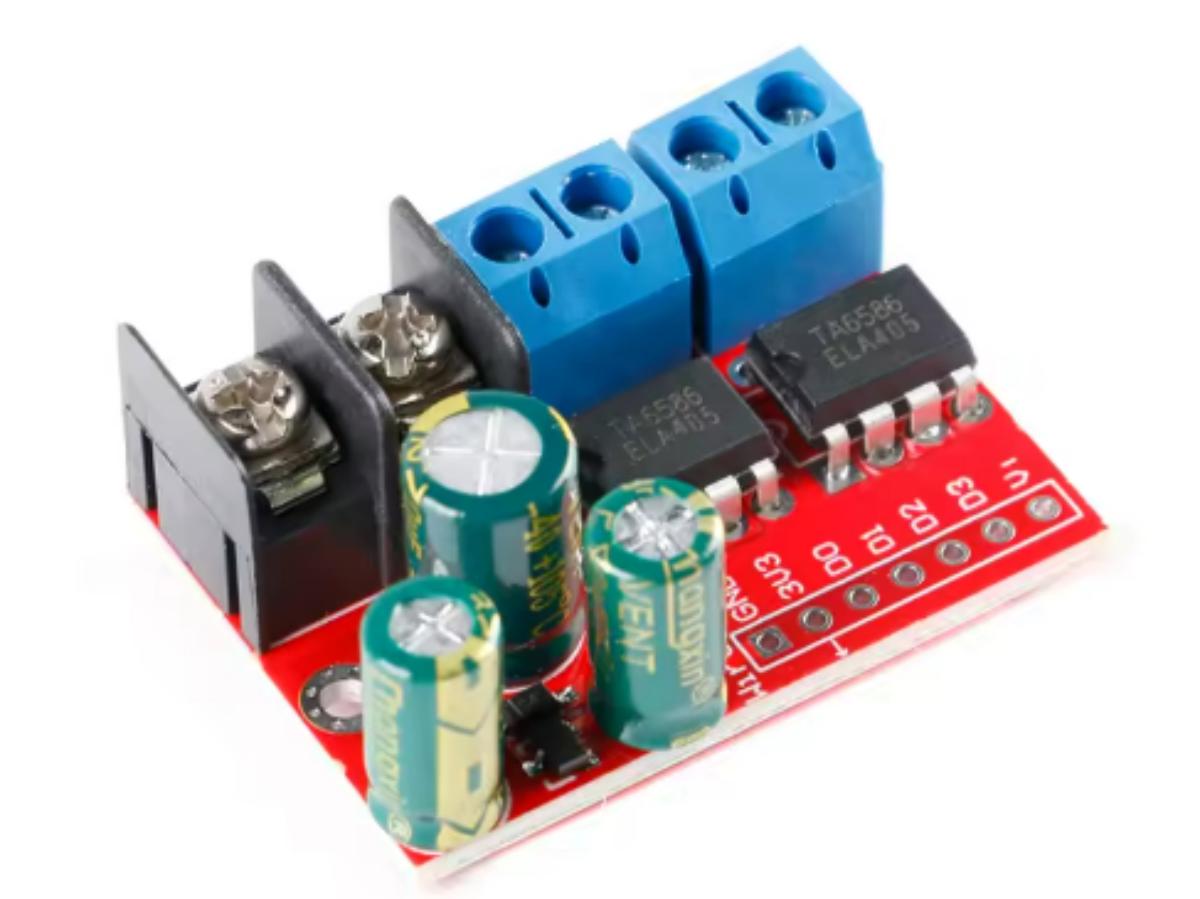
The HG7881 Four-Channel DC Motor Driver Module is an integrated driving solution specifically designed for scenarios that require simultaneous control of multiple DC motors. It integrates four independent H-bridge driving circuits, and each circuit can independently control the forward rotation, reverse rotation, and speed regulation of one DC motor, thereby achieving precise control of four motors. This design greatly simplifies the hardware connection and software programming of multi-motor systems, enabling smart cars, robots, automation equipment, etc., to operate more flexibly and efficiently.
The HG7881 Four-Channel DC Motor Driver Module can be regarded as the “power hub”.
It can control 4 DC motors (or 2 stepper motors) at the same time. With a wide voltage range of 2.5-12V, it is compatible with various small devices and is a core accessory for DIY robots, smart cars, and automation devices.

Core Advantages of HG7881 Four-Channel DC Motor Driver
Compared with the common L298N driver module, the core advantages of the HG7881 Four-Channel DC Motor Driver Module lie in its more prominent “compact size and flexibility”:
- Smaller size:Only about 48×37mm, half the size of the L298N, suitable for compact devices;
- Simpler wiring:No complex power jumpers required, directly connect the motor through terminals;
- Lower cost: The unit price is only about $2, making it a cost-effective choice for multi-motor projects;
- Strong compatibility: Supports mainstream development boards such as Arduino, ESP32, and Raspberry Pi.
HG7881 Four-Channel DC Motor Driver Core Principle Analysis
Many people are curious about how such a small board can control four motors at the same time. In fact, the core of the HG7881 is the H-bridge circuit. By controlling the on-off of 4 switching transistors, the forward rotation, reverse rotation, and stop of the motor are realized:
- Forward rotation: IA1 = High level, IB1 = Low level → The upper and lower transistors on the left side of the H-bridge are turned on, and the motor current flows from left to right;
- Reverse rotation:IA1 = Low level, IB1 = High level → The upper and lower transistors on the right side of the H-bridge are turned on, and the motor current flows from right to left;
- Stop: IA1 = IB1 = Low level (or High level) → No current path, the motor stops;
- Speed regulation:Input a PWM signal (like50% duty cycle) to IA1/IB1 to realize half-speed operation of the motor.
HG7881 Four-Channel DC Motor Driver: How to Use? — Wiring and Debugging Guide
Taking “Arduino controlling 2 DC motors (front wheels of a smart car)” as an example, we will explain the specific operations:
- First, let’s get acquainted with the module’s pins.
| Interface Type | Identification | Function Description | Common Scenarios |
|---|---|---|---|
| Control Header | VCC | Module power supply positive electrode (2.5-12V) | Connect to the positive electrode of the development board/power supply |
| GND | Module power supply negative electrode | Connect to the negative electrode of the development board/power supply | |
| IA1/B1 | Control pins of Motor A | Connect to the MCU I/O port to control the forward/reverse rotation of Motor A | |
| IA2/B2 | Control pins of Motor B | Connect to the MCU I/O port to control the forward/reverse rotation of Motor B | |
| Some modules include IA3/B3/IA4/B4 | Control the 3rd and 4th motors | ||
| Motor Terminals | MOTORA | Output terminal of Motor A | Connect to the two pins of the 1st DC motor |
| MOTORB | Output terminal of Motor B | Connect to the two pins of the 2nd DC motor | |
| MOTORC | Output terminal of Motor C | Connect to the two pins of the 3rd DC motor | |
| MOTORD | Output terminal of Motor D | Connect to the two pins of the 4th DC motor |

- Wiring steps (Arduino Uno)
| HG7881 Pins | Arduino Pins | Description |
|---|---|---|
| VCC | 5V power supply positive electrode | Module power supply (can be connected to 5V if using a 5V development board) |
| GND | Power supply negative electrode + Arduino GND | Common ground to ensure signal stability |
| IA1 | D2 | Control the forward rotation of Motor A |
| IB1 | D3 | Control the reverse rotation of Motor A |
| IA2 | D4 | Control the forward rotation of Motor B |
| IB2 | D5 | Control the reverse rotation of Motor B |
| MOTORA | Pins of the 1st motor | Connect to the left front wheel motor |
| MOTORB | Pins of the 2nd motor | Connect to the right front wheel motor |
Notes
- Power matching: The rated voltage of the motor must be within the range of 2.5-12V to avoid burnout due to overvoltage;
- Current limit:The current of a single motor should not exceed 800mA. If using a high-power motor, an external heat sink is required;
- Duty cycle range: For PWM speed regulation, the duty cycle is recommended to be set to 30%-100% (torque may be insufficient below 30%);
- Wiring anti-reversal:The motor terminals have no positive or negative poles. Reverse connection will only cause the direction to be opposite, which can be corrected by swapping the wires.
Typical Application Scenarios for the HG7881 Four-Channel DC Motor Driver
Based on the multi-channel driving characteristics of the HG7881, it is suitable for scenarios requiring multi-motor collaboration:
- Smart cars: Control the forward/reverse rotation and speed regulation of 4 wheels to achieve forward movement, backward movement, and steering;
- Robotic arms:Drive 2-4 joint stepper motors to achieve precise angle adjustment;
- Automation devices:Control the operation of conveyors, valves, pan-tilts, and other equipment;
- DIY toys:Power control for remote control cars, robot pets, etc.
What is the difference between HG7881 and L298N?
| Comparison Dimension | HG7881 Four-Channel Driver Module | L298N Driver Module |
|---|---|---|
| Number of driving channels | 4 DC motors (or 2 stepper motors) | 2 DC motors (or 1 stepper motor) |
| Operating voltage range | 2.5V-12V | 5V-46V |
| Maximum current per channel | Continuous 800mA, peak 1.5A | Continuous 2A, peak 4A |
| Size | Approximately 48×37mm (compact) | Approximately 60×50mm (relatively large) |
| Control method | Directly control forward/reverse rotation through I/O ports, supporting PWM speed regulation | Requires matching with enable terminals for control, supporting PWM speed regulation |
| Cost | Unit price about 10-15 yuan (cost-effective) | Unit price about 15-20 yuan (classic model) |
| Application scenarios | Small devices (smart cars, micro robotic arms), low-power multi-motor projects | High-power devices (large robots, industrial small loads), high-voltage scenarios |
| Protection functions | Built-in overcurrent and overheating protection | Built-in freewheeling diodes and overcurrent protection |
| Power compatibility | Compatible with 3.7V lithium batteries, 5V/6V power supplies | Compatible with 12V/24V industrial power supply, supports 5V logic output |
Summary
The HG7881 Four-Channel Motor Driver Module is a “lightweight power hub” tailored for small-scale, low-power, multi-motor collaboration scenarios. With the advantages of “small size + low price + easy operation”, it perfectly adapts to projects such as DIY smart cars, micro robotic arms, and small automation devices. It allows makers and students to achieve “forward/reverse rotation and speed regulation linkage of multiple motors” at low cost, just like equipping devices with flexible “power joints”.
In short, the HG7881 is the “cost-effective king for small multi-motor projects” — with the lowest cost and learning threshold, it can make your mechanical devices “move and move cleverly”.