

Blog
DC-DC Step-Down Buck Converter, 24/12V to 5V, 5A Power Module!
Introduction
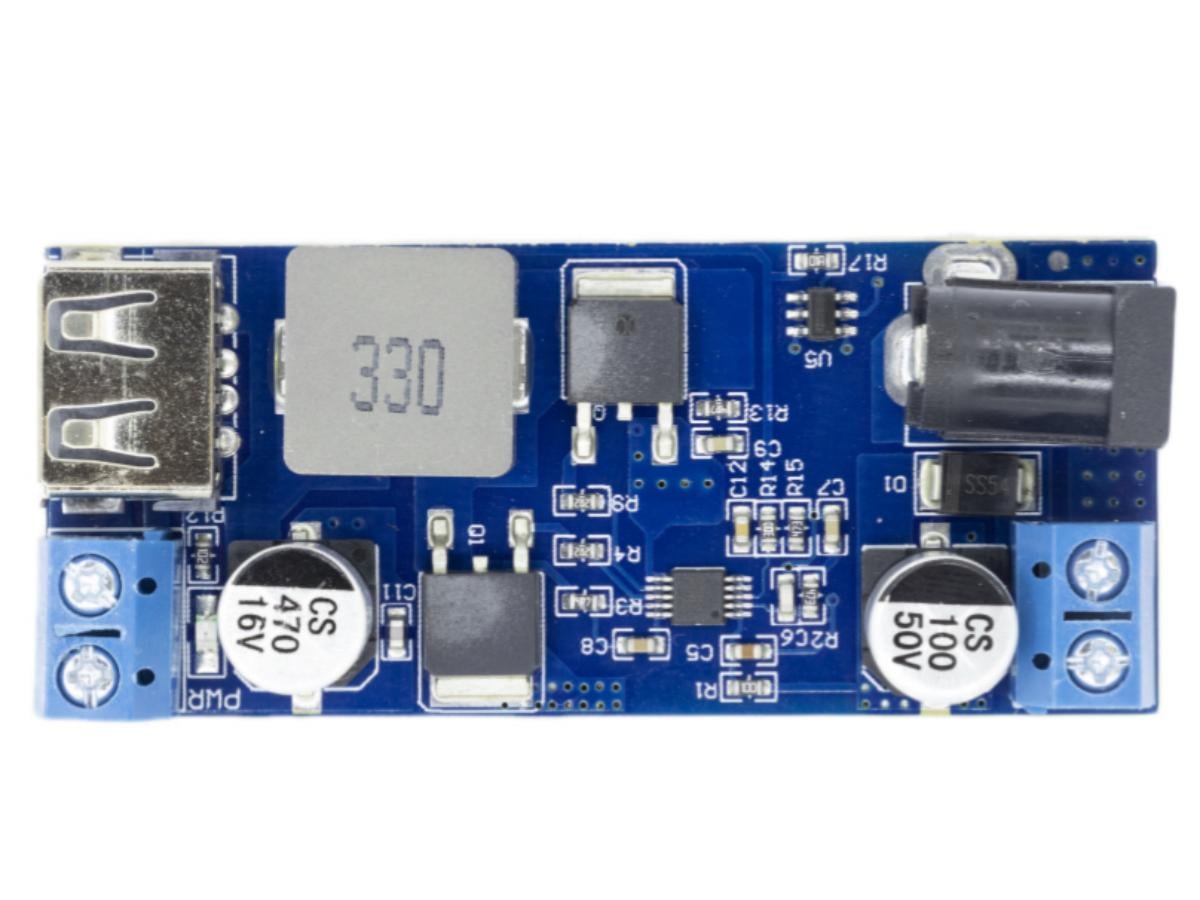
The DC-DC Step-Down Module 5A (24V/12V to 5V, Enhanced LM2596S) is a cost-effective switching power supply module, designed for high-current and wide-voltage input applications. Compared to the traditional LM2596S module, this one offers significant improvements in current handling capacity, conversion efficiency, and heat dissipation performance. It is an ideal power solution for electronics DIY and embedded projects.
The working principle of the voltage reduction module
A Buck Converter is a commonly used DC-DC converter that reduces the input voltage to the required output voltage. The basic working principle is to charge and discharge the inductor through the switching tube, thereby reducing and stabilizing the voltage. When the switch tube is on, the inductor charges and stores energy. When the switch tube is off, the inductor discharges through the diode, and the output voltage is maintained at the set value.
Module Declaration

Parameter
- Input voltage: DC 9V-36V(Supports mainstream inputs of 24V and 12V)
- Output voltage: DC 5V
- Maximum output current: 5A
- Output power: 25W(5Vx5A)
- Conversion efficiency: Utilizing synchronous rectification technology, the efficiency is 90% higher than that of the traditional LM2596S
- Operating temperature: -40℃ to 85℃
Module Feature
1.High current output, stronger load-carrying capacity: The maximum output current of the traditional LM2596S is 3A, while this upgraded module increases it to 5A. It can drive high-power loads such as Arduino projects with multiple sensors, 5V LED light strips, and smart car motors without voltage drop issues.
2.Synchronous rectification, higher efficiency: The input voltage covers 9V-36V and supports conventional inputs of 12V/24V.
3.Wide voltage input, wide adaptability: The input voltage covers 9V to 35V. It not only supports the conventional 12V/24V input but also is compatible with fluctuating voltages ranging from 7V to 40V, making it suitable for complex scenarios such as automotive and industrial power supplies.
4.Multiple protections for safer use: Integrated overheat protection, overcurrent protection, and short-circuit protection. Even if the wrong circuit is connected or the load is overloaded, the module will not burn out. It is especially suitable for beginners in electronic DIY.
5.Strong usability: Equipped with a DC plug and terminal blocks, some versions also come with a USB port and a fast charging recognition chip, allowing direct charging of mobile phones and other devices, as well as quick access to electronic projects.
LM2596S Pin Assignments

| Name | I/O | Description |
|---|---|---|
| Vin | I | Input supply voltage |
| Output | O | Switching output |
| Gnd | – | Ground |
| Feedback | I | Output voltage feedback |
| ON/OFF | I | ON/OFF shutdown Active is “LOW” or floating |
DC to DC Step Down Converter Circuit Diagram

DC DC Step Down Converter Schematic

Common Faults and Troubleshooting Methods
1.Unstable output voltage: When the DC-DC step-down converter malfunctions, the first step is to check whether the input voltage is normal. Use a multimeter to measure the value and stability of the input voltage to ensure that the input voltage is within the rated voltage range of the converter. If the input voltage is abnormal, it is necessary to check whether the power input line and power module are working properly.
2.Overheat protection trigger: Overheat protection trigger may be caused by insufficient heat dissipation. During the troubleshooting process, it is necessary to check whether the installation and heat dissipation performance of the radiator are normal. If the radiator is faulty or has insufficient heat dissipation performance, it should be replaced or added in time to improve the heat dissipation effect.
3.Short-circuit faults: For faults caused by short-circuit faults and internal component damage, it is necessary to check whether the circuit board and components are normal. Use tools such as multimeters and oscilloscopes to check whether there are any abnormalities in the solder joints and components on the circuit board. Damaged components should be replaced in a timely manner to ensure the normal operation of the converter.
4.Failed to start: For a DC-DC step-down converter that fails to start, it is necessary to check whether the start pin is driven correctly. Make sure the start pin is correctly connected and pulled up to the appropriate voltage value. If the start pin is not driven correctly, check whether the pin connection and the drive circuit are working properly.
5.Excessive ripple: Excessive ripple may be caused by an unreasonable design of the filter circuit or damage to the filter components. During the troubleshooting process, it is necessary to check whether the design and components of the filter circuit are normal. If the filter circuit design is unreasonable or the filter elements are damaged, the filter circuit should be redesigned or the filter elements replaced to reduce the ripple voltage.
6.When troubleshooting DC-DC step-down converters, you can refer to relevant technical documents and manuals to obtain more detailed fault information and troubleshooting methods. In addition, if you encounter difficult-to-solve malfunction problems, you can consult professional technical support or engineers for assistance.
DC DC Step Down Converter 24V/12v to 5v
A DC-DC buck converter efficiently steps down higher input voltages (such as 12V or 24V) to a stable 5V output by rapidly switching the current through a switching element. It uses an inductor to store energy, a diode to prevent reverse current, and a capacitor to smooth the output voltage. The converter adjusts the duty cycle of the switch through a feedback control system to maintain a stable output voltage. Compared to linear regulators, buck converters are more efficient (typically 80%-90%) because they transfer energy rather than dissipating excess energy as heat.
Applications and Examples
1.Applications in consumer electronics
In smartphones, tablets and portable gaming devices, DC-DC converters can efficiently manage battery power, ensuring long-term stable operation. In addition, they can effectively reduce the heat generation on the circuit board and enhance the overall reliability of the product. When designing DC-DC converters for consumer electronics, special attention should be paid to their starting current and quiescent current. The starting current should be low enough to avoid overburdening the battery when the device is turned on. Static current affects the standby time of the device. Therefore, a low quiescent current design is the key to ensuring the product’s battery life.
2.Industrial automation and control systems
In industrial robots, PLCS (Programmable Logic Controllers) and other devices, DC-DC converters can provide a stable control power supply to ensure the normal operation of the entire system. In addition, environmental factors in industrial applications are variable. Factors such as temperature, humidity and electromagnetic interference may all affect the normal operation of equipment. DC-DC converters typically possess excellent protection features, such as overcurrent protection, overheat protection, and short-circuit protection, which can provide a safer and more stable power environment for industrial automation equipment.
Relative Information
5A DC-DC Voltage Reduction and Stabilization Power Module
5A DC-DC Voltage Reduction and Stabilization Power Module for TYPE-C Port
5A DC-DC Adjustable Step-Down Voltage Stabilizing Power Module with Aluminum Casing
FAQ
1.What is LM2596S?
The LM2596S is a common voltage reduction module, which is widely used in various electronic devices and circuits. The LM2596S operates based on a fixed-frequency PWM (Pulse Width Modulation) control mode. It reduces the voltage by controlling the duty cycle of the output voltage and has high efficiency and stability.This chip integrates switch tubes, control circuits, protection circuits, etc. internally, and features high efficiency and ease of use.
2.LM2596S VS LM2596
LM2596S is the upgraded version of LM2596, with core differences in high-temperature adaptability and stability: LM2596 operates at -40°C~125°C for general scenarios; LM2596S boosts the temperature limit to 150°C, featuring lower noise and faster transient response, ideal for harsh environments like automotive electronics and outdoor extreme conditions.
3.What are the characteristics of the buck circuit?
1.High energy efficiency: As the BUCK circuit performs pulse modulation through switching tubes, its energy efficiency is usually higher than that of linear regulated circuits.
2.Output voltage stability: The BUCK circuit can maintain the stability of the output voltage through the combined effect of inductors and capacitors.
3.Strong controllability: The BUCK circuit, through PWM control, can precisely adjust the output voltage, thereby meeting the requirements of different application scenarios.
4.Low cost: Compared with other step-down circuits, the BUCK circuit requires fewer components, so its cost is relatively lower.