

Blog
TCS34725 RGB Color Sensor: Principles, Calibration, and Practical Solutions
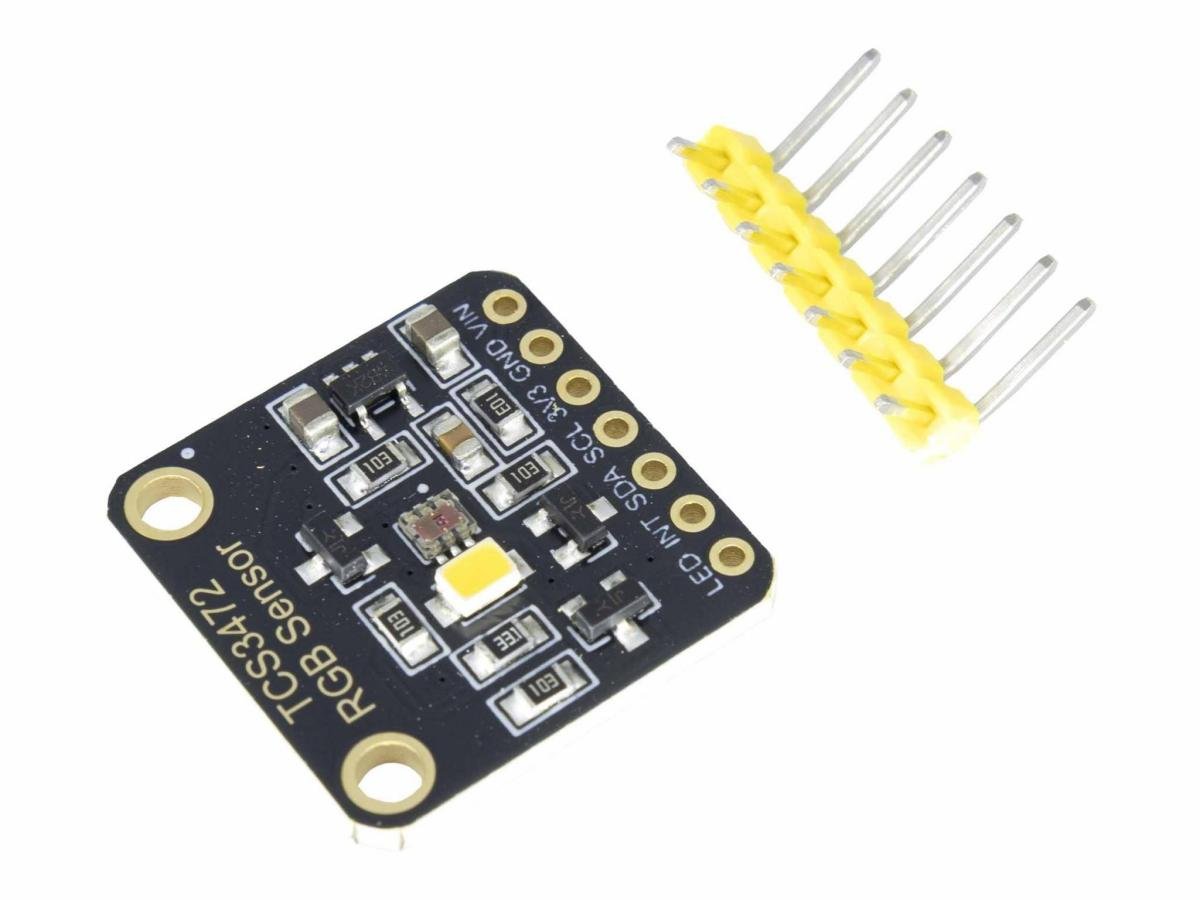
Our world is made up of vibrant colors. How do we accurately distinguish them, and is there a device that can differentiate and detect colors? Today, we will talk about the TCS34725 RGB color sensor with you!
What is TCS34725 RGB Color Sensor?
The TCS34725 RGB color sensor is a high-precision digital RGB color detection sensor that can accurately capture and distinguish various colors. It integrates three filters for red, green, and blue (RGB), and achieves precise color recognition by measuring the RGB components in reflected or transmitted light.
What is the color range of TCS34725?
The TCS32725 RGB color sensor covers the entire visible spectrum to near-infrared, capturing nearly all colors visible to the human eye. Whether it’s bright red, soft green, or deep blue, the TCS34725 can accurately recognize and quantify them. Its wide color detection range allows it to perform excellently in various color detection and recognition applications, shining in fields such as color management, product quality inspection, and environmental monitoring.
What is the working principle of TCS34725 RGB Color Sensor?
- Optical Signal Collection:The sensor has a built-in photodiode array corresponding to four channels: R, G, B, and Clear. When ambient light irradiates the sensor surface, the photodiodes in different channels selectively absorb light of corresponding wavelengths (likethe R channel absorbs red light and reflects other light, while the G channel absorbs green light and reflects other light) and convert the optical signal into a weak electrical signal.
- Signal Processing:The weak external electrical signal is amplified by an internal amplifier (with configurable gain) and then sent to a 16-bit ADCfor analog-to-digital conversion, converting the analog signal into digital color values.
- Signal Output:The digitized R, G, B, and Clear data are transmitted to the main control device via the I2C interface. The main control device can calculate specific color parameters (such as RGB values, color temperature, and color coordinates) based on these data to achieve functions like color recognition and light adjustment.
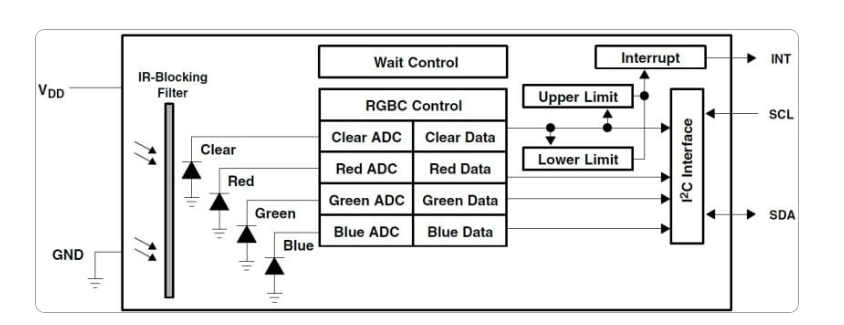
Block Diagram of the TCS34725 Sensor.
What is the composition of the TCS34725 RGB Color Sensor?
The TCS34725 RGB color sensor usually consists of key components such as a photodiode array, an infrared cut filter, a signal amplifier, an analog-to-digital converter (ADC), and an I2C communication interface.
The photodiode array is one of the core components of the sensor. It includes photodiodes corresponding to four channels: R (red), G (green), B (blue), and Clear (transparent, used to measure total light intensity). These diodes can selectively absorb light of specific wavelengths and convert it into electrical signals.
The infrared cutoff filter is used to filter out the infrared light, ensuring that the sensor only measures the color information in the visible light range, thus improving the accuracy of color recognition.The signal amplifier is responsible for amplifying the weak electrical signal generated by the photodiode so that the subsequent analog to digital converter can process it accurately.
The analog-to-digital converter (ADC) converts the amplified analog signals into digital signals, namely digitized R, G, B, and Clear data, which are the basis for subsequent color calculations.
Finally, the I2C communication interface transmits the digitized color data to the main control device, enabling data interaction and control with external systems.
Advantages of TCS34725 RGB Color Sensor?
The TCS34725 RGB color sensor has many significant advantages.
Firstly, it offers high precision, enabling it to accurately capture and distinguish subtle color differences. This makes it perform well in scenarios requiring precise color recognition, such as the precise color control in the printing industry, ensuring printed products closely match the original colors.
Secondly, the sensor has a fast response speed. It can complete a series of operations including optical signal collection, processing, and data output in a short time, greatly improving work efficiency. On some automated production lines, it can real-time detect product colors and feedback color information promptly to adjust production parameters quickly.
Moreover, the TCS34725 RGB color sensor exhibits excellent stability and reliability. It can maintain stable performance and output accurate color data under different environmental conditions, such as changes in temperature and humidity. This makes it suitable for various complex working environments, operating reliably both indoors and outdoors.
In addition, its compact size facilitates integration into various devices without occupying much space. This provides greater flexibility for device design and layout, making it widely used in various portable devices and miniaturized testing instruments.
What are the application scenarios for the TCS34725 RGB Color Sensor?
Thanks to its many advantages, the TCS34725 RGB color sensor has a wide range of applications.
In the consumer electronics field, it is often used for screen color calibration of smartphones, tablets, and other devices, ensuring accurate and realistic display colors and delivering an excellent visual experience to users. In cameras and camcorders, it can also assist in achieving precise white balance adjustment to improve shooting quality.
In industrial production, the TCS34725 RGB color sensor can be used for product appearance color detection. For example, in industries such as plastic products, textiles, and coatings, it can quickly and accurately detect whether product colors meet standards, identify color deviations in a timely manner, and ensure consistent product quality.
In food and pharmaceutical production, it can also be used to detect product color, judging whether they are fresh or meet quality requirements.
TCS34725 RGB Color Sensor pinout

The TCS34725 RGB color sensor has 7 pins: LED, INT, SDA, SCL, 3V3, GND, and VIN.
- LED pincontrols the built-in infrared LED of the sensor, which provides auxiliary lighting in low light conditions to ensure accurate color detection.
- INT pin is an interrupt output pin. When the sensor completes a color measurement or detects specific conditions, it can send an interrupt signal to the main control device through this pin to achieve rapid response.
- SDA pinis the data line of theI2C communication interface, used for bidirectional data transmission with the main control device.
- SCL pinis the clock line of the I2Ccommunication interface, responsible for synchronizing the timing of data transmission.
- 3V3 pinsupplies a 3.3V operating voltage to the sensor, ensuring the normal operation of its internal circuits.
- GND pin is a ground pin, used to establish a reference ground for electrical connections. Finally, theVIN pin is an optional power input pin. When an external 5V power supply is provided, the sensor can be powered through this pin, and the internal circuit will convert it to3.3V for use.
These pins together form the electrical interface of the TCS34725 RGB color sensor, allowing it to be easily connected and communicate with various main control devices.
Product Parameter Sheet for TCS34725 RGB Color Sensor
| Parameter | Details |
|---|---|
| Operating Voltage | 3.3V/5V |
| Operating Current | Typical current consumption of approximately 65μA in normal mode |
| Detection Distance | 3mm-10mm |
| Operating Temperature | -40°C-85°C |
| Communication Interface | I2C, maximum frequency of 400kHz |
| Resolution | 16-bit ADC, independent sampling for each color channel (R, G, B, Clear) |
| Gain Adjustment | Supports multiple gain settings such as 1x, 4x, 16x, 60x |
| Sampling Time | Configurable from 2.4ms to 614.4ms |
| Package Size | Typical value of 20.5mm*20.5mm |
| Special Features | Integrates an IR suppression filter to reduce infrared interference; supports interrupt function with configurable thresholds |
TCS34725 RGB Color Sensor datasheet
TCS34725 RGB Color Sensor connect to Arduino
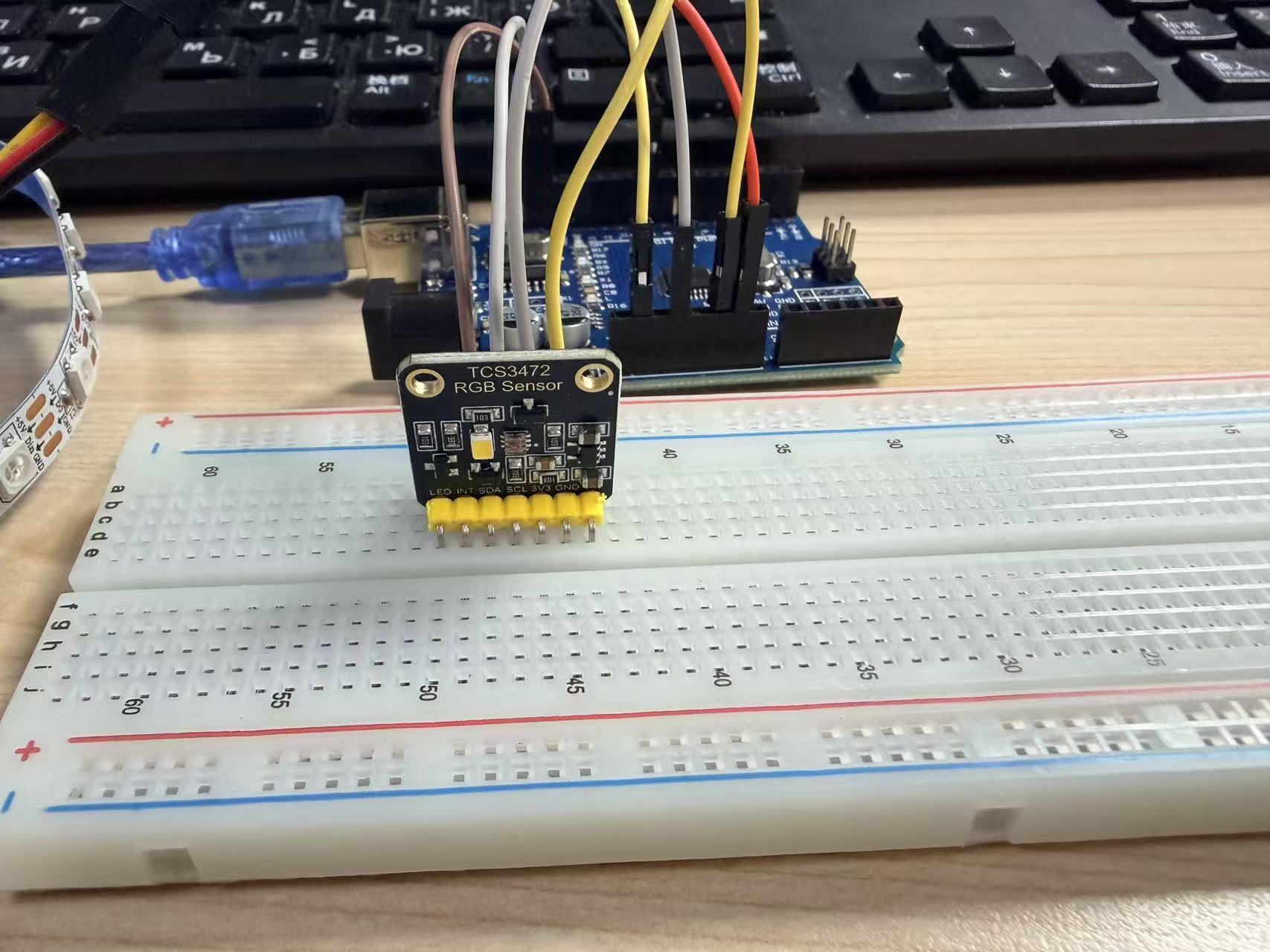
Connecting the TCS34725 RGB color sensor and an RGB light strip to Arduino allows the color detected by the TCS34725 RGB color sensor to be displayed on the RGB light strip.
First, let’s solve the wiring problem.
| TCS34725 Pin | Arduino Uno/Nano Pin | Description |
|---|---|---|
| 3V3 | 3.3V | Powers the sensor (do not connect to 5V, as it will burn out) |
| GND | GND | Ground |
| SDA | A4 | I2C data pin |
| SCL | A5 | I2C clock pin |
| VIN | Floating (no need to connect as 3V3 is used for power supply) | Alternative power supply pin for the module (internal step-down to 3.3V when connected to 5V) |
| LED | Floating or connected to a digital pin (optional) | Built-in fill light of the module; connect to a digital pin for control when needed |
| INT | Floating (optional) | Interrupt output pin, not used in this project |
| RGB Light Strip Pin | Arduino Pin | Description |
|---|---|---|
| 5V | 5V (or independent 5V power supply) | For light strip power supply with current> 500mA, it is recommended to use independent power supply and share the ground with Arduino. |
| GND | GND | Common ground (must share with the sensor and Arduino, otherwise the signal will be unstable) |
| DIN | Digital pin 9 (example) | Data output pin; any digital pin can be selected |
Sample code
					#include <Wire.h>
#include <Adafruit_Sensor.h>
#include <Adafruit_TCS34725.h>
#include <FastLED.h>

Adafruit_TCS34725 tcs = Adafruit_TCS34725(TCS34725_INTEGRATIONTIME_50MS, TCS34725_GAIN_4X);

#define LED_PIN     9
#define NUM_LEDS    20
CRGB leds[NUM_LEDS];

void setup() {
  Serial.begin(9600);

  if (!tcs.begin()) {
    Serial.println("TCS34725 sensor not detected. Check the wiring!");
    while (1);
  }

  FastLED.addLeds<WS2812B, LED_PIN, GRB>(leds, NUM_LEDS);
  FastLED.setBrightness(50);
  leds[0] = CRGB::Black;
  FastLED.show();
}

void loop() {
  uint16_t r, g, b, c, colorTemp, lux;


  tcs.getRawData(&r, &g, &b, &c);
  colorTemp = tcs.calculateColorTemperature(r, g, b);
  lux = tcs.calculateLux(r, g, b);

  uint8_t ledR = map(r, 0, 65535, 0, 255);
  uint8_t ledG = map(g, 0, 65535, 0, 255);
  uint8_t ledB = map(b, 0, 65535, 0, 255);

  Serial.print("R: "); Serial.print(ledR);
  Serial.print(" G: "); Serial.print(ledG);
  Serial.print(" B: "); Serial.print(ledB);
  Serial.print(" Color temperature: "); Serial.print(colorTemp);
  Serial.print("K Brightness: "); Serial.print(lux); Serial.println("lux");

  fill_solid(leds, NUM_LEDS, CRGB(ledR, ledG, ledB));
  FastLED.show();

  delay(2000);
}
FAQS
What is the best RGB color sensor?
Is 125% sRGB better than 100% sRGB?
Sure!In the field of color display, sRGB is a widely used standard color space that defines the range of colors a device can display.
125% sRGB means the device can display a wider color range than the standard sRGB color space, i.e., it can present more and more vivid colors. This is very beneficial for application scenarios requiring high color accuracy and rich color performance, such as professional graphic design, high-end photography, and video editing. These scenarios often require accurate restoration or creation of colors, and 125% sRGB provides a broader color space to meet this demand.
In contrast, 100% sRGB means the device can fully cover the standard sRGB color space but cannot exceed it. For general daily use, such as browsing the web, watching videos, or performing simple image processing, 100% sRGB is usually sufficient as it ensures accurate color transmission and consistency across different devices.
However, the choice between 125% sRGB and 100% sRGB depends not only on the width of the color range but also on the device’s overall performance, cost, and the user’s specific needs. For example, if the user mainly engages in daily office work and entertainment, a device with 100% sRGB may be sufficient and usually more affordable. If the user is a professional designer or photographer with extremely high requirements for color accuracy, a device with 125% sRGB or even a higher color range may be more worthy of consideration.