

Blog
Principle of Line-Tracking Module on Cars

Detailed Introduction to Types of Line Tracking Modules
What is a line tracking module?
A line tracking module is a basic module for a car to operate by identifying the color (black and white) at the bottom. Generally, there are multiple types.
How does a line tracker work?
Simply saying, the principle of line tracking modules is based on the different reflectivities of the ground surface (for example, white has a higher reflectivity and black has a lower reflectivity) to detect whether the car is running correctly along the black line.
Types of Line Tracking Modules
The types of line tracking modules are roughly divided into two categories:
1.Infrared sensor: Generally composed of an emitter and a receiver. The emitter emits infrared rays, and after the infrared rays bounce back, they are received by the receiver. The reflectivity of infrared rays is different on surfaces of different colors, so as to identify the black line.
2.Light sensor: Generally, a light sensor is used together with an LED light. After the LED light emits light, the light bounces back and is received by the light sensor. If the bottom of the light sensor is black, the reflected light decreases, and the resistance value fed back by the light sensor also decreases.
Next, I will give examples to illustrate various common line – tracking sensors.
TCRT5000
The most common infrared sensor used for line tracking is this TCRT5000. It consists of an emitter and a receiver, and is generally installed at the bottom of a car to work. If only TCRT5000 is used for line tracking, generally two or more modules are needed. It has a relatively fast response speed and low power consumption, and is very suitable for beginners’ DIY projects and learning use.

Working Process
After the infrared sensor is powered on, the infrared emission tube inside the sensor will emit infrared rays.
The emitted infrared rays propagate in the air, and when they encounter an object, they will be reflected. A part of the light will be reflected to the receiving end. Generally speaking, objects with a white surface have better reflectivity than those with a black surface.
The infrared receiving tube of the sensor is relatively sensitive to light of a specific wavelength, so it can accurately receive the infrared rays emitted by the infrared sensor.
After receiving the light, the receiving tube will generate weak electrical signals. These electrical signals need to be amplified by an amplifier and then transmitted to a microcontroller or a comparator to be compared with a threshold voltage. If it is higher than the threshold, a high or low signal level will be output.
But TCRT5000 outputs a low – level signal by comparing with the threshold.
After understanding the working process of TCRT5000, we need to understand its electrical parameters for use.
Electrical Parameter
| PARAMETER CATEGORY | PARAMETER DESCRIPTION | KEY VALUE | REMARKS |
|---|---|---|---|
| Emitter Type | Core Component | Infrared Emitting Diode (IRED) | Actively emits infrared light |
| Receiver Type | Core Component | NPN Silicon Phototransistor | Receives reflected infrared light |
| Emitter Max Current | Absolute Maximum Rating | 60 mA | Must not be exceeded to prevent damage |
| Emitter Operating Current | Recommended Parameter | 10 – 20 mA | Safe and efficient standard operating range |
| Emitter Forward Voltage | Circuit Design Parameter | 1.2 – 1.6 V | Used to calculate the current-limiting resistor value |
| Receiver Voltage Rating | Absolute Maximum Rating | 30 V | Very safe for 3.3V/5V systems |
| Typical Detection Distance | Performance Parameter | Approx. 2.5 mm | For highly reflective surfaces, at 20mA current |
| Output Signal Logic | Application Key | Active-Low | When an object is detected: DO pin outputs LOW (0V), AO voltage decreases |
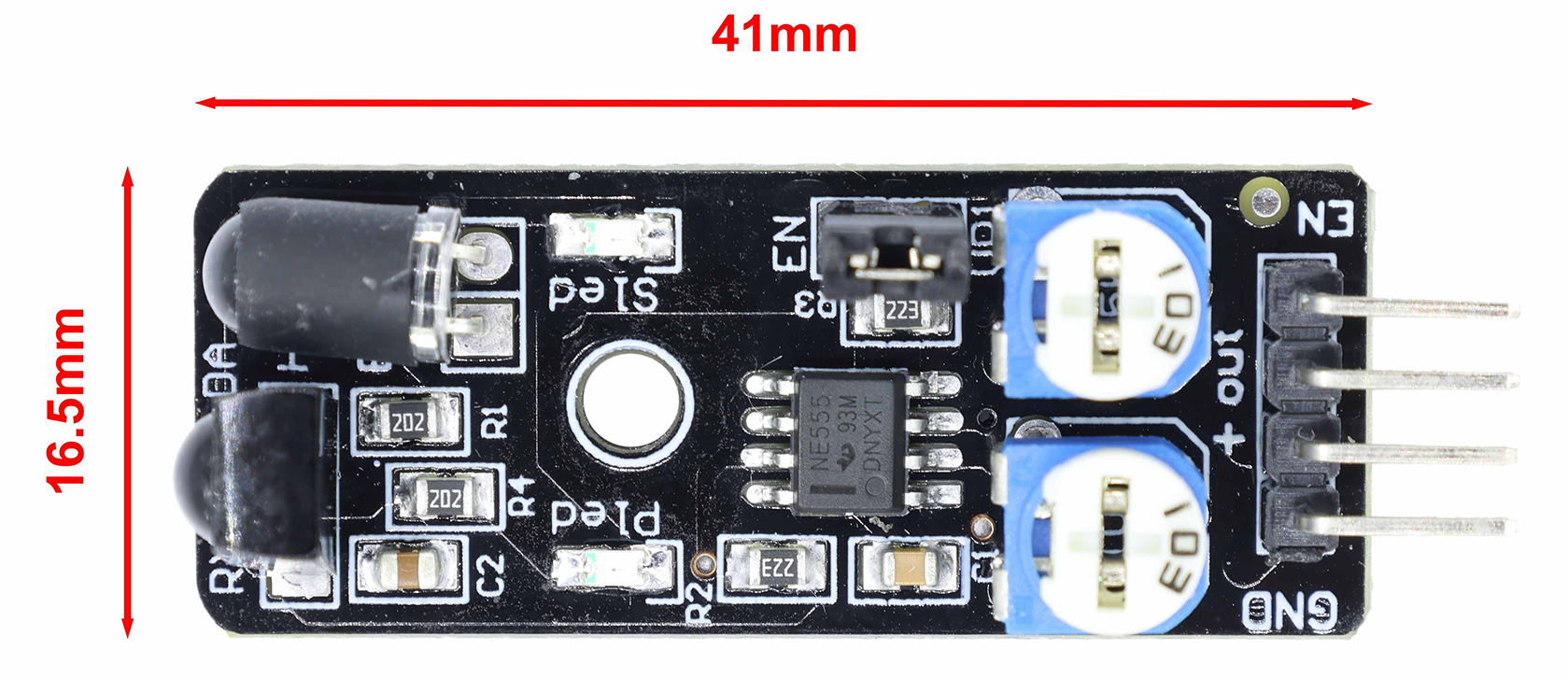
Infrared Sensor (Photoelectric Switch Version)
It has a longer detection range. The working parameters are basically the same as the above ones. It is a new type.
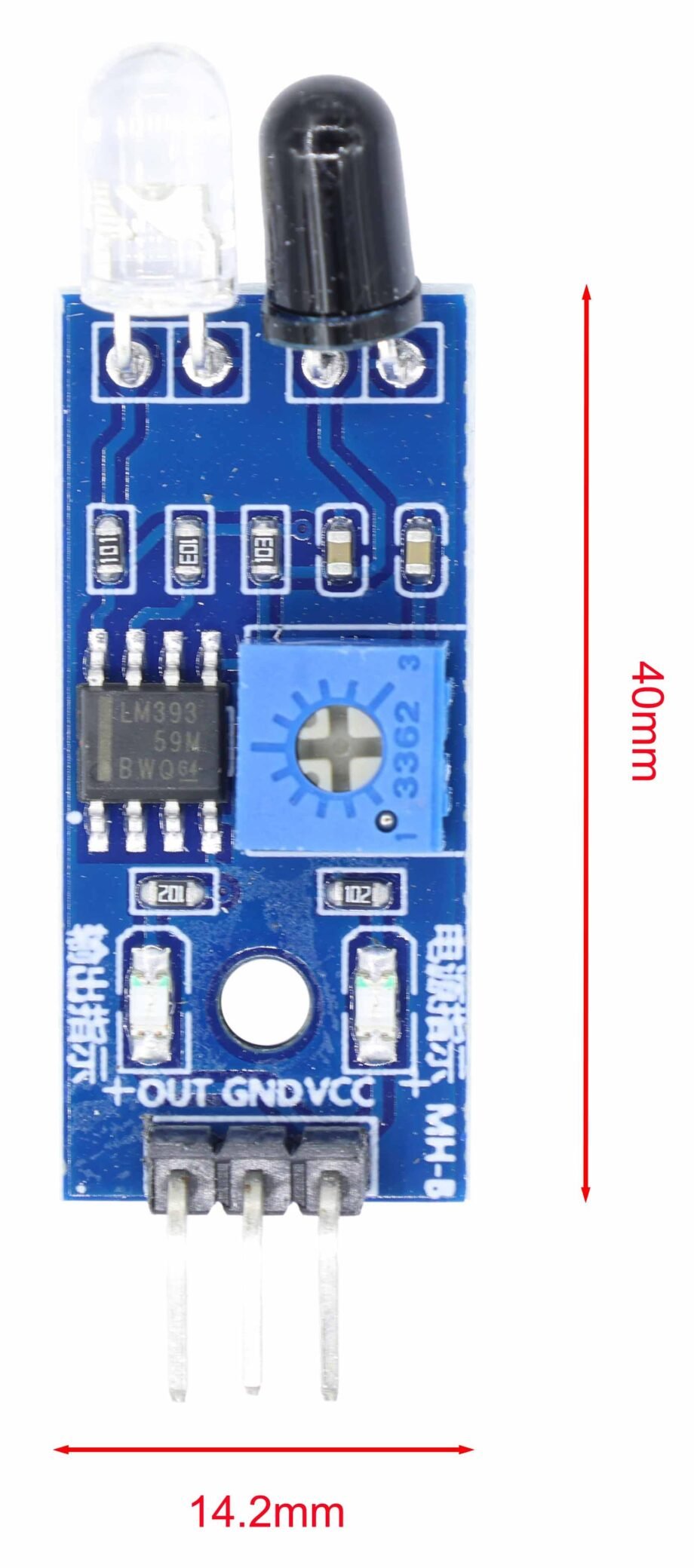
Photoelectric Reflection Version
It has the same performance as the photoelectric switch board and is more compact in size.
Three - Channel Version
The three-channel version uses the TCRT5000 sensor, which can directly function as a line tracking module. Compared to using a single or dual sensors, it offers lower error rates. It can effectively identify the vehicle’s path and is highly suitable for DIY cars or other photoelectric switch applications. Below is a video of this version’s line tracking module driving two motors, which fully and clearly demonstrates the logic of the line tracking module.

Video:
Using TCRT5000 to Control Wheels:
Electronic components used: TCRT5000 Three – channel version, relay, brushless motor, Arduino Uno
Open Arduino IDE and burn the following code into Arduino.
After burning, you can see that TCRT5000 can control the brushless motor. When a black line is detected on one side or the environment is relatively dark, the corresponding brushless motor will start to control the forward direction. For example, if a black line is detected on the left, it means the current traveling direction is to the right, and then the brushless motor on the right will stop, so as to turn left.
Four - channel Version
The 4 – channel line – tracking module has strong adaptability to ambient light. It is equipped with a pair of infrared emission and receiving tubes. The detection distance can be adjusted via the potentiometer knob. Turning clockwise increases the distance. The effective distance range is 1 – 12 cm, and the detection angle is 35°, which is suitable for long – distance line tracking, such as robot line tracking.
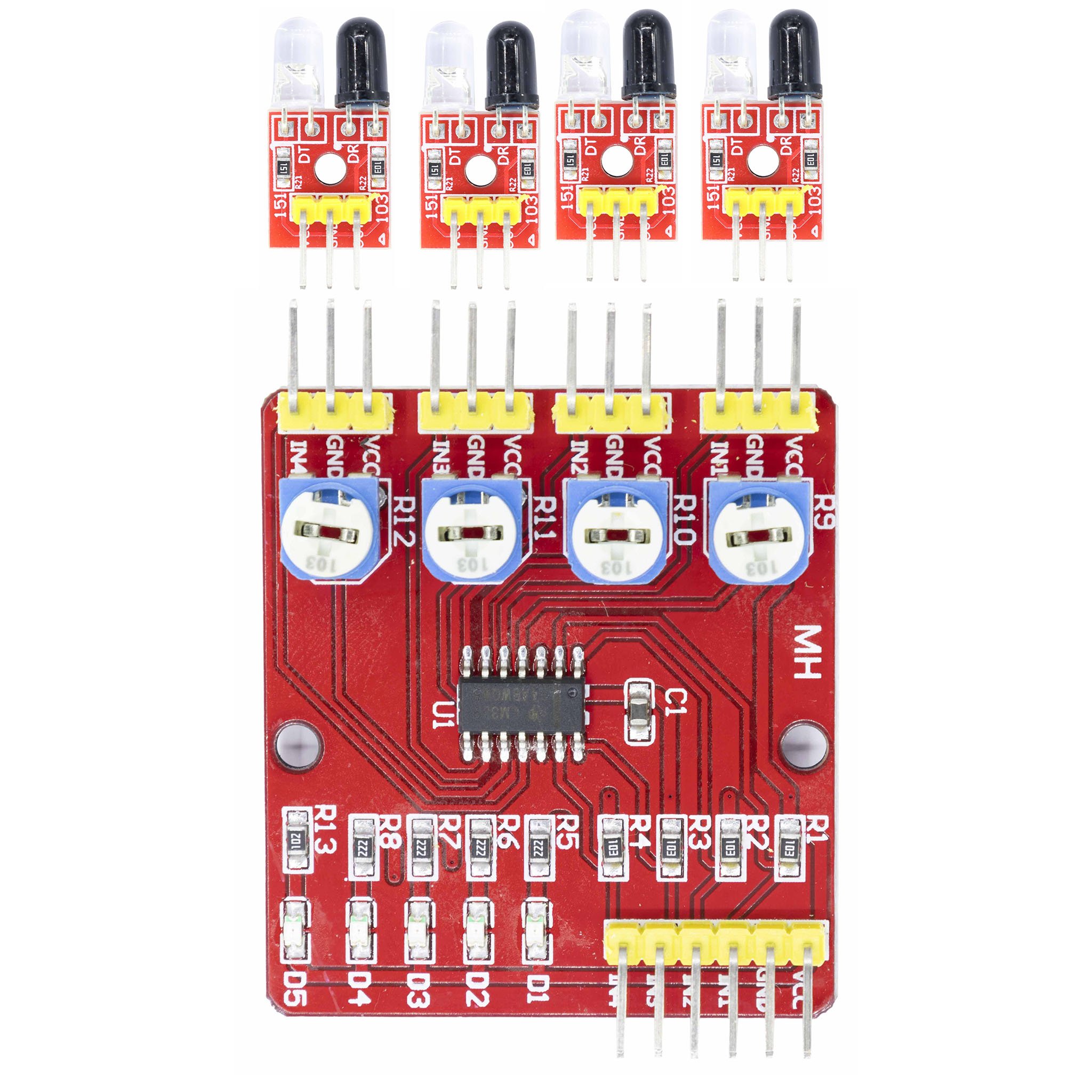
Performance Parameters:
Working voltage: DC 3.3V – 5V
Working current: It is better to choose a power supply with more than 1A for power supply.
Working temperature: -10°C to +50°C
Hollow board: 4.4mm (length) * 4.0mm (width) * 12mm (height)
Size: Small board: 25mm (length) * 12mm (width) * 12mm (height)
Output interface: 6 – wire interface (1, 2, 3, 4 are 4 – channel signal output terminals; VCC is the positive power supply; GND is the negative power supply, which is also the ground wire)
Output signal: TTL level (can be directly connected to the I/O port of the single – chip microcomputer. When the red light reflected back by the sensor is sensed, the red indicator light is on and a low level is output; when there is no infrared light, the indicator light is off and a high level is output)
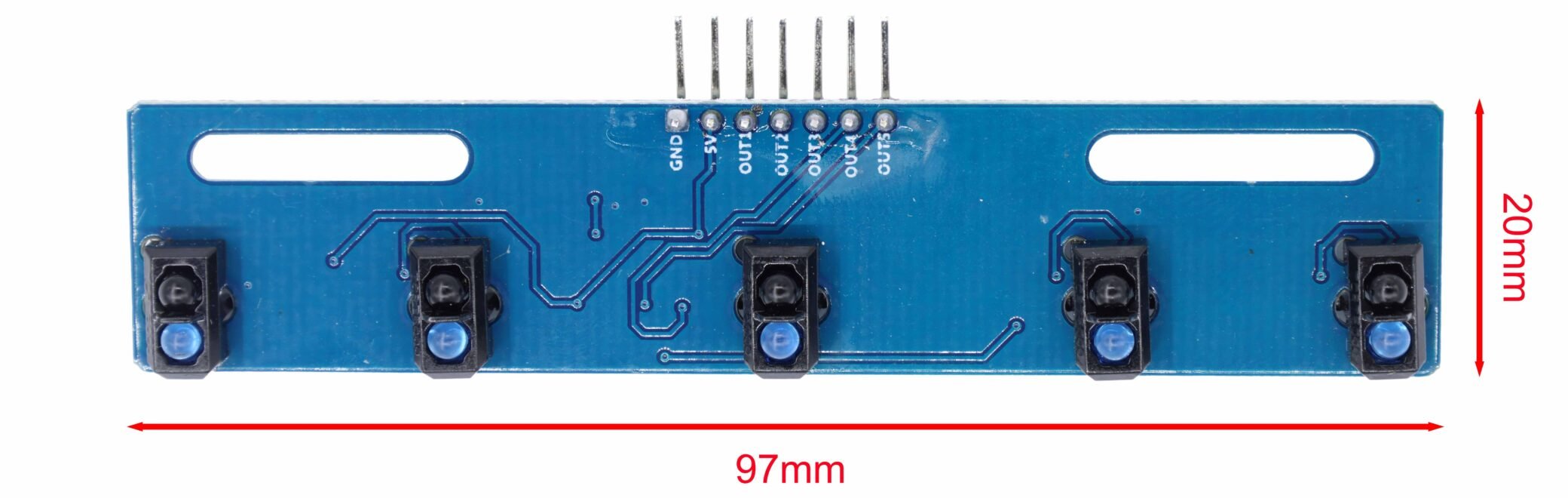
Five - channel line tracking
The five – channel line tracking still uses the TCRT5000 IR sensor. By expanding to five channels, it can more precisely adjust your DIY car. Additionally, the board frame of this version is largely compatible with the DIY car, allowing it to be installed without appearing突兀, and it offers excellent performance.
Five - channel line tracking with button
The five-channel line tracking with button version is designed for installation at the front of the vehicle. It incorporates an additional IR sensor for detecting obstacles ahead, along with an extra digital pinout interface, compared to the version mentioned above. This configuration enables both line tracking and obstacle avoidance, making it ideal for DIY car projects.

Light Sensor Version
The structure of a light sensor is relatively simple. It consists only of an LED light and a photoresistor, but it can still be used for line tracking.The resistance value of the photoresistor is affected by light. The light intensity and the resistance value are inversely proportional. The higher the light intensity, the lower the resistance value.Generally, a light sensor outputs an analog signal. It needs to adjust the threshold through a microcontroller (such as a single – chip microcomputer) to control the operation of the vehicle, so as to realize the line – tracking function.

Working Process
The working process of the light sensor for line tracking is as follows:
After being powered on, the LED light in the module will emit light.
The light travels in the air and is received by the photoresistor after reflection.
When the photoresistor receives light, its resistance value will decrease.
After the photoresistor receives light, its own resistance value becomes smaller, and the amplifier amplifies the electrical signal and then outputs it.
Electrical Parameters
| PARAMETER | SPECIFICATION |
|---|---|
| Operating Voltage | 3.3V or 5V |
| Operating Current | < 20mA |
| Operating Temperature Range | -10°C ~ +70°C |
| Detection Resolution | 10% |
| Interface Type | Analog Signal Output |
| Module Dimensions | 23 × 20mm |
| Pin Definitions | OUT (Signal Output), VCC (Power), GND (Ground) |
E18-D80NK Photoelectric Switches Product Introduction
The E18-D80NK photoelectric switch is a type of IR sensor. Compared to the TCRT5000, it offers greater range and higher accuracy, as well as a larger size, making it more suitable for use as a line tracking module in large DIY vehicles.

Add Your Heading Text Here
| Parameter | Specification |
|---|---|
| Input Voltage | 5V DC |
| Load Current | 100mA |
| Sensing Distance | 3~80cm (adjustable) |
| Diameter | 17.5mm |
| Sensor Length | 50mm |
| Lead Length | 70mm |

FAQ
How to use lR sensor module?
To use an IR sensor module, you just need to connect its pins. When it detects an object or a black line, it can output a digital signal. You can use this digital signal via a microcontroller to achieve the desired effect.
How to test if an lR sensor is working?
If there is a working indicator light, you can observe whether the indicator light is different when it is blocked and when it is not. If there isn’t one, you can measure the output pin with a multimeter. If the voltage of the output pin is different from usual when blocked, it also proves that it can work normally.
What triggers an lR sensor?
All objects can trigger an IR sensor. As long as you block within its measurement range, it can be detected (it will be affected by color).
How is the tracking module used on a small car?
To install tracking modules of different models, typically position them at the front of the vehicle. After installation, connect wires and configure code according to the module’s wiring instructions. Generally, sensors should be evenly distributed on both sides of the centerline. This ensures optimal utilization of the tracking module.