

Blog
MAX9814 Microphone Amplifier Module
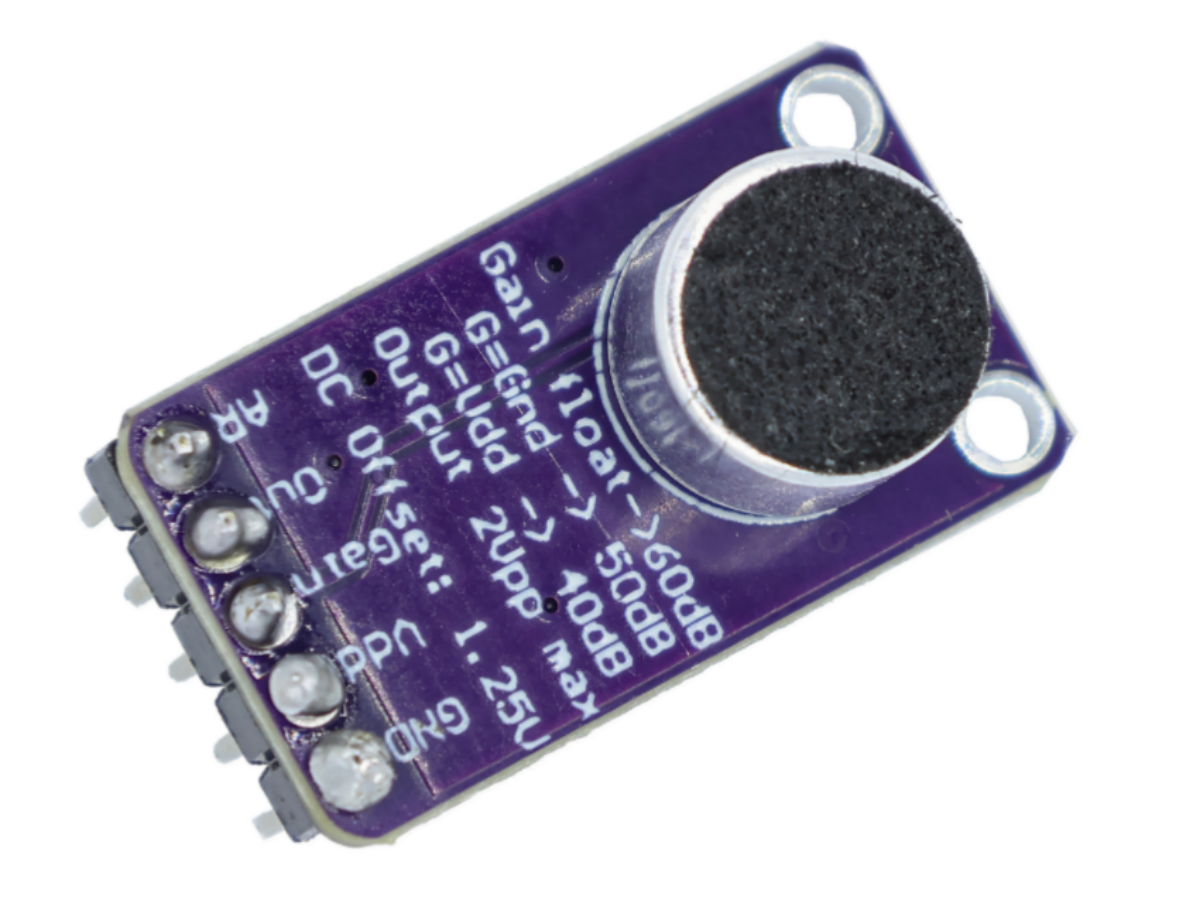
Today we’d like to introduce a microphone module widely used in real-world applications—the MAX9814.
What is the MAX9814?
The MAX9814 microphone amplifier module is an audio amplification module specifically designed for electret condenser microphones. It amplifies weak microphone signals to sufficient levels for subsequent circuit processing. Featuring low noise, high gain, and high bandwidth, this module delivers clear, high-quality audio signals. Additionally, the MAX9814 offers high power supply rejection ratio and excellent stability, making it suitable for various audio applications such as voice recognition, audio recording, and communication equipment.

How does MAX9814 work?
The working principle of the MAX9814 is based on its internal operational amplifier circuit. This circuit receives the weak signal from the electret condenser microphone and amplifies it through multiple stages to a level suitable for subsequent circuit processing.
First, the microphone captures sound waves and converts them into a weak electrical signal. Then, this signal is sent to the input terminal of the MAX9814 and undergoes initial amplification by the internal low-noise preamplifier. Next, the signal is further amplified through one or more gain stages to reach the required output level. Throughout the entire process, the MAX9814 also uses its internal feedback network to stabilize the gain and frequency response of the amplifier, ensuring the stability and quality of the output signal. Moreover, the internal power supply rejection circuit of the module can effectively reduce the impact of power supply voltage fluctuations on the output signal, further improving the clarity of the audio signal.
SIMPLE Working Principle

What is the function of AGC in MAX9814?
AGC, short for Automatic Gain Control, is a key feature within the MAX9814 microphone amplifier module. AGC automatically adjusts the amplifier’s gain based on the strength of the input signal to ensure stable and consistent output. When the input signal is weak, AGC increases the amplifier’s gain to enhance signal strength; conversely, when the input signal is too strong, AGC reduces the gain to prevent signal distortion or overload. This automatic adjustment capability enables the MAX9814 to maintain stable audio output across varying acoustic environments, enhancing the adaptability and reliability of audio systems. Through its AGC functionality, the MAX9814 microphone amplifier module delivers clearer, higher-quality audio signals, making it suitable for various occasions that require high-quality audio recording.
How many gain modes does the MAX9814 have?
The MAX9814 offers three gain modes:
| Gain Modes | Pin Name | dB |
|---|---|---|
| Gain1 | Disconnected | 60 |
| Gain2 | VCC | 50 |
| Gain3 | GND | 40 |
These gain modes allow users to adjust the amplifier’s gain according to specific application requirements, accommodating varying audio input levels and output demands. In low-gain mode, the MAX9814 is suitable for high-level microphone signals to prevent signal overload and distortion. In high-gain mode, it amplifies extremely weak microphone signals, ensuring clear audio output even at low sound levels. This flexible gain adjustment capability enables the MAX9814 to adapt to a wide range of audio applications, delivering outstanding performance from quiet recording environments to noisy communication scenarios. Furthermore, the MAX9814 maintains low noise and high stability across all gain modes through its optimized internal circuit design, providing users with high-quality audio signals.
What are the features of the MAX9814?
In addition to the aforementioned gain mode adjustment and high-quality audio signal output, the MAX9814 microphone amplifier module offers several other notable features. First, it employs a low-power design that reduces energy consumption while maintaining performance, which is particularly important for portable devices and audio applications requiring extended operation. Second, the MAX9814 exhibits excellent electromagnetic compatibility (EMC), ensuring stable operation in complex electromagnetic environments and minimizing the impact of external interference on audio signals.
Furthermore, this module also provides flexible power supply options, which can adapt to the power supply requirements of different voltage ranges and increase its compatibility in various devices. Finally, the MAX9814 has a compact package design and a small size, which is convenient for integration into various electronic devices and meets the high requirements of modern electronic products for space utilization. To sum up, the MAX9814 microphone amplifier module shows broad application prospects in the field of audio applications due to its multi-functional gain modes, high-quality audio output, low-power design, excellent electromagnetic compatibility, and compact package design.
What are the application areas of the MAX9814?
The MAX9814 is typically employed in speech recognition systems due to its unique physical characteristics, where high-precision audio amplification and clear signal output are crucial for enhancing speech recognition accuracy. In the field of audio recording, the MAX9814 delivers high-quality sound capture, meeting stringent audio quality requirements for both professional recording studios and personal audio creation. Furthermore, the MAX9814 finds extensive use in communication devices such as mobile phones, walkie-talkies, and headsets. Its low power consumption and stable performance ensure clear audio quality during extended calls. Simultaneously, the module’s compact packaging design makes it an ideal choice for portable audio equipment, delivering a more convenient and high-quality audio experience to users. In summary, the MAX9814 microphone amplifier module demonstrates outstanding performance and broad application value across multiple fields.
MAX9814 Functional Parameter Table
| Parameter | Value |
|---|---|
| Supply Voltage | 2.7V – 5.5V |
| Output Voltage | 2V under a 1.25V bias |
| Low Total Harmonic Distortion Rate | 0.04% |
| Adjustable Automatic Gain | 40dB / 50dB / 60dB |
| Frequency Response | 20Hz – 20KHz |
| Usable Temperature Range | Maximum: 85°C; Minimum: -40°C |
| Product Size | 26mm × 15mm |
MAX9814 DATASHEET
MAX9814 pins

GND: Ground terminal, used to connect the module’s negative terminal or ground potential
Vdd: Connect to power supply positive terminal
Gain: Tri-state amplifier gain control pin (GAIN=ADD: gain set to 40dB; GAIN=GND: gain set to 50dB; GAIN=floating: no compression, gain set to 60dB)
Out: Audio signal output terminal, providing amplified audio signals. This signal can be fed into subsequent audio processing circuits, such as analog-to-digital converters (ADC) or audio power amplifiers, for further processing or amplification.
AR: Three-state activation-to-release ratio selection (controls the activation time to release time ratio of the AGC circuit)
AR=GND: Activation time to release time ratio: 1:500
AR=vpp: Activation time to release time ratio: 1:2000
AR=floating: Activation time to release time ratio: 1:4000
MAX9814 Connects to Arduino to Enable Recording Functionality
Item List:
- Arduino Uno
- MAX9814 Microphone Amplifier Module
- OLED Display
- SD Card Module
- Button Module
- Several DuPont Wires
- Power Amplifier Module
- Speaker Module

Programming the device enables the following functionality:
Pressing the red button initiates recording; pressing it again stops recording.
Pressing the yellow button plays back the recording.
Sample code
					#include <SPI.h>
#include <SD.h>

// Pin definitions
const int micPin = A0;          // MAX9814 OUT connected to this pin
const int pwmPin = 9;           // Amplifier IN connected to this pin
const int recordButtonPin = 2;  // Record button
const int playButtonPin = 3;    // Play button
const int chipSelect = 10;      // SD card CS pin

// Variables
volatile bool recordFlag = false;
volatile bool playFlag = false;
File audioFile;

void setup() {
  Serial.begin(9600);

  // Initialize SD card
  if (!SD.begin(chipSelect)) {
    Serial.println("SD card initialization failed!");
    return;
  }
  Serial.println("SD card initialized successfully.");

  // Set pin modes
  pinMode(recordButtonPin, INPUT_PULLUP);
  pinMode(playButtonPin, INPUT_PULLUP);
  pinMode(pwmPin, OUTPUT);

  // Set PWM frequency to 62.5kHz to reduce noise
  // Timer1 configuration, works with pins 9 and 10 on Uno
  TCCR1A = _BV(COM1A1) | _BV(COM1B1) | _BV(WGM10); // 8-bit fast PWM
  TCCR1B = _BV(CS10);                              // No prescaling

  // Set up interrupts, trigger when button is pressed (grounded)
  attachInterrupt(digitalPinToInterrupt(recordButtonPin), setRecordFlag, FALLING);
  attachInterrupt(digitalPinToInterrupt(playButtonPin), setPlayFlag, FALLING);

  Serial.println("System ready. Press buttons to start recording or playing.");
}

void loop() {
  if (recordFlag) {
    recordFlag = false;
    recordAudio();
  }

  if (playFlag) {
    playFlag = false;
    playAudio();
  }
}

// Interrupt service routines
void setRecordFlag() {
  // Simple debounce, can add delay or software debounce if button is unstable
  if (digitalRead(recordButtonPin) == LOW) {
    recordFlag = true;
  }
}

void setPlayFlag() {
  if (digitalRead(playButtonPin) == LOW) {
    playFlag = true;
  }
}

// Recording function
void recordAudio() {
  Serial.println("Starting recording...");
  // Delete old file if it exists
  SD.remove("audio.raw");
  audioFile = SD.open("audio.raw", FILE_WRITE);

  if (!audioFile) {
    Serial.println("Failed to create file!");
    return;
  }

  unsigned long startTime = millis();
  // Record for 5 seconds, can modify as needed
  while (millis() - startTime < 5000) {
    // Read analog value (0-1023) -> 10 bits
    int sample = analogRead(micPin);
    // Store 10-bit data as 2 bytes (high byte and low byte)
    byte highByte = (sample >> 8) & 0xFF; // Get high 2 bits
    byte lowByte = sample & 0xFF;         // Get low 8 bits
    audioFile.write(highByte);
    audioFile.write(lowByte);
    // Short delay to control sample rate, approximately 9.6kHz
    delayMicroseconds(100);
  }

  audioFile.close();
  Serial.println("Recording finished.");
}

// Playback function
void playAudio() {
  Serial.println("Starting playback...");
  audioFile = SD.open("audio.raw");

  if (!audioFile) {
    Serial.println("Failed to open file!");
    return;
  }

  // Read file and output to PWM
  while (audioFile.available()) {
    // Read 2 bytes and reconstruct 10-bit sample
    byte highByte = audioFile.read();
    byte lowByte = audioFile.read();
    int sample = (highByte << 8) | lowByte;
    // Map 10-bit sample to 8-bit PWM (0-255)
    // Shifting right by 2 bits is equivalent to dividing by 4, 1023/4=255.75 -> 255
    analogWrite(pwmPin, sample >> 2);
    // Delay to match recording sample rate
    delayMicroseconds(100);
  }

  audioFile.close();
  // Stop PWM output after playback to mute
  analogWrite(pwmPin, 0);
  Serial.println("Playback finished.");
}
FAQS
What is the frequency response of MAX9814?
The frequency response of the MAX9814 ranges from 20Hz to 20KHz.
How does AGC work?
AGC works by automatically adjusting the amplifier’s gain based on the strength of the input signal. When the incoming audio signal is weak, AGC increases the amplifier’s gain to boost signal strength to an appropriate level. Conversely, when the incoming audio signal is too strong, AGC reduces the amplifier’s gain to prevent signal overload and distortion. This automatic adjustment capability enables the MAX9814 microphone amplifier module to maintain stable audio output across diverse sound environments, ensuring clarity and consistency in sound quality.
MAX9814 VS MAX9812
| Feature | MAX9814 | MAX9812 |
|---|---|---|
| AGC Response Type | Fixed attack/release time | Adjustable attack/release time (via external resistor) |
| Gain Selection | 3 fixed gain levels (40dB, 50dB, 60dB) selected via pins | 3 fixed gain levels (40dB, 50dB, 60dB) selected via pins |
| Noise Performance | Extremely low noise (typical value ~30nV) | Low noise (typical value ~42nV/Hz) |
| THD+N (Total Harmonic Distortion + Noise) | Lower (typical value 0.04%) | Lower (typical value 0.08%) |
| Shutdown Current | Lower (typical value 0.1μA) | Low (typical value 0.5μA) |
| Main Application Scenarios | High-quality recording scenarios | Voice recognition, general applications with high requirements for AGC adaptability |