

Blog
MD30-60 Thin-Film Pressure Sensor Introduction
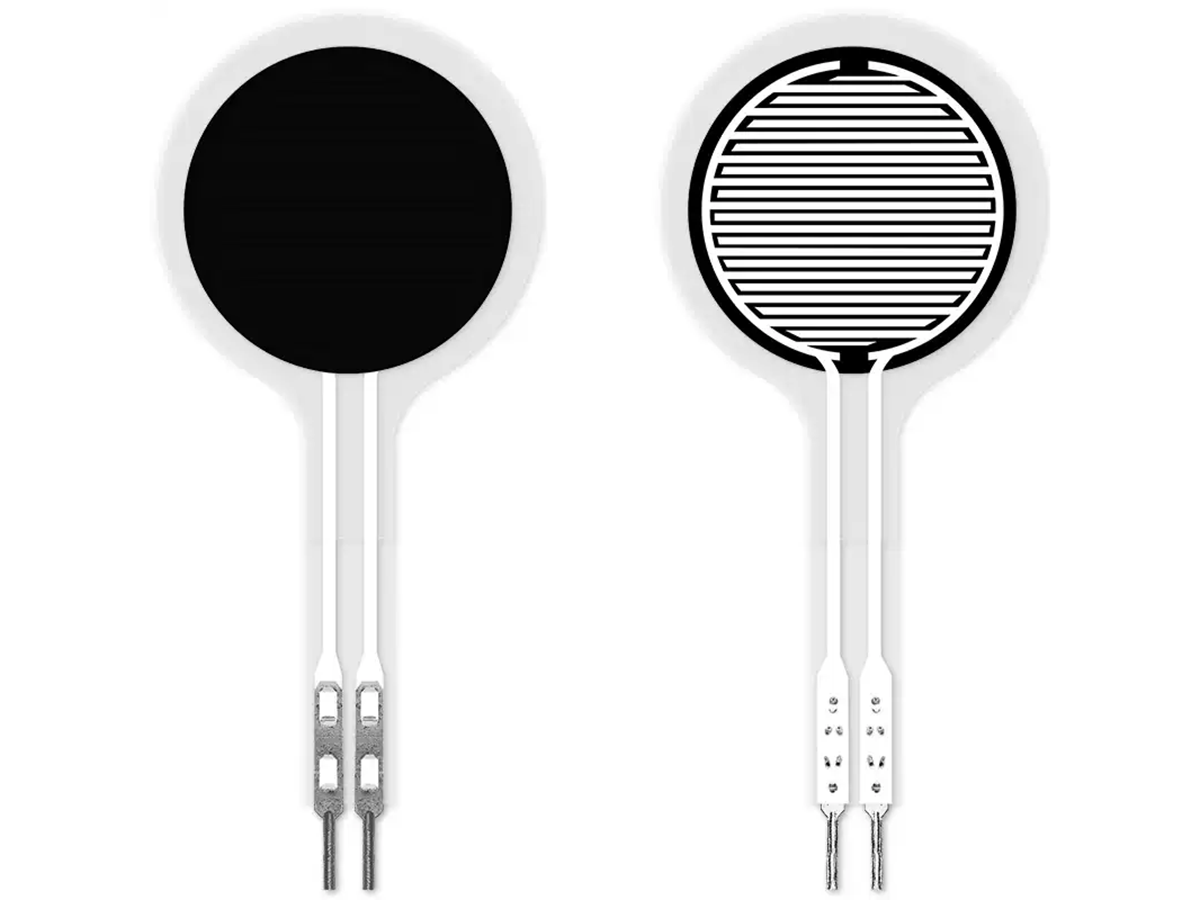
MD30-60 Introduction
The MD30-60 is a type of thin-film pressure sensor. Its main function is to measure pressure trends and squeezing pressure. It is generally used with a voltage conversion module, or you can handle voltage conversion independently. It supports both digital signal output and analog signal output. For digital signal output, the threshold can be adjusted via a potentiometer to trigger actions. For analog signal output, the sensor can be connected to the I/O interface of a microcontroller to read and process the corresponding voltage value. However, the voltage value has no proportional (direct or inverse) relationship with the pressure. Therefore, it cannot be used for accurate force measurement and can only be used to monitor pressure trends or measure analog quantities corresponding to pressure levels for indirect use.
Demo Video
Function Introduction
·Digital Signal Mode: Connect the sensor to a voltage conversion module, and connect the DOUT (digital output) pin to a microcontroller or directly to other signal interfaces. In this demonstration, the DOUT pin is connected to a relay module with digital signal control to operate a pump. By adjusting the potentiometer, the sensor can be triggered precisely when the water level in the water tank reaches half its capacity, activating the water pump to drain water and keep the water level below half.
·Analog Signal Mode: Connect the sensor to a voltage conversion module, and connect the AOUT (analog output) pin to a microcontroller for reading. In this case, an Arduino UNO is used to receive the analog voltage signal. By uploading the following code:
					// Pressure Sensor with Zero Calibration
const int SENSOR_PIN = A0;
float initialVoltage = 0;
float scaleFactor = 1.0;  // Change this value as needed

void setup() {
  Serial.begin(9600);

  // Calibrate zero point
  delay(100);
  initialVoltage = analogRead(SENSOR_PIN) * (5.0 / 1023.0);

  Serial.print("Initial Voltage: ");
  Serial.println(initialVoltage, 3);
  Serial.println("Ready...");
  Serial.println("Voltage,Processed");
}

void loop() {
  float rawVoltage = analogRead(SENSOR_PIN) * (5.0 / 1023.0);

  // Process: (voltage / scaleFactor) - initialValue
  float processedValue = (rawVoltage / scaleFactor) - initialVoltage;

  Serial.print(rawVoltage, 3);
  Serial.print(",");
  Serial.println(processedValue, 3);

  delay(100);
}


It can be observed that as the pressure increases, the output voltage decreases. To achieve a direct proportional relationship, you only need to adjust the initial defined values and slope of the function. After adjustment, although the function can show an increasing trend as pressure increases, the relationship itself is not proportional.Therefore, if you need to use it, you can observe the corresponding value of the output under a certain pressure, so as to set multiple thresholds, which is equal to setting multiple digital signal thresholds for output.
Parameter Description
| Parameter | Specification |
|---|---|
| Range | 0-20kg |
| Thickness | <0.6mm |
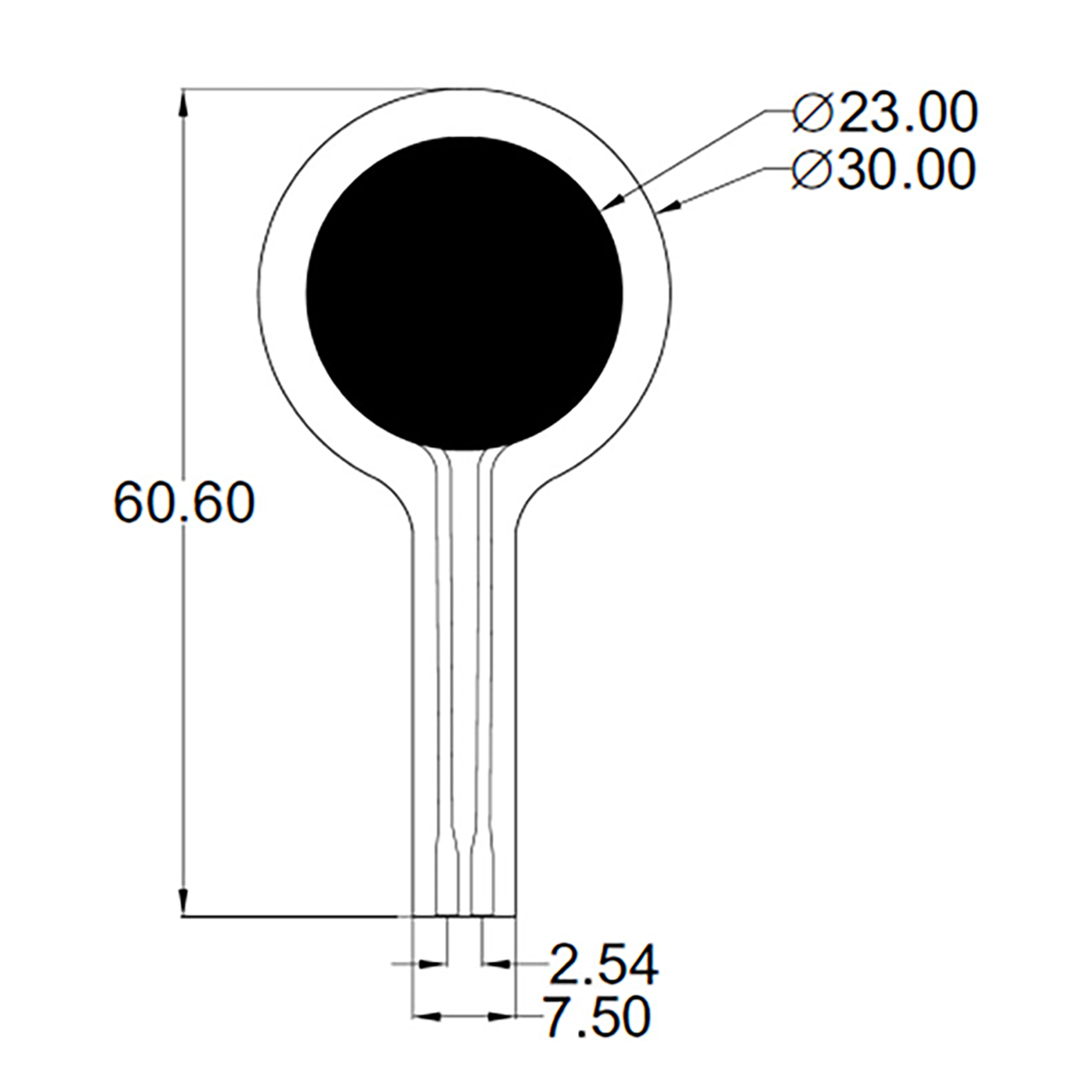
| Dimensions | Φ30mm L60mm |
| Response Point | <200g |
| Consistency | ±10% (same model batch) |
| Repeatability | ±10% (50% load) |
| Durability | >1 million cycles |
| Initial Resistance | >10MΩ (no load) |
| Response Time | <1ms |
| Recovery Time | <15ms |
| Test Voltage | Typical DC 3.3V |
| Operating Temperature | -20°C ~ 60°C |
| Electromagnetic Interference (EMI) | None generated |
| Electrostatic Discharge (ESD) | Not sensitive |
Size Description
Application Scenarios
It is often used in scenarios that require approximate detection of pressure and pressure indicators, such as self-balancing scooter detection, smart toilets, and press detection.
Usage Precautions
It should be noted that although the MD30-60 thin-film pressure sensor is made of flexible material, it is not recommended to bend it beyond 90°, as this may damage the sensor. Additionally, if the sensor is to be placed on the side or bottom of a water-containing container, proper waterproof measures must be taken to prevent sensor damage.
FAQ
How does the force-sensitive flexible sensor respond to pressure? Is the resistance constant, or does it decrease at a constant rate?
The force-sensitive flexible sensor is resistive: the greater the force, the smaller the resistance.
What is the maximum pressure that can be applied without damaging the sensor?
Although the polymer material of the sensor will only be damaged under a pressure of approximately 10,000 PSI (69N/mm²), we usually recommend applying a pressure much lower than this limit—preferably below 10N/mm².
What materials/conditions may damage the sensor?
Temperatures above 125℃, water immersion, sharp objects, shear forces, or pressures exceeding 10N/mm² may damage the sensor.
Can the sensor be attached to the surface of an object?
Yes, it is recommended to use double-sided tape to attach the sensor to the object surface. Usually, the sensor comes with such double-sided tap
What type of surface is best for attaching the sensor?
A flat, smooth surface is optimal. Moisture or dirt particles may cause false triggers of the sensor.
What voltage range can be used to power the force-sensitive flexible sensor?
The force-sensitive flexible sensor acts like a passive resistor and can be powered by any voltage. Typically, the voltage range is 0.1V to 5V.
Is the force-sensitive flexible sensor waterproof?
Force-sensitive flexible sensor materials should not be in direct contact with liquids. The sensor must be waterproof.
What impact does humidity have on the sensor?
Among all extreme environmental factors, humidity has the most significant impact. For instance, maintaining extremely high humidity (85% RH) at 85°C for hundreds of hours can cause substantial changes in electrical resistance.
What is the minimum sensing area achievable with the sensor?
The minimum size of the sensor can be 5mm (with a 3mm sensing area).