

Blog
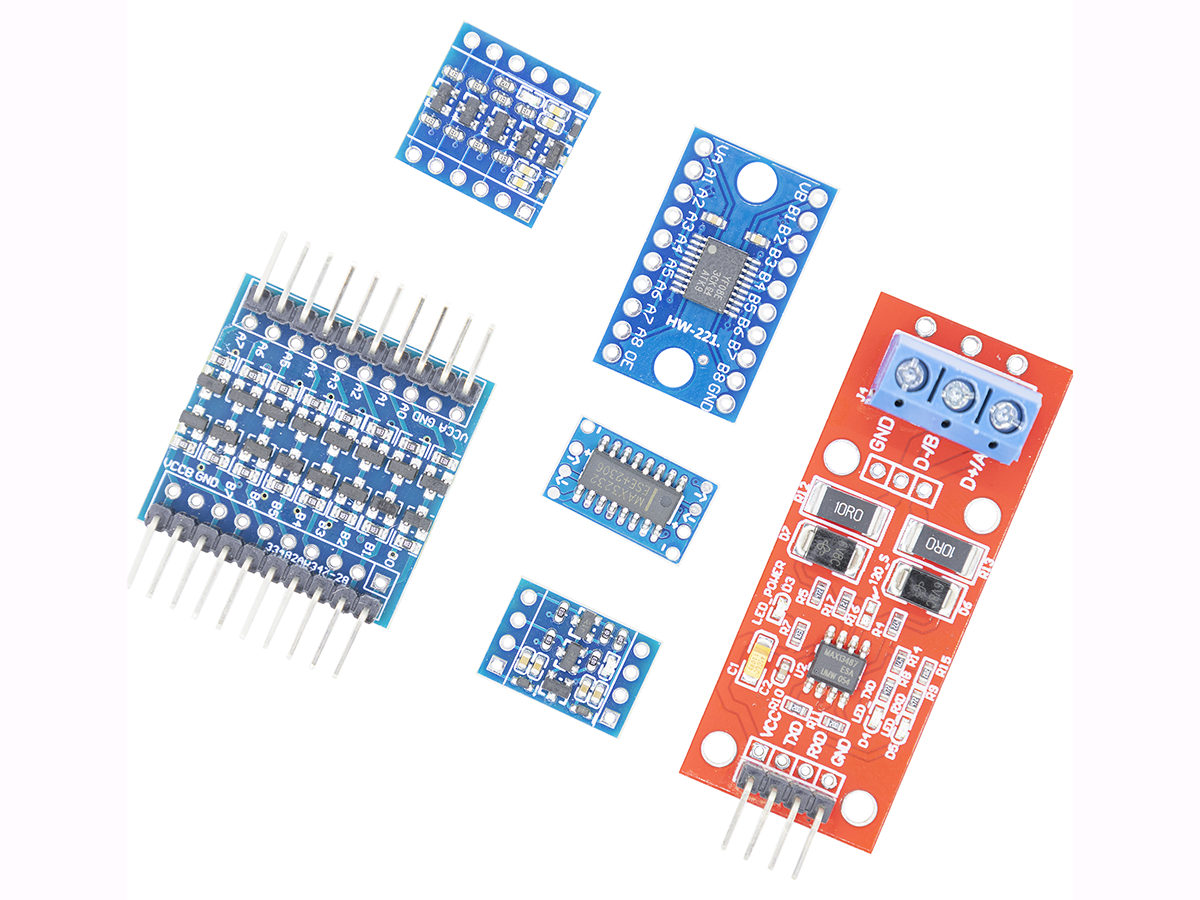
Quick Overview of Level Conversion Modules (Leave Shifter)
What is Level Conversion Module
A Level Conversion Module (also known as a Level Shifter or Level Translator) is an interface circuit module used for safe and reliable communication between devices operating in different voltage domains within an electronic system.
Its core function is to resolve signal incompatibility issues arising in modern digital circuits when different chips or components (e.g., a microcontroller operating at 5V and a sensor operating at 3.3V) use different operating voltages. It precisely converts a high/low logic signal sent from one side into a corresponding logic signal that can be correctly recognized by the other side. This prevents permanent damage to low-voltage devices by high-voltage ones and ensures the accurate transmission of logical signals.
Common types include unidirectional converters (such as the 74HC series, used for data acquisition) and more advanced bidirectional converters with automatic direction sensing (such as the TXB0108 series). The bidirectional type requires no direction control signal and is particularly suited for bidirectional data buses like I²C.
These modules often exist as standalone printed circuit boards (PCBs), integrating the translation chip, pull-up/pull-down resistors, and clearly labeled input/output ports. They provide a plug-and-play convenience for engineers, hobbyists, and prototype development.
Serving as an indispensable bridge, they are crucial for connecting devices like Arduino and Raspberry Pi to peripherals with differing voltage requirements.
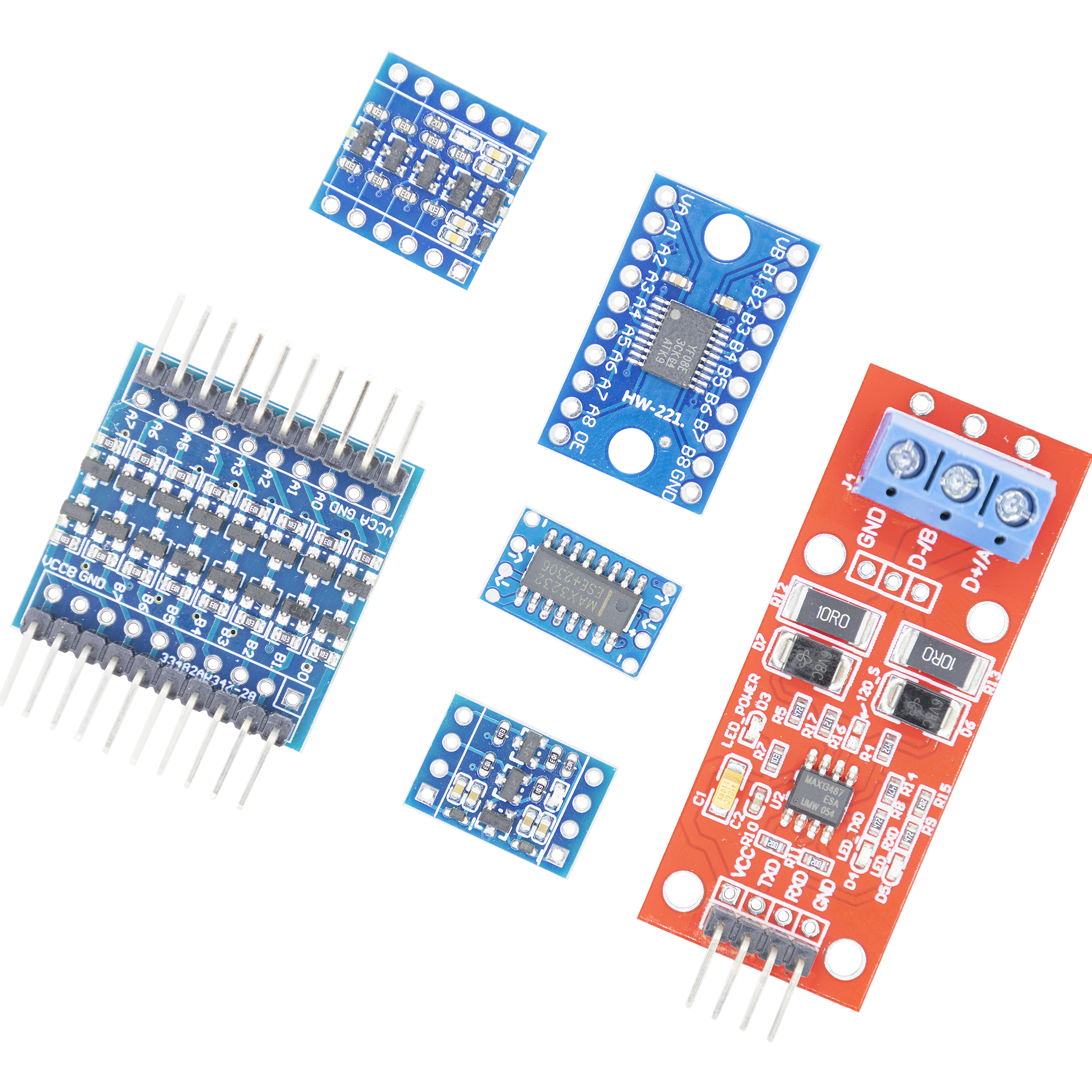
What does a level shifter do?
The purpose of a level shifter module is to connect electronic components with different voltage standards. For example, connecting a 3.3V microcontroller to a 5V peripheral requires a level shifter module to convert the voltage signals, enabling the microcontroller to correctly interpret the 5V peripheral’s output signals. This ensures accurate logic state transmission while protecting the circuit.
Types of Level Conversion Modules
The function of Level Conversion Module is to convert different level signals to other level signals, so it has a wide variety of types. Common types are roughly divided into 3.3V to 5V, RS232 to TTL, and RS485 to TTL. Meanwhile, classified by direction, they can be divided into unidirectional level converters, bidirectional level converters, and dedicated level conversion chips.
2/4/8-Channel Level Conversion Module (3.3V to 5V)
The 3.3V to 5V Level Conversion Module mainly converts and transmits 3.3V level signals and 5V level signals to each other. It is mostly used for connecting 3.3V microcontrollers such as Raspberry Pi with 5V peripherals (e.g., motors), ensuring circuit safety while maintaining lossless signal transmission. It should be noted that a level conversion module is not a voltage conversion module. A level conversion module requires 3.3V and 5V power supplies to work properly.
Performance Parameters of 2/4/8-Channel Level Conversion Module (3.3V to 5V)
| Feature | Description |
|---|---|
| Conversion Method | Bidirectional 3V-5V level conversion realized by MOSFETs |
| Power Input | With reverse connection protection; Integrated 3.3V LDO |
| Power Output | Capable of providing an external current of no more than 150mA from the 3.3V LDO |
| Status Indicator | Equipped with a power indicator light for clear visibility of working status |
| Compatible Protocols | Enables bidirectional level conversion for bus signals such as UART, I²C, 1-Wire, SPI |
Detailed Display and Explanation of 2/4/8-Channel Level Conversion Module (3.3V to 5V)
Except for the difference in the number of interfaces, the level shifter 3.3v to 5v share the same functions and electrical parameters. You can purchase one according to your needs. When in use, 3.3V and 5V power supplies must be connected separately.


Wiring Method for 2/4/8-Channel Level Conversion Module (3.3V to 5V)
- Connect VCCA to the positive terminal of the 3.3V power supply
- Connect VCCB to the positive terminal of the 5V power supply
- Connect GND to the negative terminal of the power supply; the two power supplies share a common ground
- When 3.3V TTL level is input to Ax, 5V TTL level will be output from Bx
- When 5V TTL level is input to Bx, 3.3V TTL level will be output from Ax
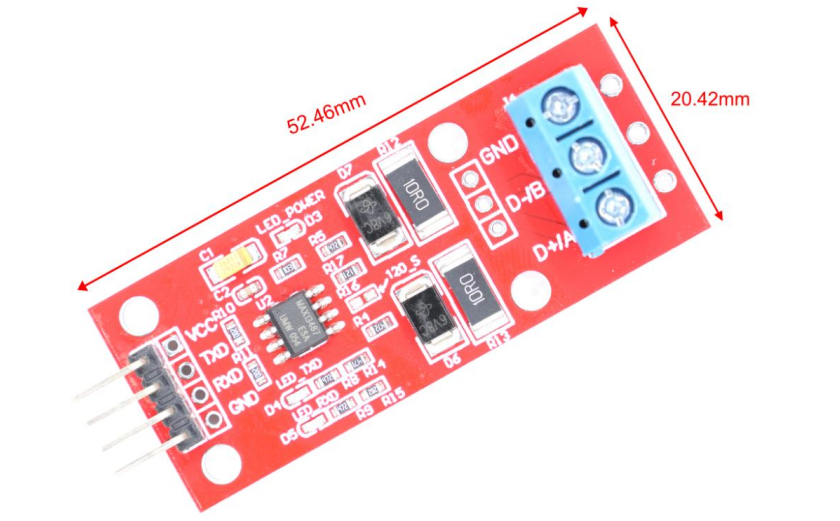
TTL to RS485 Level Conversion Module (Red Version)

Performance Parameters of TTL to RS485 Level Conversion Module (Red Version)
| Parameter Category | Parameter Item | Specification / Value |
|---|---|---|
| Basic Performance | Transmission Distance | Ultra-long-distance transmission, up to over 1,000 meters |
| Basic Performance | Signal Transmission Rate | Up to 500Kbps (error-free transmission) |
| Interface Characteristics | ESD Protection Rating | ±15KV |
| Interface Characteristics | Receiver Input Impedance | 1/4 unit load |
| Interface Characteristics | Maximum Number of Nodes | 128 |
| Environmental Characteristics | Operating Temperature | -40°C to +85°C (Industrial Grade) |
| Power Characteristics | Power Filtering | Uses surface-mounted tantalum electrolytic capacitors with dual capacitors for high and low-frequency filtering |
| Protection Features | Overvoltage Protection | Dual transient voltage suppression diodes, excellent performance |
| Protection Features | Current Protection | Uses a 1Ω current limiting resistor |
| Termination Matching | Termination Resistor | Equipped with 120Ω termination resistor (enabled by shorting R16) |
| Signal & Control | Signal Compatibility | Supports 3.3V and 5V signal control |
| Signal & Control | Signal Indicators | Includes power, RXD, and TXD signal indicators |
| Signal & Control | Hot-Swap Support | Supported, no signal latch-up phenomenon |
| Physical Design | Signal Integrity Design | Slew-rate limited driving reduces EMI and reflection; single-layer routing; large-area copper pour; surface-mount design |
Size of TTL to RS485 Level Conversion Module (Red Version)

TXS0108E 8-Bit Bidirectional Voltage Translator
The 8-bit bidirectional voltage level shifter adopts the TXS0108E chip. As a high-speed full-duplex 8-channel level shifting module, it provides bidirectional communication capability.
It supports communication compatibility between 5V MCUs (Microcontrollers) and 3.3V modules, as well as between 3.3V MCUs and 5V modules. It is suitable for level shifting in communications between MCUs and SD cards, and between MCUs and IIC/SPI serial devices. The OE (Output Enable) pin is active-high, and it is recommended to connect it to the IO pin of the low-voltage side.
In practical use, its operating method is basically the same as the 8-Channel Level Conversion Modules mentioned above, but the specific electrical parameters differ—you can choose it according to your needs.

Performance Parameters of TXS0108E 8-Bit Bidirectional Voltage Translator
| Parameter Category | Parameter Item | Specification / Value |
|---|---|---|
| Chip Information | Module Chip | TXS0108E |
| General Specifications | Converter Type | High-speed full-duplex 8-channel level converter with bidirectional communication capability |
| Voltage Specifications | VCCA Voltage Range | 1.2V – 3.6V |
| Voltage Specifications | VCCB Voltage Range | 1.65V – 5.5V |
| Voltage Specifications | Supported Conversions | 3.3V-5V, 1.8V-3.3V and other common level conversions |
| Application Scenarios | Primary Applications | Communication between 5V MCU and 3.3V modules; 3.3V MCU and 5V modules |
| Application Scenarios | Compatible Uses | Level conversion for MCU and SD card communication; MCU and I2C, SPI, UART devices |
| Control Interface | OE Enable Pin | Active high, recommended to connect to IO port of the low voltage side |
Size of TTL to TXS0108E 8-Bit Bidirectional Voltage Translator

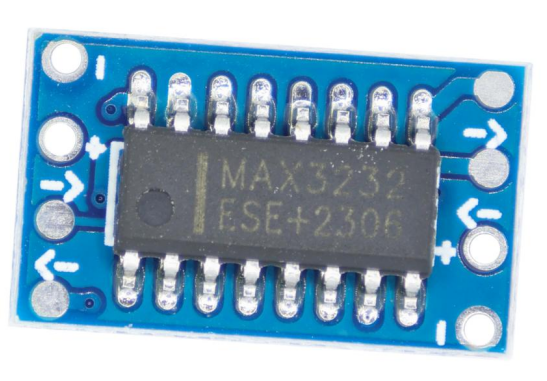
Mini MAX3232 RS232 to TTL Level Conversion Board
The Mini MAX3232 RS232 to TTL Level Conversion Board is a level conversion module used to convert RS232 level signals to TTL level signals. This is its most distinctive feature compared with the other level conversion modules mentioned above. When in use, you need to confirm the connection position of the level signals; for power supply, only one power source needs to be connected to use this module.
MAX3232 is a 3.3V/5V RS-232 transceiver with 2 drivers/2 receivers. It features 250kbps data rate, ±15kV ESD protection, and industrial temperature range (-40°C to +85°C). Requires only 4 external capacitors for operation. Widely used for serial communication interfaces.
Performance Parameters of Mini MAX3232 RS232 to TTL Level Conversion Board
| Parameter Category | Parameter Item | Specification / Value |
|---|---|---|
| Chip Information | Chip Model | Domestic MAX3232CSE |
| Electrical Characteristics | Voltage Range | 3V |
| Performance Specifications | Maximum Recommended Baud Rate | Not recommended to exceed 120kbps |
Size of Mini MAX3232 RS232 to TTL Level Conversion Board
FAQ
Why need a level shifter?
A level shifter is needed to enable communication between electronic components operating at different voltage levels, ensuring signal compatibility, preventing damage to lower-voltage devices, and maintaining signal integrity when interfacing between systems with mismatched logic levels.
What is the difference between a level shifter and a buffer?
Level shifter converts signals between different voltage levels (e.g., 3.3V to 5V) to enable communication between incompatible devices, while a buffer primarily amplifies or reinforces signals at the same voltage level to improve signal integrity, drive capacity, or isolate circuits without changing voltage.
4-Channel Level Conversion Module (3.3V to 5V) Demonstration Video
level shifter arduino: