

Blog
Introduction to DC 5V Conversion and DC 005 DC Power Supply Module
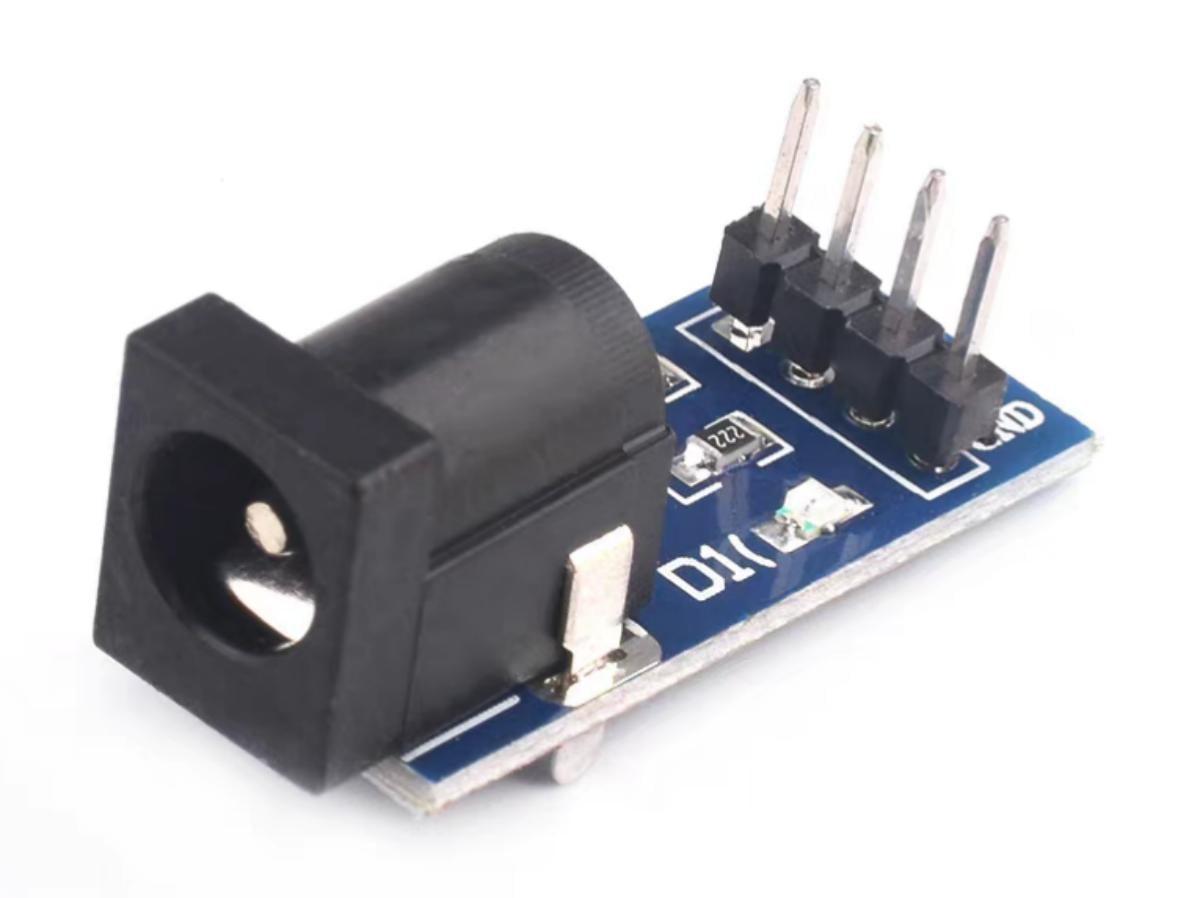
Overview
In daily life, DC 5V direct current is practically the universal standard in the world of electronic devices—powering everything from phone chargers and smart speakers to microcontroller development projects and sensor operations. To get a stable DC 5V power supply, engineers and innovators before us have created a variety of flexible power conversion solutions. It serves as a critical connection bridge for easily integrating power sources into circuit boards. Now, let’s first learn about the conversion principles related to DC 5V, then get to know the DC 005—an incredibly convenient power transfer tool!
DC 5V Power Conversion Principles
The core goal of obtaining a stable DC 5V power supply is to use conversion circuits to eliminate fluctuations and noise from the original power source, while precisely regulating the voltage to 5V. Based on the type of the original power source, the solutions are divided into two categories: AC-DC conversion and DC-DC conversion. This is essential foundational knowledge no electronics engineer should be without—make sure you give it a thorough read! I’m confident it’ll be a huge help.
AC-DC Conversion Principle
The electricity supplied by the daily power grid is 220V alternating current (AC), but most electronic devices require 220V AC to 5V DC power supply (also referred to as “5V AC-DC” in short). This makes 220V AC-to-5V DC conversion an extremely common scenario, and it involves four core processes:
- Voltage Transformation: A transformer steps down the high-voltage 220V AC to a low-voltage AC that corresponds to DC 5V (typically 7-9V, leaving a margin for subsequent rectification and filtering).
- Rectification: A diode bridge rectifier circuit converts the bidirectionally flowing AC into unidirectionally pulsating direct current (DC) — only the positive half-cycle of the current is retained, while the negative half-cycle is cut off in reverse.
- Filtering: A capacitor filter circuit composed of high-capacity electrolytic capacitors eliminates “noise” from the pulsating DC, smoothing out the waveform to make it close to stable DC.
- Voltage Regulation: This step precisely stabilizes the filtered and smoothed voltage to 5V DC, usually using one of two components: a linear voltage regulator or a switching voltage regulator.
A common example is the 7805 chip, which is a linear voltage regulator. It uses an adjustment transistor connected in series with the circuit to dissipate the excess voltage between the input and output, thereby achieving voltage regulation. The advantage of this regulator is its low output voltage ripple and low cost, but its drawbacks are equally obvious: low efficiency. This is especially noticeable when there is a large voltage difference between input and output — it consumes more power and generates significant heat. For this reason, it is more suitable for powering low-current devices, such as those requiring 5V 1A.
The other type, the switching voltage regulator, controls energy transfer through high-frequency switching (using PWM, or Pulse-Width Modulation, for example). It only allows current to flow through the circuit when the device needs power. Its key strengths are high efficiency (usually 80% to 95%) and low heat generation, making it ideal for high-current devices. Most of the phone chargers and various 5V DC adapters we use today rely on this solution — it’s the current mainstream choice.

1:AC Voltage Input;2:Transformer;3:Diode Bridge Rectifier;4:Capacitor;
DC-DC Conversion Principle
When the original power source is already direct current (DC) — such as a 12V car battery or a 24V industrial power supply — and needs to be converted to DC 5V, a DC-DC converter (e.g., a 12V DC-to-5V DC converter) is used. It functions as a voltage regulator and is categorized into two types based on the relationship between input and output voltages:
(1) Non-Isolated DC-DC Conversion
For this type, the input and output circuits are directly linked. It features a simple structure and low cost, making it suitable for scenarios where electrical isolation is not required (e.g., power supply inside a circuit board). There are two subtypes:
(i)Buck (Step-Down): Used when the input voltage is higher than the output voltage (e.g., converting 12V DC to 5V DC or 24V DC to 5V DC). A switching transistor turns on and off periodically to “chop” the input electrical energy into pulses. The energy is then stored in an inductor and filtered by a capacitor, resulting in a stable 5V DC output. For example, when a 12V 2A DC005 power adapter is connected to a device, if the device requires 5V, the internal Buck circuit will step the 12V down to 5V.
(ii)Boost (Step-Up): Used when the input voltage is lower than the output voltage (e.g., converting 3.7V lithium battery power to 5V DC for phone charging). It leverages the charging and discharging process of an inductor to boost the low voltage up to 5V.
(2) Isolated DC-DC Conversion
Unlike the non-isolated type, this variant uses components like transformers and optocouplers to achieve electrical isolation between the input and output circuits. This effectively prevents high voltages or interference from the input side from affecting the device connected to the output. It is commonly used in scenarios with high requirements for safety and anti-interference, such as medical equipment and industrial control systems. However, its drawbacks are equally notable: it is larger in size and higher in cost.
Further Insights into DC-DC Power Supply Principles
1) Buck Converter:

V-t Characteristic Curve of the Inductor:

Analysis:
The BUCK converter is the core circuit for DC voltage step-down, relying on the inductor’s energy storage cycle and volt-second balance to achieve stable voltage regulation.
Its energy transfer process consists of two stages: first, the conduction and energy storage phase. When the PWM signal turns on the MOSFET, the input voltage Vin forms a loop through the inductor L. At this moment, the voltage across the inductor equals Vin minus the output voltage Vo. Following the inductor’s volt-ampere characteristic V = L·di/dt, the current in the inductor rises linearly, continuously storing magnetic energy. During this period, the freewheeling diode remains reverse-biased and non-conductive, and the load is temporarily powered by the output capacitor
Next comes the turn-off and energy release phase. After the MOSFET turns off, the inductor, which cannot have its current drop to zero abruptly, induces a reverse voltage. This causes the freewheeling diode to conduct forward, allowing the inductor to release the stored magnetic energy. The current flows through the diode to the load and capacitor, gradually decreasing—this is how the output voltage Vo maintains stability. From the perspective of volt-second balance, during stable operation, the product of the inductor’s voltage and time in the charging phase must equal that in the discharging phase. In other words, (Vin−Vo)×Ton = Vo×Toff, where Ton is the on-time and Toff is the off-time. We define the duty cycle D as Ton/(Ton+Toff), which allows us to derive Vo = D×Vin. Since D ranges between 0 and 1, Vo is always lower than Vin; adjusting D enables continuous voltage step-down.
In practical applications, factors like the MOSFET’s on-state voltage drop, diode losses, and inductor internal resistance must be considered. For this reason, a feedback loop is needed to dynamically adjust the duty cycle, offsetting the effects of input voltage fluctuations and load changes. It is precisely this mechanism—combining “energy storage-energy release” with closed-loop control—that makes the BUCK converter the foundation of power supply design. From consumer electronics to industrial equipment, it is relied upon for stable power delivery.
2) Boost Converter:

Analysis:
The BOOST converter is the core of DC voltage step-up. It relies on the inductor to “store energy first, then release it in superposition with the input voltage,” and works with volt-second balance to stabilize a higher output voltage (Vo).
I. Energy change occurs in two stages: Magnetic energy storage → Energy release + superposition
(i) Switch ON: Inductor “accumulates magnetic energy”
When the PWM signal turns on the MOSFET:
Current path: Vin positive terminal → Inductor L → MOSFET → GND (like “pumping current” into the inductor);
Inductor characteristics: The voltage across its terminals is approximately Vin (positive on the left, negative on the right), and the current rises linearly at a rate of Vin/L, converting electrical energy into magnetic energy for storage (similar to “charging a spring with force”);
Load power supply: The output capacitor C temporarily powers the load using its own stored energy.
(ii) Switch OFF: Magnetic energy burst + voltage “gets a boost”
After the MOSFET turns off, something remarkable happens:
Current cannot be cut off abruptly, forcing the diode to conduct: The inductor current “refuses to disappear suddenly,” inducing a reverse voltage (negative on the left, positive on the right), which turns on the freewheeling diode D and forms a new loop: L’s right terminal → D → C → Load → GND → L’s left terminal;
Change in inductor voltage: At this point, the voltage across the inductor is approximately Vo – Vin (the right terminal is more “positive,” and superposes with Vin to boost the voltage), and the current decreases at a rate of (Vin – Vo)/L (since Vo > Vin, the rate is negative, meaning the current actually reduces);
Energy superposition: The magnetic energy released by the inductor is combined with Vin to charge capacitor C together, forcing Vo to remain continuously higher than Vin — equivalent to “two forces pushing the voltage upward in tandem.”
II. Volt-second balance: Why can the voltage stay stable?
When the circuit operates stably, the product of “voltage × time during the magnetic energy storage stage” for the inductor must equal that of “voltage × time during the energy release stage” (this is volt-second balance):
Vin*Ton = (Vo−Vin)*Toff
Where Ton is the MOSFET’s ON-time; Toff is the OFF-time; Ts is the PWM period (Ts = Ton + Toff).
Define duty cycle D as Ton/Ts (the ratio of ON-time to the total period), and we can derive: Vo = Vin/(1−D);
Since 0 < D < 1, 1−D will be less than 1, so Vo is naturally higher than Vin — the closer D is to 1 (the longer the MOSFET stays ON), the more powerful the voltage boost (just like the longer a spring is compressed, the stronger the force when it bounces back).
III. Dual closed-loop “managers”: The secret to stable voltage
The Boost converter has two “managers” monitoring voltage and current:
Voltage outer loop: Keeps a close eye on Vo, compares it with a reference voltage (e.g., 2.5V), and decides whether to “release more energy” (when Vo is low) or “release less energy” (when Vo is high);
Current inner loop: Monitors the inductor current IL closely via the MOSFET’s source resistor, compares it with the “command” (error voltage) from the voltage outer loop, and adjusts the PWM pulse width — a wider pulse width means the inductor stores more energy, increasing Vo; a narrower pulse width means less energy storage, decreasing Vo.
IV. “Minor troubles” in engineering and how to handle them
In practical applications, factors like the MOSFET’s ON-state voltage drop, diode losses, and inductor internal resistance all “siphon off energy.” Therefore, a feedback loop is essential to dynamically adjust the duty cycle and offset the effects of Vin fluctuations and load changes.
This mechanism of “magnetic energy storage – energy release + voltage superposition” combined with dual closed-loop control makes the BOOST converter the core of step-up power supplies — from battery voltage boosting to photovoltaic conversion, it’s the one that “pushes the voltage up.”
DC 005 DC Power Module
The DC 005 isn’t a power conversion chip at all—instead, it’s a standardized DC power interface module. Its primary function is to provide a safe and convenient port for external power input to circuit boards, and it’s often used in conjunction with AC-DC adapters and DC-DC converters.


Core Function: What It Is & What It Does
Put simply, the DC 005 module is a combination of a DC 005 socket and a matching DC 005 power plug—serving as the “power entry point” for devices. It mainly performs three key roles:
- Physical Connection: Plugging the power plug into the socket quickly connects external power sources (e.g., 5V DC adapters, 5V power cables) to the circuit board, enabling instant power supply.
- Reverse Polarity Protection: The positive and negative contacts inside the socket are fixed. Only when the plug’s polarity matches can power be supplied normally—preventing device damage from reversed connections.
- Universal Compatibility: As a DC 005 general interface, sockets and plugs of this type from different brands are fully interchangeable. This significantly cuts down on device adaptation costs.
Key Specs: Check the Datasheet
To use the DC 005 module effectively, refer to its DC 005 datasheet. The core specifications include:
- Input Voltage Range: Most modules accommodate 5V–24V DC (corresponding to “DC 5-24V”), but this varies by model. For example, a “12V 2A DC005” module is designed for 12V DC power supplies with a 2A current.
- Rated Current: Standard DC 005 modules typically have a rated current of 1A–2A, while high-power versions can reach 3A–5A. Choose based on your device’s power consumption: if a 5V DC motor requires 2A, select a module with a rated current ≥ 2A.
- Connector Size: A standard DC 005 socket has an inner diameter of approximately 5.5mm. The plug’s outer diameter must match this size to ensure smooth insertion/removal and stable contact.
Common Applications
Thanks to its affordability and strong versatility, the DC 005 module is widely used in consumer electronics, industrial control, and maker projects:
- Consumer Electronics: It serves as the power entry point for small speakers, routers, and surveillance cameras—usually paired with a 5V DC power supply or 5V USB charger.
- Industrial Equipment: Used as an auxiliary power interface for sensors and PLC modules, compatible with 12V or 24V industrial power supplies (matching “DC 5-24V”).
- Maker Projects: Functions as the external power interface for microcontroller development boards like Arduino and STM32, easily connecting to 5V power cords or 5V DC input cables.
- Specialized Devices: Some speed controllers with DC 005 interfaces (e.g., DC0052 speeders) use this module to connect to power supplies, providing adjustable voltage for 5V DC motors.
Usage Precautions
Always check the module’s input voltage range—never connect a power supply that falls outside this range. For instance, plugging a 24V power supply into a DC 005 module only rated for 5V–12V will likely burn the module. When inserting or removing the plug, disconnect the power first to avoid arcing (sparks) that could damage the contacts. For high-power devices (e.g., those drawing over 2A), select a DC 005 module with a higher rated current. Also, use sufficiently thick wires to prevent overheating issues.

Related Products
FAQ
What does DC 5V mean?
DC 5V simply refers to 5 volts of direct current. “DC” stands for direct current, where the direction of the current never changes; “5V” means the voltage level is 5 volts. This voltage is extremely common in electronic devices because it’s safe and stable—many chips and small components rely on it for power. Things like the USB ports in computers, cooling fans, and LED indicator lights mostly run on 5V direct current.
How to achieve 220V AC to 5V DC power supply?
Turning 220V alternating current (AC) into 5V direct current (DC) isn’t a complicated process. First, use a transformer to step down the high-voltage 220V AC to low-voltage AC, usually around 7-9V; next, employ a bridge rectifier circuit to convert that low-voltage AC into unidirectional pulsating DC; then, use a capacitor for filtering to smooth out the pulsating current; and finally, use a linear voltage regulator like the 7805 chip to stabilize the voltage to a steady 5V DC output. This is exactly how the phone chargers and low-power adapters we use daily work.
What devices use DC 5V?
Quite a few devices require DC 5V power. Common ones include mobile phones and tablets when they’re charging; smart speakers and routers also can’t do without it. Electronic components like microcontroller development boards, small sensors, and micro motors often run on 5V too. Plus, all USB devices—since the USB standard output is 5V DC. On top of that, devices like surveillance cameras, Bluetooth speakers, and 3D pens mostly need 5V power as well. 5V chargers either power devices directly—like router chargers—or charge batteries, which is how phone chargers work.
What charger is DC 5V?
Most phone chargers have a basic output of DC 5V, such as the common 5V/2A and 5V/3A specs. Some fast-charging adapters can handle higher voltages like 9V or 12V, but they’ll automatically switch back to 5V mode when connected to regular devices. Things like standard USB chargers—such as the USB output ports on phones and power banks—power adapters labeled “Output: DC 5V”, and chargers with a 5V DC input, all fall into the category of DC 5V chargers.
How to make a 5V DC power supply?
Making your own 5V DC power supply depends on what original power source you use. If you’re using 220V AC: prepare a 220V-to-9V transformer, a bridge rectifier, a 1000μF electrolytic capacitor, and a 7805 linear voltage regulator. Connect them in the order: transformer → rectifier → capacitor → 7805—then the output terminal of the 7805 will be 5V DC. If you have a 12V DC power source, just use a Buck-type DC-DC module: connect the 12V power to the input and adjust the output to 5V. And if you’re using a lithium battery, use a Boost-type DC-DC module to step up the 3.7V lithium battery voltage to 5V.
What does DC 5V 1A mean?
“DC 5V 1A” refers to a power supply’s output specifications. “DC 5V” means the output voltage is 5 volts of direct current, and “1A” is the maximum output current of 1 ampere—so the output power works out to 5V multiplied by 1A, which is 5 watts. This spec is really common for low-power devices, like routers and small speakers. It means the device can draw a maximum of 1A from this power supply; if the device needs more than 1A, the power supply might shut down due to overload protection.
Procurement and Selection Tips
When buying DC 5V products for sale, you’ll need to check the output voltage, rated current (to make sure it matches your device’s power consumption), and interface type (like USB or DC 005). Choose based on your device’s input voltage and current needs—for example, a “12V 2A DC005” model. Prioritize modules with reverse polarity protection and gold-plated contacts; these are more stable. For outdoor or industrial use, go for waterproof and temperature-resistant versions. If you’re using a DC 005 module, you’ll need matching DC 5V power cords and DC 5V connectors. Just make sure their interface sizes fit the module.