Back to products
Level Shifter Module
Level Shifter Module Price range: $0.49 through $1.991pcs

Motor Speed Test Module

Price range: $1.12 through $1.181pcs

Dimensions N/A
Brand

easyelecmodule

SKU: N/A Category: Tag:
DESCRPIPTION AND FEATURES

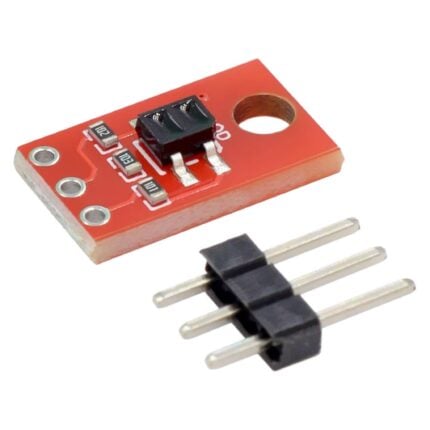
Motor Speed Measuring Sensor Module

———————–with Imported Slotted Photocoupler Sensor

Product Features

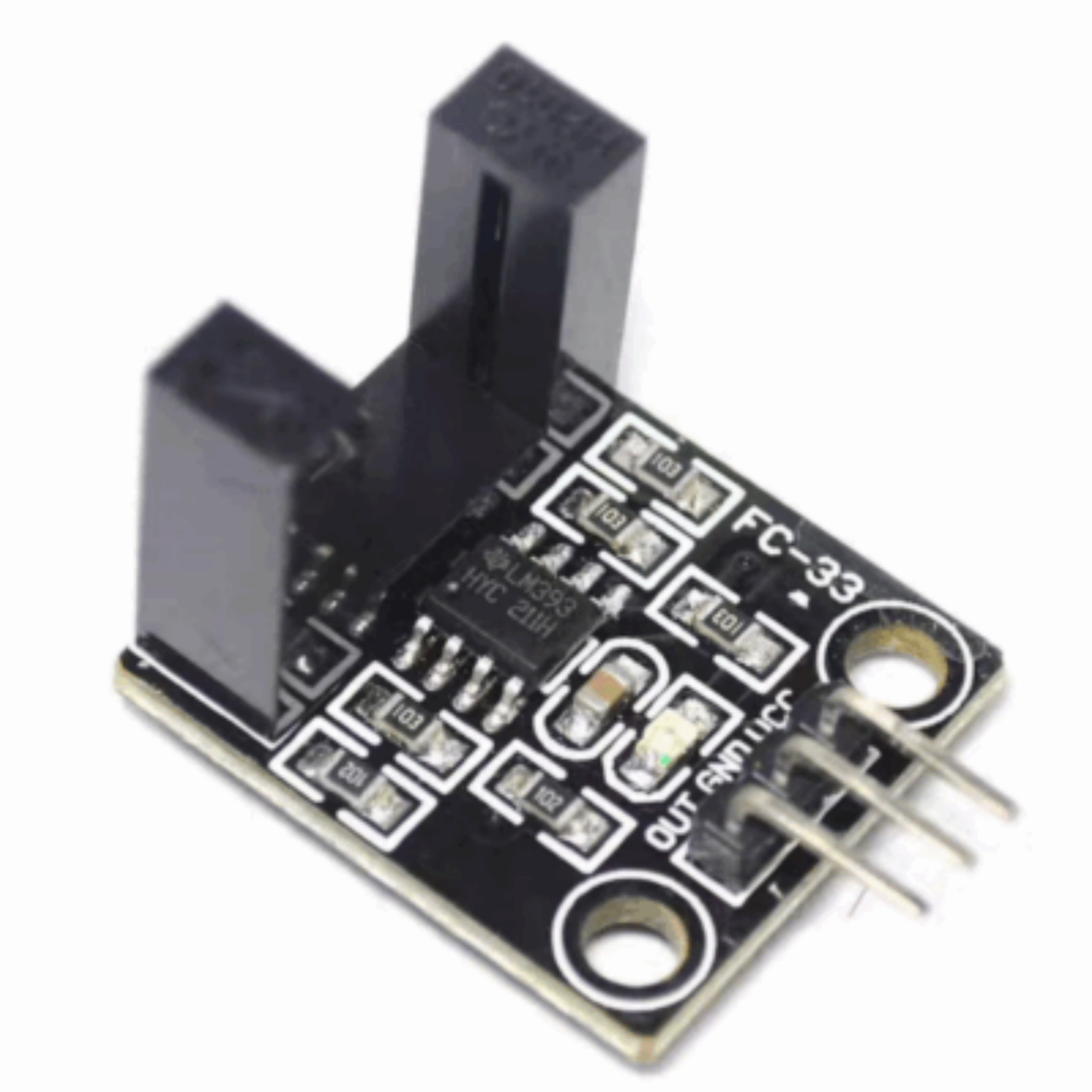
  1. Adopts imported slotted photocoupler sensor.
  2. Slot width: 10mm.
  3. Equipped with an output status indicator LED: the LED turns off when outputting high level, and turns on when outputting low level.
  4. Output logic: High level when blocked; Low level when unblocked.
  5. Comparator output: Features clean signal, good waveform, and high driving capability (over 15mA).
  6. Operating voltage: 3.3V – 5V.
  7. Output type: Digital switching output (0 and 1).
  8. Provided with mounting bolt holes for easy installation.
  9. Small PCB dimensions: 2.3cm x 2cm.
  10. Uses wide-voltage LM393 comparator.

Application

Widely used in motor speed detection, pulse counting, position limiting, and other scenarios.

Instructions for Use
  • When there is no obstruction in the module slot, the receiving tube is turned on, and the module’s D0 pin outputs a low level; when obstructed, the D0 pin outputs a high level.
  • The module’s D0 pin can be connected to a relay to form functions such as a limit switch, and can also be connected to an active buzzer module to form an alarm.

Speed Measuring Sensor Module

—————————————-Counter Module

Product Features

  1. Adopts an imported slotted photocoupler sensor with a slot width of 5mm.
  2. Equipped with an output status indicator LED: the LED turns off when outputting high level, and turns on when outputting low level.
  3. Output logic: High level when blocked; Low level when unblocked.
  4. Comparator output: Features clean signal, good waveform, and strong driving capability (over 15mA).
  5. Small PCB dimensions: 3.2cm x 1.4cm.
  6. Uses a wide-voltage LM393 comparator.

Application

Widely used in motor speed detection, pulse counting, position limiting, and other scenarios.

  1. When there is no obstruction in the module slot, the receiving tube is turned on, and the module’s D0 pin outputs a high level; when obstructed, the D0 pin outputs a low level.
  2. The D0 output interface can be directly connected to the MCU (Microcontroller Unit) IO pin to detect whether there is an obstruction on the top of the sensor. For example, when used with a motor encoder disk, it can detect the motor’s speed.
  3. The module’s D0 pin can be connected to a relay to form functions such as a limit switch, and can also be connected to an active buzzer module to form an alarm.

Wiring Instructions

    • VCC: Connect to the positive power supply terminal (3.3-5V).
    • GND: Connect to the negative power supply terminal.
    • DO: TTL switching signal output.
    • AO: Non-functional on this module.

Car Speed Measuring Module

————–Encoder Disk Counting Sensor Module

Product Features

It adopts a slotted through-beam photoelectric sensor, which consists of an infrared light-emitting diode (IR LED) and an NPN phototransistor, with a slot width of 5.9mm. The sensor triggers and outputs a TTL low level as long as an opaque object passes through the slot (when used with the car encoder disk sold in our store). A Schmitt trigger is adopted to debounce pulses, ensuring extremely stable operation. It is suitable for applications such as car speed measurement and distance measurement! Equipped with M3 screw mounting holes on both ends.

Once VCC and GND are properly connected, the module’s signal indicator LED will light up. When there is no obstruction in the module slot, the receiving tube is turned on, and the module’s OUT pin outputs a high level; when obstructed, the OUT pin outputs a low level, and the signal indicator LED turns off.
The module’s OUT pin can be connected to a relay to form functions such as a limit switch, and can also be connected to an active buzzer module to form an alarm.
The OUT output interface can be directly connected to an MCU (Microcontroller Unit) IO pin, typically to an external interrupt, to detect whether the sensor is obstructed. For example, when used with a motor encoder disk, it can detect the motor’s speed.

Application

Distance Measurement:

The speed measuring sensor outputs pulse signals, with one pulse triggering one interrupt. The infrared ray is in a low-level state when it is unobstructed (conducted), so we set the interrupt to low-level trigger mode. Generally, an encoder disk has an integral number of slots; regardless of the specific number of slots, the working principle remains the same. For example, with a 10-slot encoder disk (i.e., 10 empty slots), when the motor completes one full rotation, the infrared ray will be unobstructed (conducted) 10 times, and the external low-level trigger will be activated 10 times.
Following this logic, the speed measuring sensor can achieve its distance-measuring function: since we know one full motor rotation corresponds to 10 interrupts, we calculate the total number of interrupts. Dividing this total by 10 gives the number of motor rotations. Then, by calculating the circumference of the wheel (the distance the wheel covers in one rotation), we can deduce how far the car has traveled.

Speed Measurement:

Building on the logic of distance measurement, we use an MCU (Microcontroller Unit) timer to count the number of external interrupts received within 1 second. For instance, if 20 external interrupts are received in one second, we can determine that the car’s wheel completes 2 rotations per second. By further calculating the circumference of the wheel, we can obtain the distance the car travels per second—i.e., the car’s speed.

Be careful

Correct Wiring Instructions!

  • Never reverse the positive and negative connections, as this will burn out the electronic components on the board.
  • For reference, Arduino users should set the MCU’s I/O pin to input mode (receive mode); otherwise, the module will not work.
  • For other MCUs or more advanced control boards (such as ARM-based ones), if I/O port configuration (input/output mode) is required, the port must be set to input mode (receive mode)—the module will not function otherwise.
  • 51-series microcontrollers can be used directly without the need to configure the input/output mode.
Reviews (0)

Reviews

There are no reviews yet.

Be the first to review “Motor Speed Test Module”

Your email address will not be published. Required fields are marked *

Shipping and Delivery

Shipping Cost

We only ship to the United States. Shipping costs are calculated based on the total order amount.

Shipping Method And Delivery Time

All orders will be processed and shipped within 72 hours of placing the order (excluding weekends and holidays). They will ship from Shenzhen, China, primarily via 4PX logistics. Depending on the destination and logistics conditions, other carriers such as DHL, FedEx, UPS, USPS, etc., may also handle the delivery. Estimated shipping time is 7-12 business days, with actual delivery occurring in 10-17 business days, depending on logistics conditions.

Payment:

We accept Visa, Master card, Maestro, American Express, JCB, Dinner's Club, Discover, Paypal, Apple Pay, Google Pay .